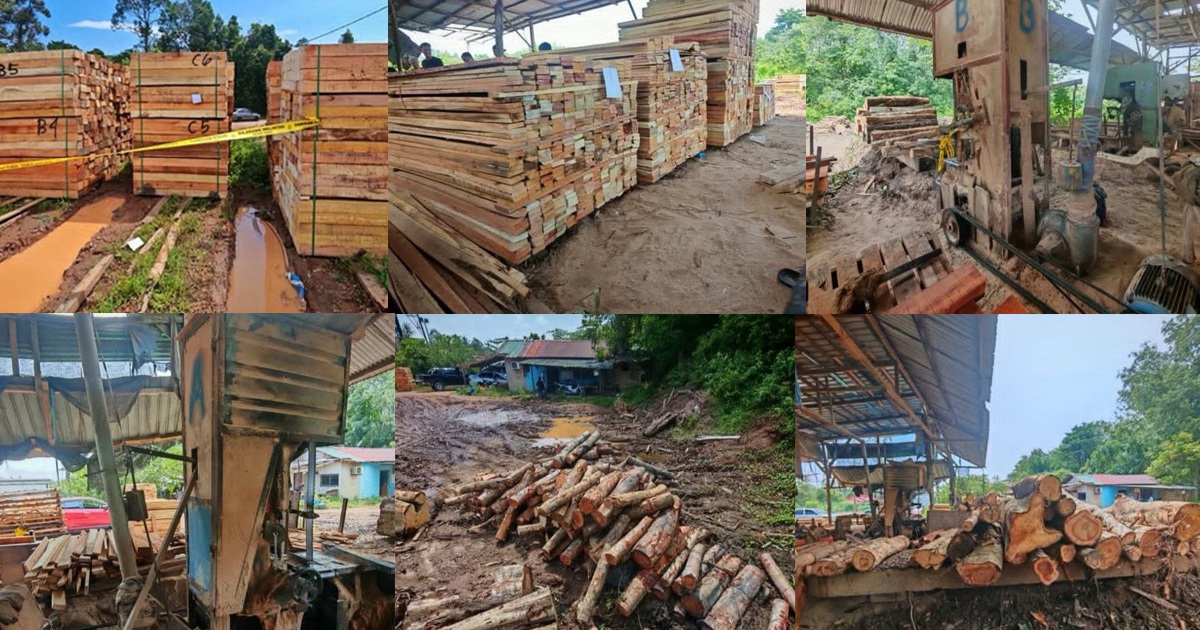
Authorities in Kelantan have moved against an illegal timber operation, arresting the operator and three workers during a coordinated enforcement action at an unlicensed sawmill facility in Kampung Bukit Kechik, Tanah Merah. The raid, which unfolded during daylight hours today, has exposed yet another instance of clandestine timber processing operations that authorities believe continue to undermine Malaysia's forest management and resource control frameworks across the northern states.
The operation represents an escalation in efforts to combat what enforcement officials describe as persistent challenges in regulating timber extraction and processing activities outside formal licensing channels. The seizure of equipment and processed logs with an estimated value of RM600,000 demonstrates the significant financial stakes involved in illegal timber operations, even at what may appear to be small-scale facilities operating under the radar. Each such operation chips away at the legitimate timber industry's market share and undermines the economic value of sustainable forest management practices that Malaysia seeks to promote internationally.
The arrested sawmill operator, whose identity has not been disclosed pending investigations, faces questioning regarding the operational status and licensing history of the facility. Preliminary inquiries suggest the premises had been functioning without the requisite authorisation from state forest management authorities. Such unlicensed operations typically emerge in less densely populated rural areas where monitoring capacity may be stretched, though the interior regions of Kelantan have increasingly become focal points for enforcement attention in recent years.
The three workers detained alongside the operator are being processed to establish the scope of their knowledge and involvement in the operation's day-to-day functioning. Authorities are probing whether these individuals understood the unlicensed nature of their employment or were recruited without full awareness of the legal status of the sawmill. Questions surrounding worker culpability in such operations often influence how charges are eventually structured, with distinctions sometimes drawn between operators knowingly violating regulations and workers caught up in employment by unscrupulous business owners.
The recovered machinery and equipment catalogue typically includes mobile saws, cutting implements, drying racks, and processing tools essential to converting raw timber into saleable products. The sophistication of equipment seized often reflects the scale and duration of an operation's prior activities. In this instance, the RM600,000 valuation suggests a facility capable of processing substantial timber volumes, indicating the operation may have functioned for an extended period before law enforcement attention intensified.
Kelantan's forestry sector has long presented regulatory challenges given the state's significant forest coverage and the economic pressures facing rural communities. The emergence of unlicensed sawmill operations in peripheral areas reflects tensions between resource scarcity, rural livelihoods, and environmental stewardship. While enforcement actions address the immediate legal violations, they rarely tackle the underlying economic drivers that motivate individuals to engage in informal timber processing despite known legal risks.
The raid aligns with broader state and federal initiatives to strengthen control over timber flows in East Coast states, where monitoring difficulties have periodically enabled illicit operations to flourish. Malaysian timber has faced reputational pressures in international markets concerning sustainability credentials, making domestic enforcement actions significant for maintaining certification standards that Malaysian exporters depend upon. Each successful crackdown provides evidence to international certifiers that the regulatory framework functions effectively.
Investigators are now determining whether the timber seized originated from legal concessions or was extracted from protected areas or private land without authorization. The source of raw materials represents a critical variable in understanding the full scope of illegality, as it determines whether violations involved processing alone or encompassed extraction violations as well. Collaborative investigation between forestry authorities and state enforcement agencies will likely continue as prosecution preparations advance.
The detention period will be utilized to gather evidence regarding operational duration, timber volumes processed, and distribution networks utilized to market finished products. Authorities are particularly interested in establishing whether the illegal operation supplied timber to registered retailers or construction companies operating with apparent legitimacy, as this would expand the investigation's scope considerably. Such downstream connections often prove challenging to establish but are crucial for addressing systemic vulnerabilities in supply chain oversight.
This seizure contributes to enforcement statistics that Malaysian authorities cite when demonstrating commitment to sustainable forest management in international forums. However, the persistently recurring nature of such operations suggests that deterrence mechanisms currently in place may be insufficient to prevent new operations from emerging. Enhanced penalties, increased monitoring capacity, and community engagement strategies are factors that stakeholders advocate for when evaluating enforcement effectiveness.
The case also reflects how technical capabilities and awareness among enforcement personnel have evolved, with coordinated raids like this suggesting improved intelligence gathering and inter-agency coordination. Rural communities in timber-dependent areas increasingly recognize enforcement presence, though economic alternatives remain limited in many localities. The arrested individuals will face legal proceedings under relevant timber regulations, with outcomes likely to influence sentencing precedents and operator calculations regarding enforcement risk tolerance.

