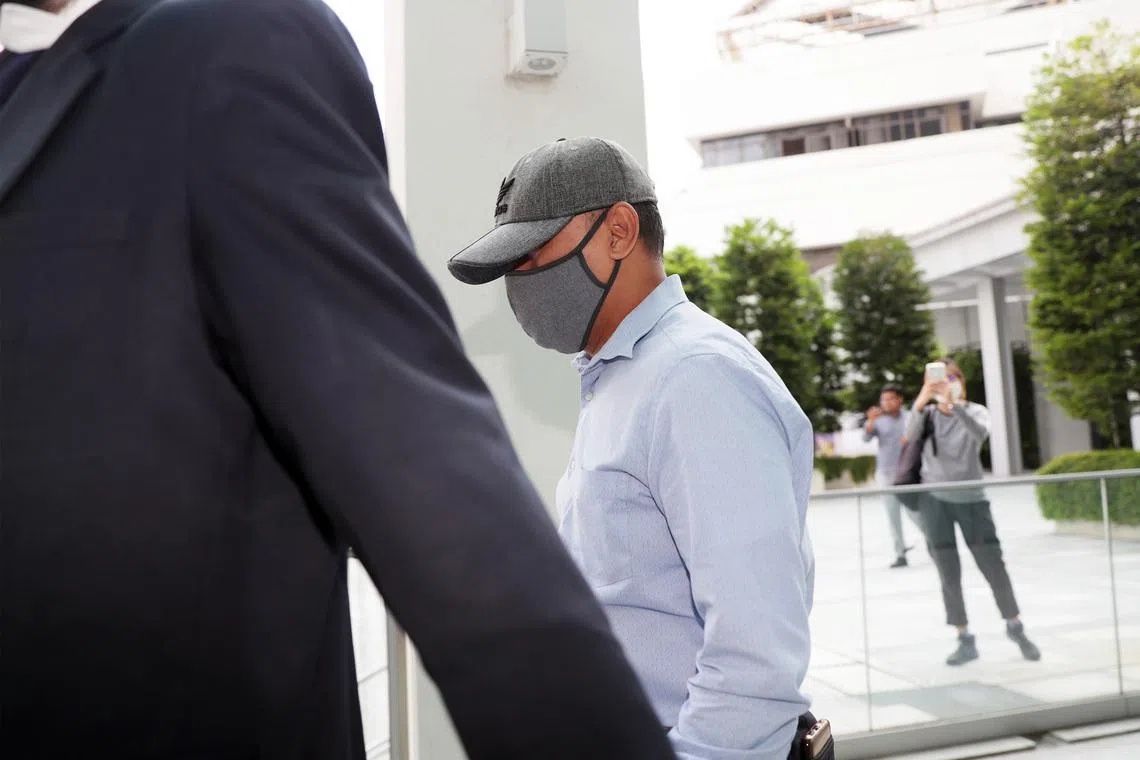
Abdul Rahim Mawasi, the former executive chairman of Darul Aman Mosque and Sallim Mattar Mosque in Singapore, has been handed a 14-month prison sentence following his conviction on corruption charges. The 59-year-old, who was also a senior officer with the Islamic Religious Council of Singapore (MUIS) before his secondment to lead the two mosques, was found guilty of abusing his position to direct construction work worth S$223,000 to a company owned by a longtime associate, in what prosecutors describe as a deliberate scheme to circumvent public procurement integrity.
The corruption centred on a decade-long friendship between Mawasi and Mohd Mustaqim Kam, also known as Kam Hock Beng, who directed construction firm Zeal-Con Engineering. In mid-2018, the two men hatched an arrangement whereby Mawasi would help secure contracts for Kam's company at the two mosques he oversaw. In return, Kam would funnel profits from these jobs as paid-up capital into a travel company they would jointly establish for pilgrimage tours. Crucially, Mawasi would not invest any of his own money upfront, making this a one-sided bargain contingent entirely on his willingness to misuse his official authority to steer lucrative work toward Zeal-Con.
Court documents reveal the mechanics of the scheme with striking detail. When Darul Aman Mosque sought vendors for yard construction work in 2018, Zeal-Con initially submitted a quote of S$128,600 in August. However, after what prosecutors say were extensive price discussions between Mawasi and Kam, the company submitted a revised quote on September 12 for S$118,000—substantially undercutting the nearest competitor's bid of S$125,500. Three weeks later, Zeal-Con was awarded the contract. The evidence demonstrated that Mawasi had provided Kam with crucial pricing intelligence that allowed the company to position its bid strategically, information that should never have been shared outside formal procurement processes.
A similar pattern emerged at Sallim Mattar Mosque. In September 2018, Zeal-Con quoted S$115,700 for renovation work on various sections of the building, including the roof and reception area. By July 2019, that figure had been reduced to S$105,000—again following what the court found to be advisory discussions initiated by Mawasi. The following month, the mosque awarded the contract to Zeal-Con at the lower amount. Prosecutors emphasised that the mosque's management board, unaware of these behind-the-scenes negotiations, could not exercise independent judgment in selecting contractors. This subversion of transparent decision-making struck at the heart of institutional governance and public trust.
To further obscure the arrangement, Mawasi engineered a layer of concealment that would prove his undoing. When Kam converted an existing shell company into Amal Travel and Tour (ATT) in late 2019, creating 100,000 shares with paid-up capital of S$100,000, he allotted 25,000 shares to Mawasi's son rather than to Mawasi himself. The prosecution argued this was deliberately designed to hide Mawasi's financial stake in the venture from his employer MUIS. By placing shares in his son's name, Mawasi attempted to distance himself from any apparent conflict of interest while still deriving benefit from the scheme. This misdirection—failing to disclose his interest to MUIS—compounded the corruption charge with evidence of intentional concealment.
When tried in court, Mawasi denied any involvement with ATT and maintained he held no shares in the company, a technically accurate statement given the formal title held by his son. His legal representation, led by lawyer Satwant Singh Sarban Singh, argued for leniency, pointing to his previously clean record and requesting a sentence of no more than six months' jail. Yet the court rejected this framing, viewing the deliberate obfuscation and calculated nature of the corruption as aggravating factors that warranted a stiffer penalty reflecting the seriousness of public sector wrongdoing.
Mawasi's accomplice, Kam Hock Beng, then 66, received a six-month jail sentence in February 2025 after his own conviction. Deputy Public Prosecutor Bryan Wong stressed during sentencing that while the actual works performed by Zeal-Con were satisfactorily completed—meaning the mosques did not suffer obvious material loss—this did not diminish the gravity of Mawasi's breach of trust. The offence lay fundamentally in the corruption itself: a public officer had leveraged privileged access to procurement information to guarantee contracts for a chosen vendor, fundamentally poisoning the bidding process and violating the principles of fair competition and institutional integrity that underpin religious organisations' stewardship of communal funds.
The case illuminates vulnerabilities in institutional oversight within the religious sector, where executive officers wielding significant purchasing authority may operate with less scrutiny than their counterparts in government agencies. MUIS, as the statutory board overseeing Islamic affairs in Singapore, would likely face questions about how such misconduct occurred over an extended period and what preventive measures are needed to strengthen internal controls and conflict-of-interest declarations. The fact that Mawasi had served MUIS since 2005 and had been entrusted with leadership of two major mosques suggests the breach represents a significant institutional failure in monitoring and accountability.
For Malaysian readers and observers across Southeast Asia, this case offers cautionary lessons about governance in religious institutions. Many mosques, madrasahs, and Islamic charitable organisations across the region similarly depend on executive officers managing procurement and contracts with considerable autonomy. The Mawasi case demonstrates how personal relationships and financial incentives can compromise decision-making even among trusted, long-serving leaders. It underscores the importance of implementing robust conflict-of-interest policies, requiring competitive bidding with transparent evaluation, and establishing oversight mechanisms that are independent of the executive whose decisions are being reviewed—principles that apply whether funds derive from government grants, endowments, or congregational donations.
Mawasi's sentence of 14 months represents the court's determination that senior officials entrusted with public or quasi-public funds must face meaningful consequences for corruption. His bail has been set at S$30,000, and he was expected to surrender on July 10 to begin his sentence. Beyond the immediate personal penalty, the conviction sends a signal to officers in similar positions throughout Singapore and the broader region: misusing official authority for private financial gain, particularly through schemes involving friends and family, will be treated as serious criminal conduct warranting imprisonment. The case also serves as a reminder that corruption in the religious sector, despite its sometimes quieter profile compared to scandals in commerce or government, is no less damaging to institutional legitimacy and community trust.

