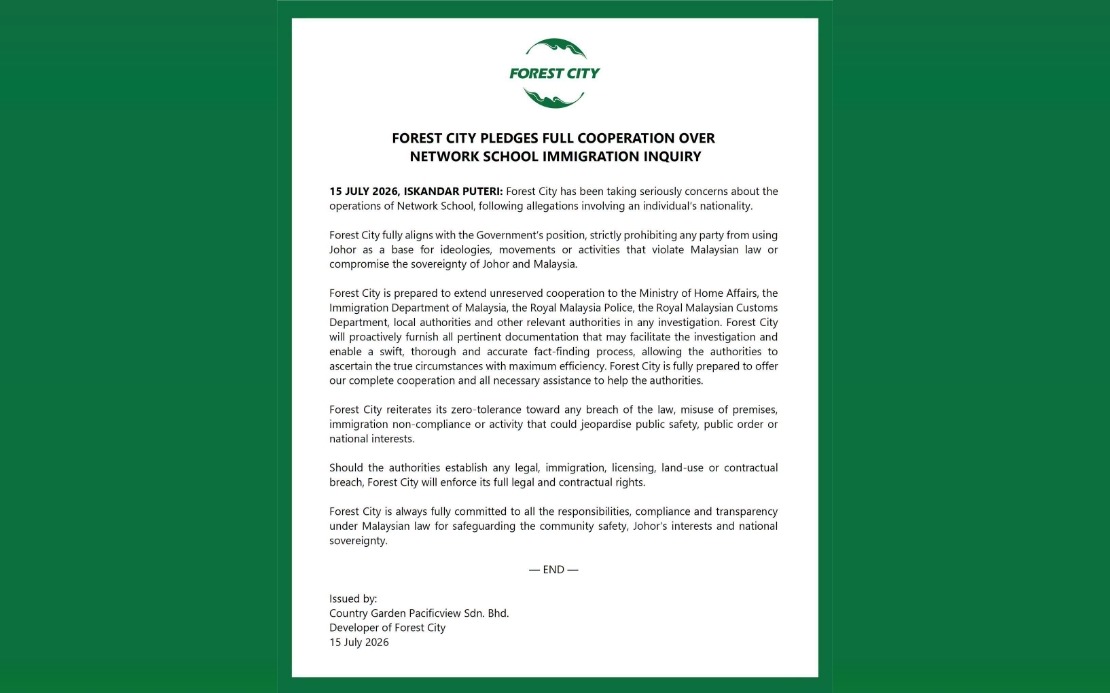
The developer behind Forest City, the sprawling mixed-use township in Johor Bahru, has declared its readiness to work alongside government agencies in examining the operations of Network School, which has come under scrutiny for allegedly enrolling Israeli citizens. Country Garden Pacificview Sdn Bhd issued a formal statement underlining its commitment to assist with what has become a sensitive national security matter, signalling corporate accountability in an episode that has drawn public attention to oversight gaps within a major commercial development.
The statement from the developer reflects broader concerns about how residential and commercial enclaves, particularly large-scale foreign-invested projects, maintain control over activities conducted within their boundaries. Country Garden Pacificview emphasised that it considers the matter with appropriate gravity and aligns itself with Kuala Lumpur's position that Johor, and by extension any Malaysian territory, cannot serve as a staging ground for operations that breach domestic law or compromise national sovereignty. This positioning is significant given the developer's status as a major Chinese investment in Malaysian property.
According to the developer's commitment, Forest City stands prepared to engage with multiple arms of government including the Home Ministry, the Immigration Department, the Royal Malaysia Police, the Royal Malaysian Customs Department, and relevant local authorities. The breadth of this cooperation framework indicates the multifaceted nature of the investigation, spanning immigration compliance, security clearance, customs protocols, and municipal regulation. Such interconnected oversight reflects how Malaysia's various agencies must coordinate when foreign nationals potentially circumvent immigration procedures.
Country Garden Pacificview has pledged to furnish all documents and records necessary to expedite investigation proceedings, positioning itself as an actively transparent entity in the fact-finding process. This commitment extends beyond passive cooperation to active facilitation, suggesting the developer recognises that its reputation and operational future depend on demonstrating robust internal controls and willingness to support state authorities. The availability of comprehensive documentation could prove crucial in establishing what knowledge, if any, the developer's management possessed regarding Network School's operations.
The developer has also publicly articulated a zero-tolerance framework applicable to legal violations within its precincts, including unauthorised use of facilities, breaches of immigration statutes, and activities that endanger public safety and civic order. This declaration serves a dual purpose: it signals to residents and investors that Forest City maintains standards of compliance, whilst simultaneously establishing clear expectations for all entities operating within the development. Such corporate positioning is increasingly important in Malaysia's investment landscape, where foreign developers must navigate both commercial success and political sensitivities.
The investigation was triggered when Johor Menteri Besar Datuk Onn Hafiz Ghazi called upon the Home Ministry and related agencies to examine Network School's activities, noting that foreign participants appeared to have utilised passports from countries other than Israel to gain entry to Malaysia. This sophisticated approach to border circumvention—using third-party travel documents rather than Israeli credentials—suggests intentional effort to obscure the composition of programme attendees and raises questions about who facilitated or approved such arrangements. The implication that individuals deliberately misrepresented their nationalities elevates the investigation beyond administrative oversight into potential fraud territory.
In response to the allegations, the Immigration Department conducted a sweep of Forest City, inspecting 266 foreign nationals spanning 40 countries. While initial verification confirmed that all individuals possessed valid immigration documentation at the time of the inspection, authorities have explicitly stated that deeper investigations remain underway. This distinction between immediate document validity and broader investigation is crucial; it suggests authorities are examining not merely whether paperwork exists, but whether that paperwork was obtained through misrepresentation, whether conditions of entry were violated, and whether any activities conducted fell outside the scope of approved visas.
The Network School investigation occurs within Malaysia's broader geopolitical context regarding Israeli engagement. Malaysia maintains no diplomatic relations with Israel and has long positions itself as supportive of Palestinian causes, making any suggestion of Israeli citizen presence—particularly in organised educational contexts—politically charged. The case thus intersects questions of immigration enforcement, corporate responsibility, and Malaysia's international posture, explaining why the developer felt compelled to issue a detailed statement rather than minimal acknowledgement.
For Malaysian investors and multinational corporations operating large-scale developments, the Forest City situation provides instructive lessons about due diligence responsibilities. Developers cannot claim ignorance about activities within their controlled premises, particularly those involving organised institutional operations like schools. The investigation implicitly establishes that property developers bear some accountability for tenant operations, regulatory compliance, and the verification of participant credentials when activities touch upon immigration matters. Future development approvals may increasingly incorporate specific compliance requirements and oversight mechanisms.
The incident also highlights vulnerabilities in Malaysia's immigration and security apparatus that sophisticated actors can exploit. The use of secondary passports to circumvent standard nationality-based screening represents a method that authorities must detect and prevent at borders, yet it apparently succeeded in this instance. Enhanced coordination between the Immigration Department, Customs, and local agencies—precisely what the investigation now involves—may yield procedural improvements to prevent similar circumvention attempts in future.
Broader implications for Southeast Asia include the reality that transnational education initiatives, particularly those in politically sensitive contexts, require heightened scrutiny. Network School's apparent operation in Forest City raises questions about who established the programme, funding sources, curriculum content, and intended participant base. Regional governments may increasingly insist upon greater transparency regarding foreign educational operations, particularly those that appear deliberately obscured through documentation practices.
The cooperation pledged by Forest City's developer will prove significant in determining whether Network School represented isolated misconduct, systemic negligence, or something more coordinated. Immigration Department findings, coupled with documentation furnished by Country Garden Pacificview, should clarify the scope and intent of the operation. The investigation's conclusions will likely influence how Malaysian authorities approach oversight of foreign-invested developments and how developers themselves manage tenant activities.
Ultimately, the Forest City case demonstrates that in Malaysia's current climate, corporate actors cannot remain indifferent to activities occurring within their premises, regardless of operational distance. Developers operate within an ecosystem where national security, immigration integrity, and international relations intersect with property development. Country Garden Pacificview's stated cooperation reflects understanding that maintaining stakeholder confidence—with government, residents, and the investing public—requires proactive transparency and alignment with state priorities regarding sovereignty and law enforcement.

