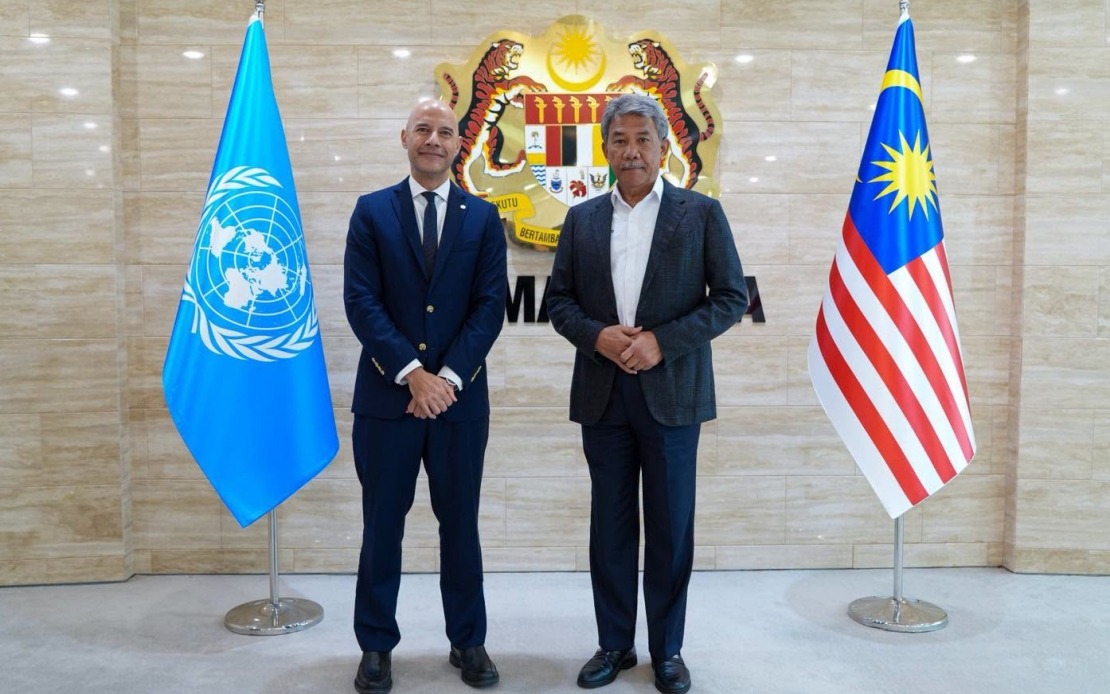
Foreign Minister Datuk Seri Mohamad Hasan received a formal visit from Nikolas Myint, the United Nations Resident Coordinator covering Malaysia, Singapore and Brunei, during a courtesy call at Wisma Putra on Wednesday. The meeting represented an important diplomatic engagement as Myint, who was appointed to the position by United Nations Secretary-General on May 31, 2026, begins his tenure in the region.
The discussion provided a platform for both officials to examine areas of mutual interest and potential collaboration between Malaysia's government and the multilateral organization. Such high-level exchanges between foreign ministries and UN representatives typically serve to map out cooperation frameworks and address matters of mutual concern across various sectors including development, humanitarian response, and regional stability.
Mohamad articulated Malaysia's perspective through a Facebook statement, emphasizing the country's commitment to strengthening its relationship with the United Nations system. He highlighted Malaysia's recognition of the critical role the UN plays in addressing transnational challenges that transcend borders and demand coordinated international responses. These global issues range from climate change and public health crises to conflict resolution and sustainable development initiatives.
The Foreign Minister specifically signalled Malaysia's intention to maintain close working relationships with both the UNRC office and the various specialized UN agencies already operating within the country. This commitment extends beyond ceremonial engagement, suggesting practical collaboration on implementation of development programmes and technical cooperation initiatives that serve Malaysia's own aspirations while contributing to regional and global objectives.
For Southeast Asia, the appointment of a single resident coordinator to oversee three distinct countries—Malaysia, Singapore and Brunei—reflects the UN's resource constraints and administrative efficiency measures. This arrangement consolidates diplomatic and operational oversight while potentially improving coordination across the sub-region on issues that affect multiple nations simultaneously. The tri-country responsibility highlights how UN presence adapts to demographic and economic realities in the region.
Myint's incoming tenure arrives at a significant moment for Malaysia's international engagement. The country has increasingly sought to position itself as a bridge-builder in regional affairs while maintaining active participation in global governance structures. Enhanced coordination with UN agencies can facilitate Malaysia's efforts to address pressing domestic challenges including poverty reduction, educational advancement, and environmental protection while maintaining international relevance.
The timing of this courtesy call also suggests that Malaysia's Foreign Ministry is proactively engaging with new UN personnel to establish rapport and define operational expectations. Such foundational meetings often prove crucial in establishing the tone for future interactions and determining how effectively UN programmes can be implemented within the national context. The cordial exchange signals Malaysian receptiveness to UN initiatives.
From a regional perspective, the UN Resident Coordinator's presence in Kuala Lumpur as the hub office for three countries underscores Southeast Asia's importance to the international system. Malaysia, as the economic and diplomatic centre of ASEAN, provides the logical location for such coordination, further cementing its role as a regional hub for multilateral activities and international organization presence.
The reference to cooperation "in line with the nation's development aspirations and global well-being" indicates Malaysia's balanced approach—prioritizing national interests while acknowledging broader international responsibilities. This positioning reflects how middle-power nations navigate between protecting domestic priorities and contributing meaningfully to global governance frameworks.
Looking forward, the strengthened diplomatic relationship between Malaysia's Foreign Ministry and the UN's resident coordination office should facilitate smoother implementation of development programmes, improved information flows on international initiatives, and more effective advocacy channels for Malaysian interests within UN structures. Regular engagement at this level typically translates into tangible outcomes in areas such as sustainable development goal achievement and technical assistance programmes.
The meeting also demonstrates Malaysia's continued commitment to multilateralism despite growing complexity in international relations. In an era of shifting geopolitical dynamics and increased scrutiny of international organizations, Malaysia's proactive engagement signals confidence in the UN system and willingness to collaborate constructively with its mechanisms and personnel. This approach maintains Malaysia's standing as a responsible international actor and responsible UN member state.

