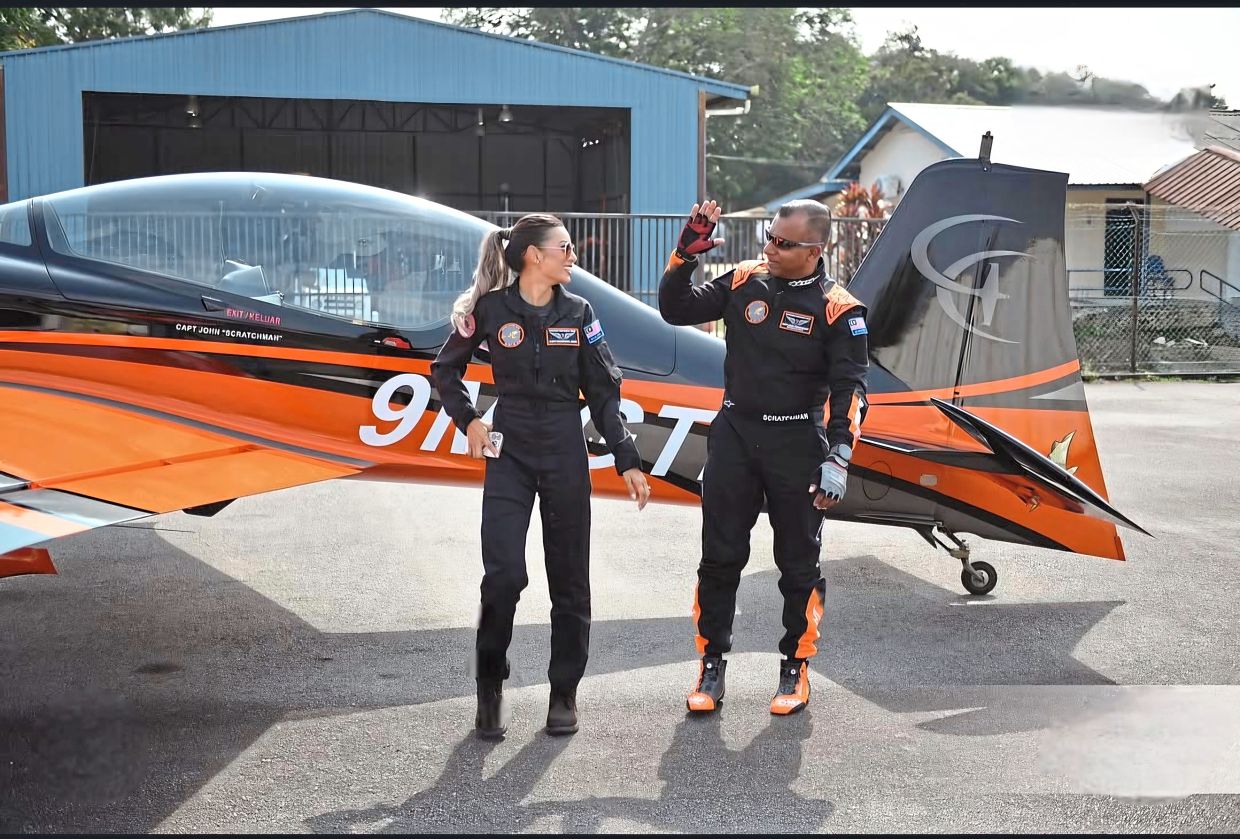
The cockpit has become a family inheritance for Samantha Laura John. At 26, she has just completed her pilot training in Ipoh, joining her 54-year-old father, retired Royal Malaysian Air Force Lieutenant-Colonel John Sham Alagarsamy, in a profession that demands precision, discipline and an unwavering commitment to excellence. Their trajectory through Malaysia's aviation ecosystem reflects a deeper narrative about generational influence, parental encouragement and the evolving role of women in sectors traditionally dominated by men.
John's three-decade career in the RMAF established both a personal legacy and a household philosophy around aviation. He spent 26 years as a fighter pilot, instructor and examiner before transitioning to commercial aviation in 2019, demonstrating that expertise cultivated in military service could flourish in civilian operations. His transition proved transformative not just professionally but as a statement: expertise earned through discipline and rigorous training transcends institutional boundaries. Now heading training operations at a flying school in Ipoh, he continues to shape the next generation of aviators through mentorship and structured curriculum development. Beyond his primary vocation, John has carved out recognition as Malaysia's first and only civil aviator certified by the Civil Aviation Authority of Malaysia for aerobatics, a distinction that underscores his technical mastery and innovative approach to aviation. His performances at premier events including the Langkawi International Maritime and Aerospace Exhibition have demonstrated the artistic and technical dimensions of flight, proving that aviation encompasses far more than the mechanics of getting from point A to point B.
Samantha's fascination with her father's work began in childhood, watching him prepare for training missions and combat readiness exercises. She recalls the mixture of pride and curiosity that accompanied his uniform and the mysterious nature of his professional commitments. When she witnessed firsthand the scarcity of female pilots in Malaysian aviation—a field where gender representation remains a persistent challenge—her determination crystallised. Rather than viewing the underrepresentation of women as a barrier, she interpreted it as an invitation to reshape the landscape. John's parenting philosophy proved instrumental in this trajectory. He articulated a belief system centred on ambitious dreaming, telling his children that aiming for the stars guaranteed at least reaching the sky, a metaphor that reframed apparent impossibilities as stepping stones toward achievement.
The family's postings across Malaysia's military establishments—from Labuan to Kuantan, Alor Setar and Butterworth in Penang—exposed Samantha to the structural realities underpinning national defence and aviation infrastructure. These moves, while disruptive to conventional schooling and childhood stability, functioned as an informal curriculum in discipline, purpose and the machinery of state institutions. She developed intimate knowledge of how air bases operate, the rigour demanded of pilots entrusted with safeguarding Malaysia's airspace and maritime borders, and the sacrifices embedded in professional military service. In 2012, when John pursued postgraduate studies at the Australian National University, the family relocated to Canberra where he was attached to the Australian Defence Force. This international exposure broadened Samantha's understanding of defence cooperation frameworks and comparative aviation systems, introducing her to institutional approaches and methodologies beyond Malaysia's borders.
Her pathway to qualification proved non-linear, reflecting both authentic self-discovery and the complexity of aligning passion with practical career construction. After completing her IGCSE, she initially enrolled in a cadet pilot programme with an airline operator in Sepang, Selangor in 2018. This two-year immersion proved instructive but ultimately misaligned with her deeper aspirations. Rather than pursuing the conventional ladder within that organisation, she recognised the distinction between rewarding work and authentic vocational fit, a distinction increasingly important in contemporary career narratives. The realisation prompted her return to formal pilot training, which culminated in her 2025 qualification. She articulates her commitment to aviation with striking clarity: the cockpit provides a therapeutic space where multidimensional awareness—looking ahead, thinking ahead, maintaining situational consciousness across multiple vectors—becomes the dominant requirement.
Currently, Samantha operates from Kota Kinabalu where she manages an event management enterprise with her husband, David Chong, 30, while simultaneously offering vocal coaching instruction. This configuration represents a pragmatic accommodation between geographic relocation, marital partnership and her parallel interest in music performance. Yet her pilot's licence signals an unfinished professional narrative. She expresses genuine intention to return to commercial aviation and establish a career in that sector, suggesting that her current activities represent a productive interlude rather than a permanent departure from her primary calling. This sequencing—establishing a business foundation while maintaining pilot currency—reflects contemporary approaches to career management where individuals cultivate multiple competencies and income streams rather than adhering to singular, linear professional trajectories.
The broader context of parental influence on career selection has attracted academic attention within Malaysian institutions. Universiti Teknologi Malaysia's research on undergraduate career intentions identifies strong parent-child relationships, transparent communication and mutual trust as predictive factors in shaping long-term professional decisions. The study emphasises that parental influence operates through modelling and encouragement rather than coercion, a distinction critical to understanding Samantha's trajectory. John explicitly rejects the notion that he imposed aviation upon his children, instead framing his approach as creating an environment where ambitious aspiration becomes normalised and achievable. This philosophy proved decisive: Samantha pursued aviation not because she was pushed but because she witnessed its viability and meaning through paternal example.
The emergence of female pilots in Malaysia remains a notable phenomenon, with representation increasing incrementally across commercial and military sectors. Sisters Safia Amira Abu Bakar and Safia Anisa Abu Bakar followed their father, Captain Abu Bakar Shafie, into aviation, establishing another intergenerational narrative. These examples collectively suggest that aviation's traditionally masculine institutional culture may gradually accommodate greater gender diversity as more women qualify and visible role models increase. Samantha's achievement contributes to this subtle but meaningful shift, providing evidence to prospective female aviators that the cockpit remains accessible regardless of gender, provided sufficient preparation and determination converge.
Their recent family gathering over lunch at an Indonesian restaurant in the Klang Valley—where John visited to spend time with his wife Lynda Shanti Ganesaguru, a businesswoman, and his son Shayne Zacchaeus John—illustrated the textured quality of their relationships. The laughter and reminiscence about postings across Malaysian air bases suggested that disruptive relocations ultimately strengthened rather than fractured family cohesion. Samantha's observations about how military life shaped her discipline, worldview and sense of collective purpose indicate that professional institutional experience, however demanding, can constitute invaluable education for accompanying family members. The respect she displays toward her father when speaking transcends conventional filial affection; it reflects esteem grounded in his demonstrated expertise, consistent principles and authentic engagement with her professional aspirations.
John's recognition through the Most Gallant Order of Military Service during his RMAF tenure acknowledges his contribution to national defence while situating his professional identity within frameworks of public service. His subsequent articulation of success—measured by positive impact on others, particularly children who internalise values through observation more than instruction—reframes achievement beyond rank, compensation or institutional position. This philosophical stance, communicated through consistent action across a career spanning military and civilian sectors, appears to have profoundly influenced Samantha's approach to her own pilot training and career deliberation. She exemplifies a generation that integrates paternal influence with genuine autonomy, accepting guidance while ultimately charting her own course through aviation's complex landscape.
The dual dimensions of John's professional identity—fighter pilot and aerobatic performer, military instructor and commercial trainer, innovation advocate in civil aviation—may have inadvertently equipped Samantha with a perspective that views aviation not as a single monolithic career but as a diverse ecosystem offering multiple pathways toward expertise and professional satisfaction. Her willingness to explore event management and vocal coaching alongside her pilot qualification suggests she has internalised this pluralistic view. As she contemplates a return to commercial flying, she carries forward both her father's technical legacy and his broader philosophical commitment to continuous learning, disciplined practice and meaningful contribution to the sector's ongoing development.

