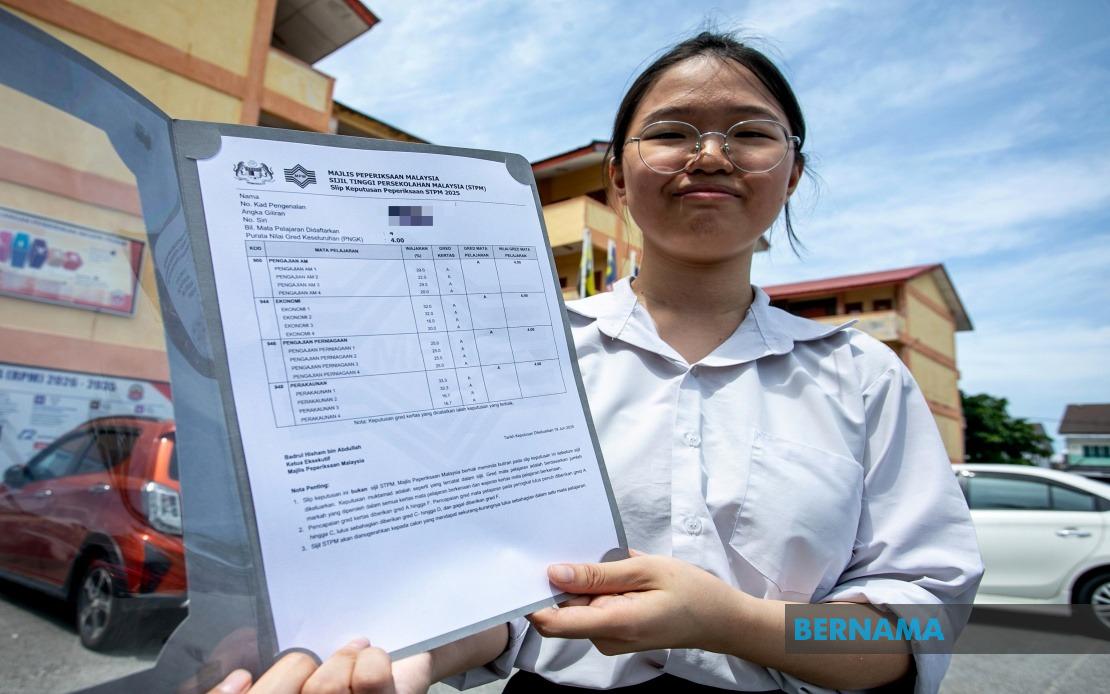
Yong Xin Yi, a 20-year-old student from SMK Jalan Tasek in Ipoh, has emerged as one of the standout performers in this year's Sijil Tinggi Persekolahan Malaysia (STPM) examination, securing an impressive result of four distinctions across all subjects. Her achievement places her among an elite group of five students from the same school who attained the same benchmark in the 2025 sitting of the examination. What sets her accomplishment apart is not merely the grades themselves, but the methodical approach she employed to reach this pinnacle of academic success.
The foundation of Xin Yi's strategy rested on a disciplined timetable that she adhered to with consistency. Each day after completing her classroom instruction, she committed to a focused revision period spanning from 5:00 pm to 10:00 pm, allowing her to consolidate the material she had encountered during teaching and learning sessions. This structured allocation of time became the backbone of her preparation, ensuring that the knowledge absorbed in class could be systematically reinforced and deepened through deliberate practice. Such commitment to a routine reflects a maturity in understanding that excellence in public examinations demands more than aptitude alone—it requires deliberate, sustained effort over an extended period.
However, Xin Yi emphasises that her five-hour nightly revision regime did not operate in isolation. She underscores the critical importance of active engagement during classroom instruction itself, arguing that attentiveness to teachers' explanations during the school day substantially reduced the cognitive burden during evening study sessions. By absorbing concepts directly from her educators, she minimised the confusion and ambiguity that often plagues students who rely too heavily on self-directed learning from textbooks. This perspective offers a valuable lesson for Malaysian secondary students: classroom time is not a mere formality but a cornerstone of effective examination preparation. Students who treat their daily lessons as opportunities for genuine comprehension rather than passive note-taking position themselves to study more efficiently outside the classroom.
Complementing her classroom focus, Xin Yi maintained meticulous completion of all assigned homework. She recognises that the tasks set by teachers serve a pedagogical purpose beyond simply accumulating work—they function as practical tools for mastering complex topics. This attention to homework completion, combined with her evening revision blocks, created a comprehensive learning ecosystem that addressed concepts from multiple angles and reinforced foundational understanding through application. Her approach suggests that students who view homework as a nuisance rather than an opportunity for consolidation may be forfeiting a critical vehicle for deeper comprehension.
Across her four subjects—General Studies, Principles of Accounting, General Studies, and Economics—Xin Yi maintained a Cumulative Grade Point Average (CGPA) of 4.00, demonstrating consistency across diverse disciplinary domains. Yet she candidly acknowledges that not all subjects presented equivalent challenges. General Studies proved particularly demanding, requiring not only factual knowledge but sophisticated writing capabilities and a precise understanding of the examination's format and marking criteria. Rather than treating this challenge as an obstacle to circumvent, Xin Yi responded by allocating disproportionate attention to the problematic subject, ensuring that her perceived weakness was converted into a strength through targeted intervention. This adaptive approach—diagnosing areas of vulnerability and responding with intensified focus—represents a sophisticated metacognitive strategy that serves students well beyond the examination hall.
The backdrop to Xin Yi's academic trajectory includes her status as an only child, a family position that often brings distinct pressures and expectations. Her parents, working as a clerk and a phone salesman respectively, have instilled in her a profound sense of purpose tied to family advancement. She views her examination success not as a personal achievement to be celebrated in isolation, but as a means of honouring her parents' sacrifices and improving her family's material circumstances. This motivation—rooted in filial responsibility and collective family welfare—resonates deeply within Malaysian culture and provides context for understanding the intensity with which she approached her studies. Her aspiration to utilise her success to elevate her family's fortunes speaks to the transformative power that education continues to hold within Southeast Asian societies.
Having secured her impressive STPM results, Xin Yi has set her sights on a career in economics, a field she selected after careful deliberation regarding her personal interests and the sector's long-term prospects. She intends to pursue university education at Universiti Putra Malaysia (UPM), where she hopes to deepen her understanding of economic principles and develop the analytical skills necessary for a professional career in the field. Her decision-making process—grounded in realistic assessment of both personal aptitude and labour market opportunity—demonstrates the kind of forward-thinking orientation that extends her achievement beyond the examination itself into meaningful life planning.
Xin Yi's journey offers several insights for Malaysian students currently preparing for major examinations. The first is that structured routine, consistently implemented, generates measurable returns. The second is that classroom engagement and external revision constitute complementary rather than competing activities. The third is that identifying and addressing areas of weakness through targeted additional effort, rather than avoiding such subjects, accelerates overall improvement. Finally, her experience underscores the enduring importance of family support and motivation as psychological resources that sustain effort through demanding periods of academic preparation. As Malaysia continues to produce cohorts of high-achieving STPM students, the stories of individuals like Xin Yi provide not merely inspirational narratives but practical blueprints for academic excellence grounded in discipline, strategic thinking, and purposeful effort.

