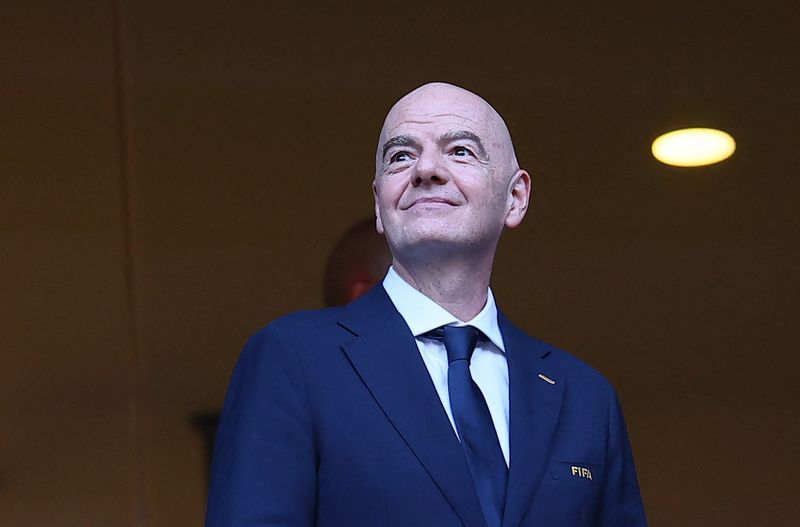
FIFA President Gianni Infantino's grip on power has visibly loosened following his abrupt decision to shelve a divisive proposal to sell commercial rights to the World Cup, triggering an unprecedented crisis within world football's governing body that threatens his reelection plans. The 56-year-old Swiss-Italian executive, who has led FIFA since 2016, backed away from the $4.2 billion scheme late Friday after three days of extraordinary turmoil within the organisation, issuing a public apology for the manner in which the initiative had fractured the global game.
The reverberations from the collapsed proposal continue to reshape the political landscape at FIFA headquarters. Five major European national associations, notably England's Football Association, have formally rescinded their endorsement of Infantino's candidacy ahead of the FIFA Congress scheduled for Morocco in March 2026. Denmark has gone further, indicating outright that it would never cast a vote for the incumbent president. This represents a stunning reversal for a leader who once appeared politically untouchable within the world body, underscoring how severely the miscalculation has damaged his standing among traditional football powerhouses.
While a modest number of nations have publicly declared firm positions—with 211 national federations ultimately casting votes at Congress—the sheer fact that Infantino has alienated key stakeholders through what observers characterise as a lack of consultation signals deeper structural problems within his administration. The proposal, which would have introduced private investment into World Cup operations for the first time in the competition's history, appears to have been drafted and presented to confederations without adequate advance coordination, a cardinal error in consensus-based international sports governance.
The regional confederations that oversee football across entire continents have emerged as the critical battleground. UEFA, European football's powerful administrative body, and CONCACAF, which governs the sport in North and Central America plus the Caribbean, issued pointed statements on Saturday declaring they had lost confidence in Infantino's leadership. The AFC, Asian football's confederation, stopped short of such direct censure but nevertheless branded the lack of consultation "totally unacceptable" and called for institutional reform at FIFA. These three confederations, according to reporting in the Times of London, are reportedly coordinating efforts to remove Infantino from office, potentially through tactics ranging from operational paralysis to establishing rival competitions.
Infantino's strategy for survival must centre immediately on preventing the convening of an Extraordinary Congress, which could be triggered if 43 or more FIFA member associations submit a formal written request. Such a gathering would dramatically accelerate his political difficulties and potentially accelerate moves toward his replacement. Beyond that threshold, the president has roughly seven months to repair fractured relationships with his traditional power base and consolidate support among those federations who remain aligned with him.
The foundation of Infantino's political power, inherited from his predecessors Joao Havelange and Sepp Blatter, has always rested outside Europe's wealthy football associations. Developing and less prosperous national bodies, particularly across Africa, Asia, and the Middle East, depend substantially on FIFA's financial distributions to maintain their operations. Infantino's abandoned proposal had specifically targeted these associations, offering promises of dividends ranging from $20 million to $40 million in early 2025 for those who backed the scheme. This financial incentive mechanism illustrated his understanding that poorer federations represent his electoral constituency.
However, the episode has exposed a critical vulnerability in this strategy: even economically dependent associations expect to be meaningfully consulted on major decisions affecting their interests, particularly when those decisions carry substantial reputational and financial implications. The abruptness with which the proposal emerged and was subsequently abandoned has left many smaller federations feeling manipulated rather than valued, potentially eroding the loyalty Infantino cultivated through financial patronage.
The political equation facing Infantino's opponents presents its own complexities. Any serious challenger seeking to displace the incumbent would need to appeal simultaneously to prosperous European and South American associations, which object to his governance style and strategic decisions, while also crafting a compelling narrative for developing nations that explains how continued support for alternative leadership serves their financial and institutional interests. The nomination deadline falls on November 18, leaving approximately four months for opposition forces to identify, vet, and position a viable candidate with crosscontinental credibility.
For Malaysian readers and Southeast Asian observers, the unfolding FIFA drama carries implications beyond football administration. The AFC, which encompasses Malaysia's football federation, sits at the intersection of these power struggles. The confederation's measured but critical response to Infantino's conduct suggests it may ultimately align with broader moves to either force substantial governance reforms or support an alternative presidential candidate. The approach taken by Southeast Asian nations within the AFC could prove decisive in regional voting blocs.
Moreover, the fundamental question illuminated by this crisis concerns how international sports bodies make consequential decisions affecting their member organisations. The failure to embed proper consultation mechanisms and stakeholder engagement into FIFA's decision-making process has proven costly. As football continues to generate unprecedented commercial interest and investment opportunities, the governance structures determining how those opportunities are allocated, evaluated, and managed require robust institutional safeguards that currently appear to be lacking.
The coming months will test whether Infantino can successfully reconstruct his coalition through a combination of damage control, relationship rehabilitation, and perhaps modest concessions on governance reforms. Alternatively, the crisis may crystallise into a decisive political realignment that fundamentally reshapes FIFA's leadership and direction. What remains certain is that his once-commanding position atop world football has become substantially more precarious.

