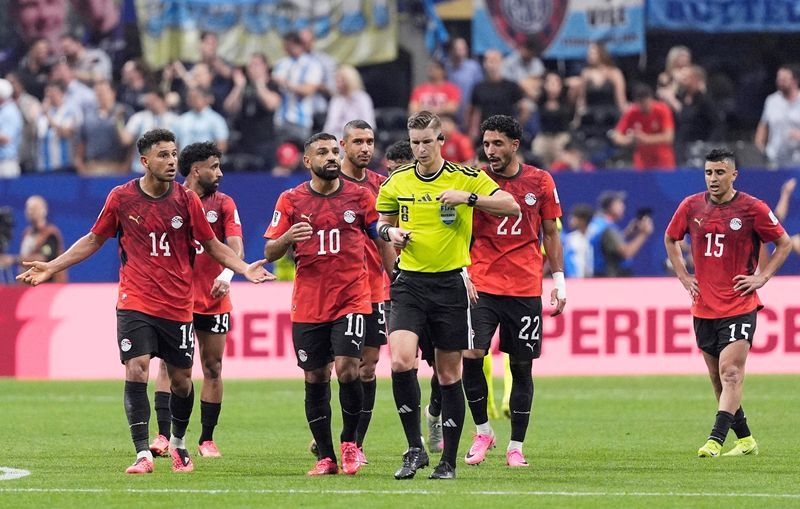
FIFA's refereeing chief Pierluigi Collina has firmly rejected accusations of bias in Argentina's controversial 3-2 win over Egypt during the World Cup round of 16, declaring that match officials maintained strict independence throughout the encounter. The statement comes after Egypt's Football Association contested several key decisions, particularly the disallowance of a second-half goal and a non-penalty incident that preceded Argentina's dramatic stoppage-time winner.
In a detailed interview published on FIFA's official platform this week, Collina acknowledged that scrutiny of refereeing decisions forms an inevitable part of football discourse. However, he drew a sharp distinction between constructive analysis and what he termed "unfounded allegations" that question the integrity of World Cup officials. His remarks directly address Egyptian complaints that emerged following their elimination from the tournament.
The match itself revealed the high stakes and emotional investment surrounding World Cup football. Argentina overturned a 2-0 deficit to secure victory with Enzo Fernandez's dramatic injury-time goal, a sequence of events that prompted Egypt's coaching staff and football authorities to voice serious concerns about decision-making consistency. Coach Hossam Hassan suggested external pressure may have influenced the referee's performance to keep a major football nation in the competition.
Egypt's grievances centred on two pivotal moments. The first involved Mostafa Zico's goal being ruled out for an alleged foul in the build-up by Marwan Attia on Argentina defender Lisandro Martinez. The Egyptian Football Association characterised this foul as non-existent, arguing the decision lacked foundation. The second involved a challenge on Mohamed Salah that went unpunalised moments before the sequence resulting in Argentina's winning goal, raising questions about the application of consistent penalty standards.
Collina defended the VAR intervention that overturned Zico's goal, explaining that the video system correctly identified a foul during the attacking possession phase. His reasoning reflected FIFA's fundamental principle that any foul, regardless of whether it appears obvious to the naked eye, warrants VAR intervention if undetected by the on-field referee. This technical position highlights how modern football's reliance on video technology can introduce tension between real-time perception and reviewed footage analysis.
On the Salah incident, Collina maintained that both the referee and VAR deemed the contact between the Egyptian winger and Julian Alvarez as "normal football contact" rather than a penalty-worthy infringement. He elaborated that deliberately stepping on an opponent's foot constitutes a foul, whereas a defender who makes initial ball contact before incidental bodily contact has not necessarily violated the rules. This distinction illustrates the inherent subjectivity within football law, even when applied by experienced officials assisted by technology.
Collina's statement carries particular significance for Southeast Asian football audiences, where trust in officiating standards directly impacts league credibility and fan engagement. The Egypt-Argentina dispute reflects broader global anxieties about whether refereeing can remain impartial when major nations with substantial international influence are involved. Malaysia's own football development depends partly on international confidence that officiating follows consistent, apolitical principles across all competitions.
The FIFA refereeing chief made an explicit point about protecting officials from threats and intimidation. Allegations questioning integrity can expose referees and their families to harassment, Collina warned, framing this as a matter extending beyond sports into personal safety. This concern resonates across the football world, where online abuse of match officials has become increasingly common regardless of decision accuracy.
Collina acknowledged that some refereeing decisions necessarily involve subjective judgment, a candid admission that distinguishes his position from absolute claims of perfect impartiality. Yet he expressed confidence that VAR principles had been correctly applied throughout the tournament, suggesting that systematic procedures can mitigate individual bias even when discretionary calls remain unavoidable. This represents the current consensus among football's governing bodies: technology combined with protocols can approach objectivity without achieving it entirely.
The controversy underscores persistent tensions in modern football between traditional on-field refereeing authority and technological review. While VAR was introduced to correct egregious errors, its application sometimes creates new disputes about whether certain decisions warrant intervention at all. For Asian football federations and regional leagues considering VAR implementation, the Argentina-Egypt case provides instructive lessons about public communication and the critical importance of explaining controversial decisions transparently.
Egypt's elimination despite competitive performance has added emotional weight to their complaints, yet Collina's defence of the officials suggests FIFA views the refereeing decisions as technically sound within established parameters. This stance reflects institutional confidence in official training and VAR protocols, though it does little to resolve the perception among Egypt's supporters that major football nations receive favourable treatment in knockout competitions.
Moving forward, the incident highlights why FIFA and continental confederations must invest in transparent referee education and consistent application of rules across all matches and nations. For Malaysia and other Southeast Asian football nations aspiring to compete at world level, understanding how international standards are enforced becomes essential for both coaches and administrators preparing teams for continental and global tournaments.

