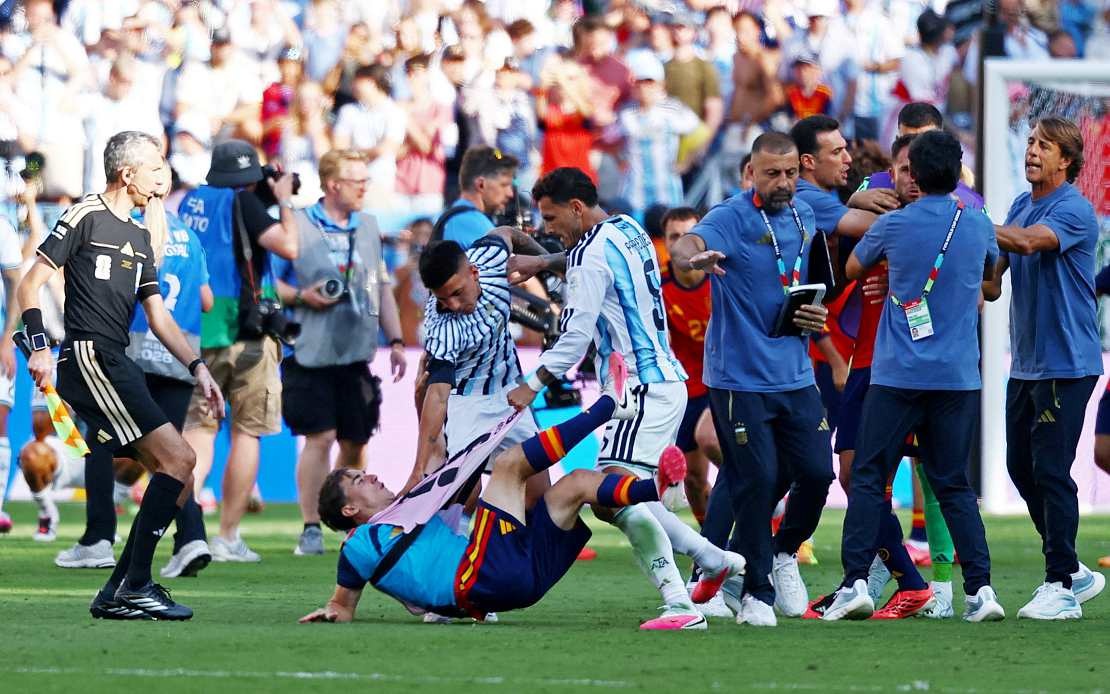
FIFA has announced a formal investigation into potential rule breaches by Argentina's national team in the aftermath of their World Cup final loss to Spain, signalling the world football governing body's serious intent to address conduct issues that emerged during one of the tournament's most contentious matches. The probe centres on events that unfolded after the final whistle in New Jersey, when tensions between the teams boiled over on the pitch as Spain celebrated their victory.
The focal point of FIFA's investigation concerns midfielder Leandro Paredes, whose actions toward members of the Spain squad immediately following the match drew immediate concern from tournament officials. According to reports, Paredes appeared to throw punches at Spanish players during the on-pitch celebrations, an incident captured in real-time that prompted the match commissioner to document the altercation in their official report. This report subsequently triggered FIFA's decision to appoint a dedicated Disciplinary and Ethics Prosecutor to examine whether Argentina's players violated the FIFA disciplinary code.
Argentina's physical intensity throughout the tournament had already become a defining narrative, with the squad drawing repeated criticism for their aggressive tactical approach. During the semi-final victory over England, this pattern intensified when midfielder Enzo Fernandez received a red card after accumulating two yellow cards, a sequence that underscored the team's propensity for hard-edged play. The final against Spain continued this theme, suggesting a broader strategic philosophy that prioritised physicality over restraint, though such tactics had proven effective in advancing Argentina's campaign.
The disciplinary process represents a significant moment in football governance, as FIFA moves swiftly to address what it considers breaches of conduct standards. In a formal statement, FIFA confirmed that following its assessment of match reports and pursuant to Article 36 of the FIFA disciplinary code, the Disciplinary Committee has authorised a dedicated prosecutor to investigate potential violations. The statement notably indicated that further details would be communicated once the prosecutor completes their independent review, a process that could take weeks.
Beyond the immediate post-match altercation, uncertainty persists regarding whether FIFA's investigation encompasses other controversial incidents from Argentina's tournament run. Specifically, questions remain about whether disciplinary action will extend to Argentina's display of a banner asserting Argentine sovereignty over the Falkland Islands following their semi-final triumph over England. Such political gestures fall squarely within FIFA's purview under Article 34.3 of tournament regulations, which explicitly restricts political messaging during official competitions.
Argentina's football association, the AFA, has previous experience with FIFA sanctions for similar conduct. The body was previously fined for displaying comparable political messaging during a 2014 friendly against Slovenia, a precedent that suggests FIFA maintains a clear framework for addressing these violations. However, enforcement consistency across confederations has varied considerably, raising questions about whether FIFA applies standards uniformly or adapts its approach based on political considerations and international sensitivities.
Comparatively, UEFA has demonstrated a more stringent enforcement posture on related matters. Following Euro 2024, the European confederation imposed one-match bans on Spanish players Rodri and Alvaro Morata after they engaged in chanting about Spain's territorial claims to Gibraltar during celebratory moments. This action provides a revealing contrast to FIFA's historical approach and raises expectations that the global body might adopt similarly decisive measures regarding Argentina's conduct, though no such precedent guarantees consistency in FIFA's decision-making.
FIFA's historical record on political gestures reveals an institution that has intensified scrutiny of on-pitch messaging in recent years. The most prominent example emerged at the 2022 World Cup in Qatar, where FIFA explicitly warned the English Football Association that captain Harry Kane would face sporting sanctions, beginning with a yellow card, if he wore the 'OneLove' rainbow-coloured armband during matches. That stance occurred in Qatar, where national law criminalises homosexuality, creating a complex intersection of international sport, human rights advocacy, and geopolitical sensitivities that FIFA navigated with particular rigidity.
The investigation's implications extend beyond Argentina's immediate circumstances to shape perceptions of FIFA's enforcement authority and consistency. Malaysian football followers and Southeast Asian observers may view this case through the lens of how international governing bodies apply regulations across different nations and confederations. The outcome could establish precedents affecting how domestic federations address political or contentious conduct by their athletes, particularly in tournaments where regional powers compete for continental or global prominence.
The timing and scope of FIFA's investigation also reflect broader tensions within modern football between preserving the sport's supposed political neutrality and acknowledging that athletes are global citizens with legitimate social and political concerns. Argentina's alleged conduct during the final, whether characterised as passionate commitment to national pride or concerning behaviour warranting discipline, sits within this contested space where football, nationalism, and governance intersect in complex ways.
FIFA's appointment of a dedicated prosecutor signals that the governing body takes these allegations seriously and intends to conduct a thorough examination before reaching conclusions. The investigation's outcome will likely influence how football's global authorities approach similar situations in future tournaments, potentially setting benchmarks for acceptable post-match behaviour and the boundaries of permissible political expression within FIFA-sanctioned competitions. For now, the process remains open-ended, with the prosecutor's findings expected to provide clarity on whether Argentina's actions constitute disciplinary violations meriting sanctions.

