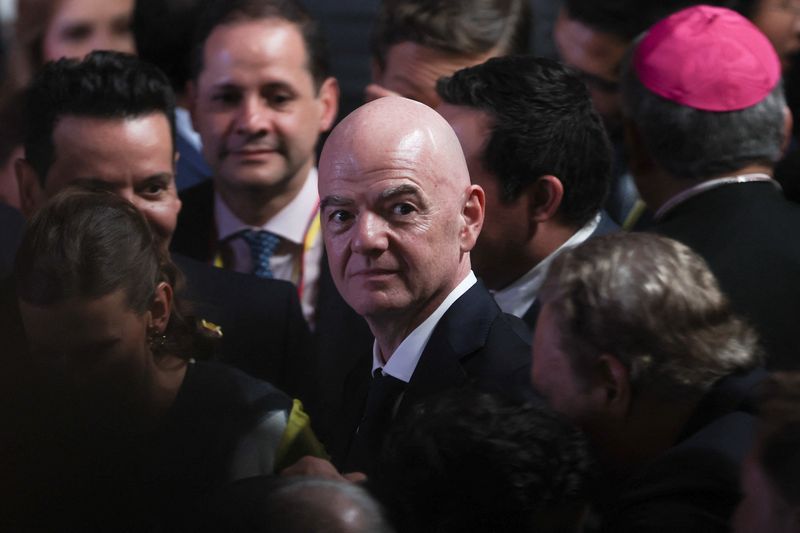
The fate of embattled FIFA president Gianni Infantino should ultimately rest with the organisation's democratic membership vote in 2027, according to Confederation of African Football (CAF) president Patrice Motsepe, who rejected calls from major continental bodies for the Swiss executive to step down immediately. Speaking to Sky News, Motsepe emphasised that while Infantino faces intense scrutiny over his leadership and failed attempts to privatise World Cup operations, the proper forum for resolving his political future remains the membership-wide election scheduled for March in Rabat, Morocco.
Infantino's position has become increasingly precarious following coordinated attacks from three powerful confederations representing Europe, Asia, and North America. UEFA, AFC, and CONCACAF have all publicly questioned his suitability to lead world football, citing governance concerns and his controversial push to attract private investors into FIFA competitions, including the sport's premier tournament. The breadth of this opposition from multiple continental federations simultaneously represents an unprecedented challenge to his authority and has created genuine uncertainty about whether he can secure re-election when member associations gather for FIFA's 77th Congress.
However, Motsepe's intervention introduces an alternative perspective within world football's power structure. Rather than joining the chorus demanding Infantino's immediate removal, the CAF leader advocates for faith in established institutional processes and the collective judgment of FIFA's membership. His position reflects African football's traditional alliance with Infantino, who has cultivated strong relationships across the continent during his tenure and invested substantially in developing African club competitions and national team programmes. This backing from Africa, which commands significant voting strength through its 54 member associations, could prove decisive in any electoral contest.
The CAF president framed the issue as one of fundamental democratic principle and due process. Motsepe argued that if individual confederations disapprove of an executive's conduct, the appropriate remedy is not unilateral pressure for resignation but rather the orderly presentation of competing candidates at elections where all stakeholders participate on equal terms. He explicitly invited Infantino's critics to field alternative presidential candidates rather than attempting to force his departure through political intimidation, suggesting this approach would better serve football's interests while respecting institutional legitimacy.
Motsepe acknowledged that leaders deserve scrutiny and that FIFA's governance frameworks exist precisely to investigate misconduct allegations. He emphasised his own willingness to face tough questioning regarding his presidential conduct and articulated support for robust accountability mechanisms. Yet he simultaneously warned against circumventing established procedures, even for seemingly justified causes. His comments reflected a concern that allowing confederations to pressure out a sitting president through coordinated public campaigns could establish a dangerous precedent undermining institutional stability and the rules-based order that protects smaller football associations from being overwhelmed by larger powers.
This stance carries particular significance for Southeast Asian football. The AFC's prominent role in demanding Infantino's removal means that regional federations must navigate between their continental confederation's official position and their own institutional interests. Many Asian associations, particularly those from developing nations, have benefited from FIFA's investment initiatives and Infantino's efforts to distribute development funding more equitably across confederations. A leadership transition at FIFA could alter these dynamics, potentially affecting resource allocation and tournament hosting opportunities for countries like Malaysia, Thailand, and Vietnam.
Motsepe's framing of the dispute as ultimately resolvable through electoral democracy rather than behind-the-scenes negotiation or confederation pressure campaigns reflects broader questions about FIFA's governance model. The organisation operates as a membership association where each of the 211 national federations theoretically holds equal voting power, yet actual influence concentrates among wealthy European and South American confederations that control vast broadcasting and sponsorship revenues. Elections provide the formal mechanism through which this power structure is validated or potentially rebalanced, though outcomes are heavily influenced by pre-existing alliance structures and resource disparities.
The timing of this intervention matters strategically. By staking out this position now, Motsepe signals that Africa will not automatically align with UEFA, AFC, or CONCACAF pressure campaigns, even when those confederations claim moral authority. This independent posture potentially strengthens African football's negotiating position within FIFA's internal politics. It also suggests that Infantino retains sufficient institutional support to mount a credible re-election campaign, provided he can consolidate African votes alongside sympathetic associations from other regions.
Yet Motsepe's advocacy for electoral process does not constitute a blanket endorsement of Infantino's current leadership or his controversial policy initiatives. Rather, he separated the question of Infantino's personal future from broader governance concerns. The CAF president emphasised that FIFA must address the systemic challenges that prompted confederations to revolt, including the governance implications of attempted private investment in World Cup competitions and questions about executive accountability. These issues require resolution regardless of who ultimately occupies FIFA's presidency, and their persistence could undermine the legitimacy of whoever emerges victorious from next year's election.
The impending 2027 Congress will test whether FIFA's membership remains capable of meaningful democratic choice or whether the organisation has evolved into a venue where predetermined outcomes are merely ratified through voting. If Infantino successfully defends his position despite opposition from UEFA, AFC, and CONCACAF, it will demonstrate that Africa and smaller confederations can effectively counterbalance Western influence within FIFA's governance structures. Conversely, if his opponents successfully mobilise sufficient support to unseat him, it may indicate that confederations can transcend traditional alliance patterns when facing what they perceive as governance crises. Either outcome will shape world football's institutional development for the decade ahead.
Motsepe's intervention also reflects practical realities within African football. CAF remains engaged in its own governance reforms and institutional rebuilding following years of administrative dysfunction and financial mismanagement. Maintaining constructive relationships with FIFA's leadership and ensuring continued investment in African competitions takes priority within CAF's strategic calculus. From this perspective, supporting the electoral process while neither fully endorsing nor opposing Infantino personally allows African football to protect its interests while preserving flexibility as institutional developments unfold.

