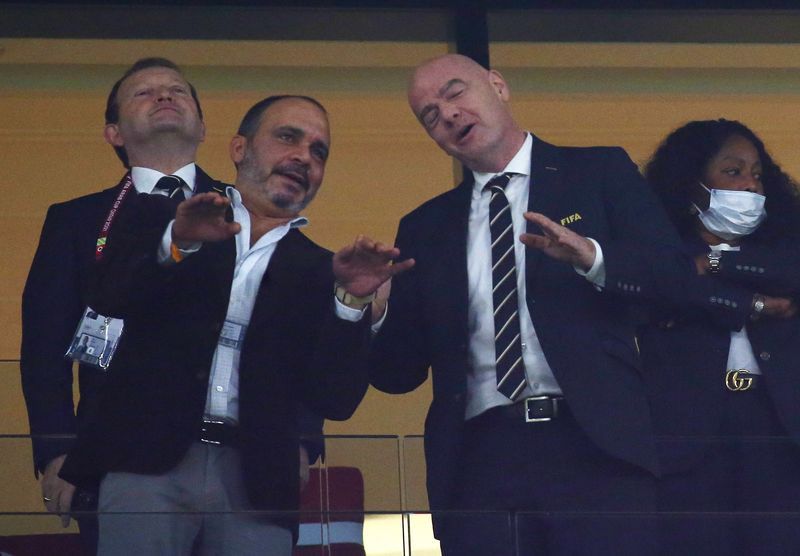
Jordan's football association has at last received outstanding prize money for the national team's participation in the 2025 Arab Cup, with the payment arriving just two days after Prince Ali bin Hussein, the FA's president, publicly levelled serious accusations against FIFA regarding the delayed funds. The prize money, which should have been received eight months earlier following Jordan's run to the final of the tournament held in Qatar last December, was finally transferred on Thursday morning, according to Prince Ali's statement posted on social media.
The timing of the payment's arrival coincided with an intensifying public row between Prince Ali and FIFA President Gianni Infantino. The Jordanian football leader had escalated his criticism after Infantino withdrew a controversial proposal to sell a stake in World Cup commercial rights, a decision that triggered significant pushback from confederations and national associations across football's global governance structure. In the wake of this withdrawal, Prince Ali framed the delayed prize money within a broader pattern of what he characterised as conditional assistance from FIFA's administration.
Prince Ali's allegations were notably severe, suggesting that FIFA had verbally communicated during the World Cup period that supporting Infantino's leadership "would go a long way to helping our FA out." The Jordan FA chief explicitly listed the eight-month delay in receiving the Arab Cup prize money as a concrete example of the difficulties his association faced, implying that FIFA had withheld or delayed legitimate financial obligations as leverage. This framing positioned the prize money dispute not as a simple administrative oversight but as part of what he termed a pattern of pressure exerted through financial incentives tied to political endorsements.
The context for this dispute extends beyond Jordan's immediate grievance. Prince Ali had withdrawn his initial support for Infantino after the FIFA president attempted to push through a World Cup commercialisation scheme that would have fundamentally altered the tournament's structure. When that proposal collapsed under pressure from multiple confederations and national associations, Infantino's position within FIFA's leadership hierarchy appeared vulnerable, prompting what Prince Ali characterised as an attempt to shore up political support through preferential treatment of federation problems.
In his public statement on Thursday, Prince Ali acknowledged receiving the delayed funds but made clear that their arrival would not alter his fundamental position on FIFA's leadership. He expressed gratitude to FIFA's administration for "suddenly this morning delivering what was owed to our players and coaching staff," yet the phrase "suddenly" carried obvious implications about the questionable circumstances surrounding the payment's long delay and its eventual release following his public accusations.
Prince Ali's resistance to backing Infantino represents a significant political development within football governance, as confederation leaders increasingly scrutinise FIFA's administrative practices and the concentration of power within its executive structure. By refusing to endorse the president despite receiving the disputed funds, Prince Ali signalled that his criticism stemmed from genuine concerns about FIFA's institutional practices rather than mere negotiating tactics. He explicitly stated that both he and Jordan's FA would not vote for Infantino, a position that carries weight in elections determining FIFA's leadership.
The broader context involves FIFA's handling of a crisis triggered by its abandoned World Cup commercialisation proposal. Following a contentious meeting in Morocco on Wednesday, FIFA's leadership formally apologised to member associations for errors made in advancing the proposal, yet simultaneously reaffirmed institutional support for Infantino himself. This manoeuvre represented an attempt to separate critique of a specific policy decision from broader confidence in the president's leadership, a distinction that critics like Prince Ali rejected.
FIFA declined to offer any substantive response to Prince Ali's allegations of leveraging prize money for political endorsement. The silence from FIFA's communications apparatus contrasted sharply with its willingness to apologise for the World Cup proposal debacle, suggesting the organisation's leadership chose not to dignify the accusations with direct engagement. This approach may have reflected either confidence that the payment would defuse the dispute or a calculated decision to avoid further public escalation.
The episode illustrates persistent governance challenges within international football, where the distribution of financial resources and the exercise of discretionary decision-making remain concentrated within FIFA's executive structure. For Malaysia and other Southeast Asian football associations, the Jordan dispute serves as a cautionary example of how larger confederations and FIFA navigate competing interests around tournament participation, prize distribution, and political alignment within football's global governance hierarchy.
The nine-month gap between Jordan's Arab Cup achievement and receipt of promised prize money raises questions about FIFA's administrative efficiency and financial management systems. Whether the delay reflected genuine bureaucratic dysfunction or deliberate withholding remains contested, yet the damage to FIFA's credibility among federation leaders appears substantial. Prince Ali's willingness to publicly challenge the FIFA president on these grounds suggests that other associations may harbour similar grievances about delayed payments or conditional treatment.
As FIFA approaches presidential elections and faces continued scrutiny over governance practices, the Jordan FA chief's refusal to be mollified by the eventual payment delivery demonstrates that financial remedies alone cannot resolve institutional trust deficits. The broader question for football's international governance structure concerns whether FIFA can implement reforms addressing the concentration of discretionary authority that enabled such disputes to emerge and persist for extended periods.

