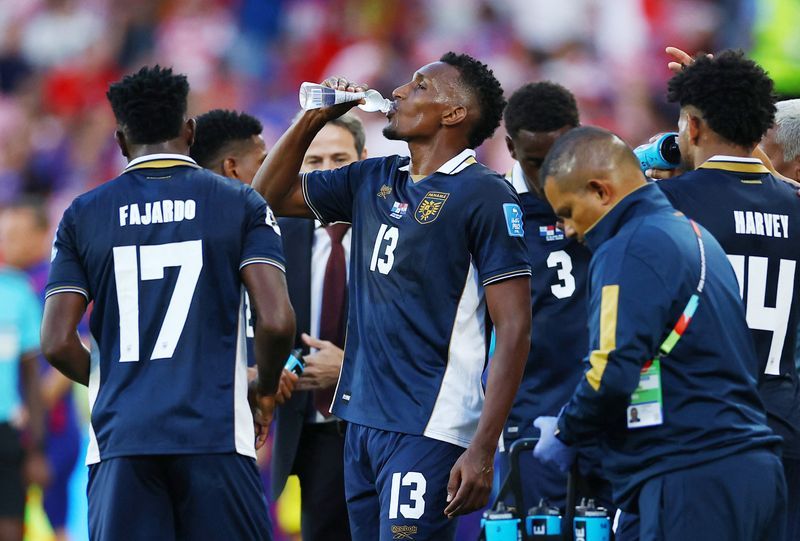
FIFA president Gianni Infantino has moved to quell mounting criticism of the World Cup's newly introduced hydration breaks by asserting that the governing body's decision rests entirely on player welfare and competition integrity, not financial considerations. The mandatory three-minute stoppages, implemented at the 22nd and 67th minutes of every match across the North American tournament, have sparked widespread debate since matches began, with detractors questioning whether the innovation fundamentally undermines the sport's rhythm and essence.
The introduction of these cooling breaks was ostensibly designed to protect player safety in hot climates, yet they have simultaneously created valuable commercial windows for broadcasters to insert advertising content. This coincidental benefit has fuelled scepticism among sections of the global football community, with some fans and commentators viewing the measure as a trojan horse for monetisation rather than genuine player protection. Infantino's Wednesday statement directly addressed this perception, emphasising that FIFA has derived no additional financial benefit from the breaks because all broadcast agreements were finalised well before their implementation.
Coaching staff now use these interruptions to deliver in-match tactical adjustments, a capability that previously did not exist during regular play. This new strategic dimension has emerged as a significant point of contention among respected figures in football management. England manager Thomas Tuchel characterised the breaks as fundamentally altering match dynamics, arguing they interrupt the natural flow that defines football as a contest. Similarly, Uruguay's Marcelo Bielsa contended that fragmenting matches into shorter, discrete segments strips away the sport's core characteristic of sustained, uninterrupted intensity spanning two continuous periods.
However, not all coaching staff have rejected the modification outright. Spain coach Luis de la Fuente and Netherlands captain Virgil van Dijk have acknowledged the logical basis for hydration breaks during periods of extreme heat, though they expressed reservations about applying the rule uniformly regardless of temperature conditions or venue facilities. Their nuanced position reflects a growing divergence of opinion within football's professional ranks, suggesting that contextual application might address concerns while preserving the intended safety mechanism.
Infantino expanded his justification by highlighting the exceptional demands placed on teams during a World Cup tournament compressed into 39 days, during which competitors may contest up to eight matches. The intensity of such scheduling, combined with elevated temperatures in North American venues, creates physiological stress that exceeds typical domestic league conditions. From FIFA's perspective, providing a regulated rest opportunity ensures all participating teams can manage player fatigue more effectively within a standardised framework, rather than allowing recovery opportunities to depend on variable environmental factors.
The FIFA chief further contended that equity concerns underpinned the policy, pointing out that without standardised breaks, coaches in hotter conditions would gain tactical advantages unavailable to their counterparts in cooler environments. His reasoning suggests that mandatory breaks level the competitive playing field by ensuring every coach, regardless of match circumstances, receives identical opportunities to implement strategic adjustments. This perspective frames hydration breaks not as a disruption but as a mechanism for ensuring competitive fairness across diverse climatic conditions.
Critics have raised concerns that the breaks artificially extend match duration without corresponding rule changes, potentially altering the strategic mathematics of football. Teams accustomed to exploiting fatigue during the final stages of conventional matches may find their time-honoured approaches rendered less effective if players receive regulated rest periods. For Malaysian and Southeast Asian readers, this development carries particular significance given the region's tropical climate and the likelihood that regional and continental tournaments may adopt similar measures.
Infantino maintained that the breaks have not diminished match intensity, suggesting players continue performing at high levels throughout games despite the interruptions. This assertion remains contested by some observers who argue that the psychological reset provided by planned stoppages fundamentally alters the competitive environment and cannot be adequately compensated for by residual player fitness.
The hydration break controversy reflects broader tensions within modern football regarding the balance between player welfare and competitive integrity. As climate change intensifies summer temperatures globally, governing bodies across various football jurisdictions face similar decisions about whether and how to implement heat-management protocols. The World Cup experiment will likely inform policy decisions affecting tournaments throughout Asia and beyond, making the current debate consequential for the future development of football competition standards in equatorial and subtropical regions where Southeast Asia's teams regularly compete.

