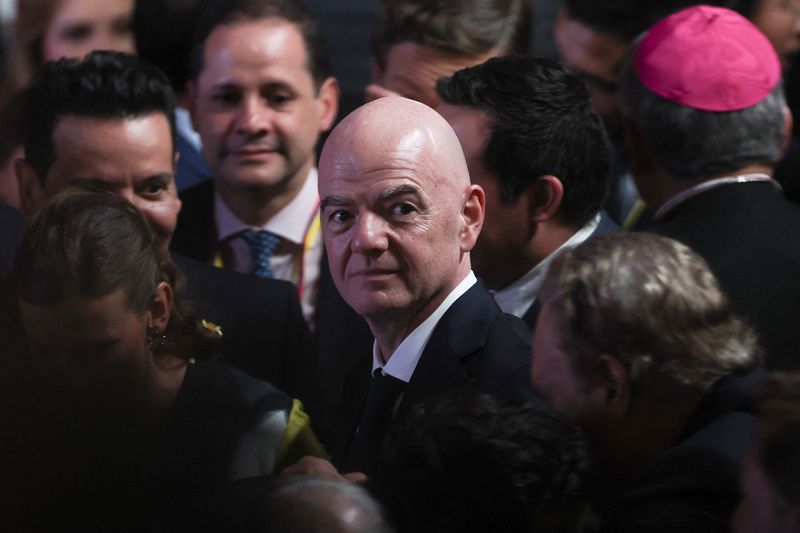
The global football governing body issued a forceful statement on Saturday defending President Gianni Infantino against what FIFA characterised as a "concerted and ongoing effort" to undermine his position, signalling the organisation's determination to weather an unprecedented institutional crisis. The warning comes as tensions within the sport's leadership structure have reached a critical juncture, with fundamental questions being raised about Infantino's fitness to lead FIFA into the coming years.
At the heart of the current turmoil lies the spectacular failure of an ambitious proposal to generate approximately $4.2 billion through the sale of commercial rights spanning the FIFA World Cup and other tournaments. The scheme, which would have fundamentally reshaped how football's flagship competition is monetised, encountered fierce resistance from multiple quarters within the sport's establishment. European football's governing body UEFA proved particularly vocal in its opposition, whilst numerous national associations and high-ranking FIFA officials publicly questioned both the proposal's merits and the process through which it was advanced.
The commercial initiative's collapse triggered demands for Infantino's immediate resignation and necessitated an emergency leadership meeting in Morocco this week, where FIFA's executive apparatus attempted to restore confidence in the president's continued tenure. Despite the fraught atmosphere surrounding this gathering, the assembled leadership formally reaffirmed its support for Infantino, suggesting that the office of the presidency retains institutional backing even as external criticism mounts. This apparent show of unity, however, masks deep divisions within FIFA's decision-making structures regarding both strategy and governance.
FIFA's statement deliberately avoided naming specific critics or identifying the sources of alleged undermining efforts, instead issuing a broad warning that any challenge to Infantino's leadership must proceed through the organisation's established democratic mechanisms and statutory framework. The governing body accused detractors of attempting "through allegation, insinuation or misinformation" to achieve objectives that cannot be secured through legitimate institutional processes. This formulation suggests FIFA's leadership perceives the criticism as fundamentally illegitimate, regardless of its substantive merit.
Recent allegations published by The Daily Telegraph concerning payments made by UEFA to a former employee during Infantino's earlier tenure as the European body's general secretary have provided fresh ammunition for his critics. Infantino has categorically denied these accusations, and FIFA has dismissed them as entirely without foundation. Nevertheless, the emergence of such claims has intensified scrutiny of the president's track record and decision-making during his career progression through European football administration.
The timing of this institutional crisis carries significant implications for global football governance, as Infantino seeks election to a fourth consecutive term at the FIFA Congress scheduled for March in Morocco. Currently, no credible challenger to his re-election has emerged, despite the severity of the current difficulties. This vacuum in opposition leadership, combined with Infantino's substantial support among FIFA's 211 member associations, suggests he retains formidable political resources even as his authority faces serious challenge.
The global landscape of football confederation responses reveals a deeply fractionalised world body. UEFA's declaration that it has lost confidence in Infantino represents a significant blow from Europe, traditionally the sport's most influential continental confederation. Norway's Football Federation President Lise Klaveness went further, explicitly calling for resignation on grounds that Infantino no longer commands the institutional trust necessary to govern effectively. However, this European-led critique finds little purchase elsewhere within FIFA's membership structure.
African football has emerged as a crucial pillar of support for the embattled president. The Confederation of African Football unanimously backed Infantino's leadership on Thursday, providing him with the backing of the world's largest single continental confederation by membership numbers. This unified African position carries particular weight within FIFA's voting structures, where African nations collectively represent a significant bloc of electoral power. The CAF's explicit endorsement effectively neutralises potential challenges originating from the African continent.
South America's CONMEBOL confederation has similarly signalled its resistance to any attempt to remove Infantino outside the framework of a full membership vote. This position effectively protects the president by requiring that any challenge must clear the high bar of winning support from a majority of FIFA's 211 member associations, a prospect that appears remote given current patterns of continental backing. Mexico's football federation has also publicly endorsed Infantino, despite its own regional confederation CONCACAF having called for a "comprehensive reckoning" with his presidency. The Mexican federation's statement that it will neither recognise nor approve any process convened outside FIFA's institutional framework reinforces the barriers protecting the incumbent president from sudden removal.
The structural dynamics now becoming apparent suggest that Infantino's position, whilst politically weakened and reputationally damaged, remains defensible through FIFA's formal procedures. The failed World Cup commercialisation scheme has exposed weaknesses in his strategic judgement and decision-making processes, yet the global football establishment appears reluctant to pursue institutional change through extraordinary means. Instead, opposition to Infantino's leadership appears likely to be channelled through the scheduled March congress election, where his re-election now faces genuine uncertainty despite his continued structural advantages.
For Malaysian and Southeast Asian football observers, this crisis at the highest levels of FIFA governance carries important implications for how the global sport will be administered during a period of significant competition expansion and commercial development. The successful implementation of new FIFA tournament formats and commercial arrangements depends upon restored confidence in presidential leadership and institutional decision-making processes. The current standoff demonstrates that major football confederations retain the capacity to constrain executive power, even as FIFA's president commands substantial resources and institutional backing.

