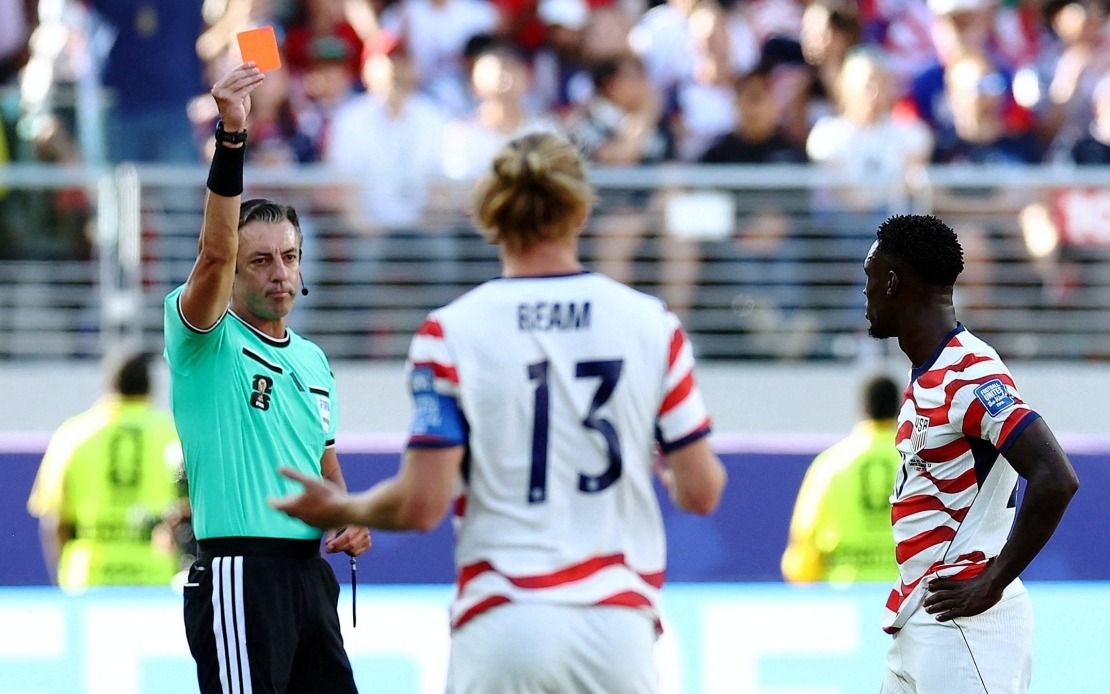
FIFA's decision to suspend rather than enforce the suspension of American striker Folarin Balogun has triggered a significant diplomatic dispute within world football's governing body, just hours before a crucial World Cup knockout encounter. The 23-year-old forward, who has emerged as a key attacking force for the United States with three tournament goals, will be eligible to feature in Monday's round-of-16 clash against Belgium in Seattle following FIFA's announcement on Sunday, despite having received a red card in his nation's previous match against Bosnia and Herzegovina on July 1.
Balogun's dismissal came for an act of violent conduct when he stamped on defender Tarik Muharemovic during the Americans' dominant 2-0 victory over the Bosnian side. The incident drew immediate censure from FIFA's Disciplinary Committee, which determined that the player's actions violated Articles 14 and 66 of the FIFA Disciplinary Code. In a conventional application of tournament rules, this infraction would automatically bar a player from their team's next fixture. Yet FIFA invoked Article 27 of its Disciplinary Code, which grants the disciplinary committee discretionary authority to suspend enforcement of sanctions, thereby postponing the one-match ban for a probationary period lasting one year.
The regulatory framework underpinning FIFA's decision appears technically sound within the literal language of Article 27, which does permit such suspensions when deemed appropriate. However, the organization's invocation of this provision has collided directly with the tournament's established procedures and the reasonable expectations of competing federations. Belgium's Royal Belgian Football Association responded swiftly with an official statement expressing "astonishment" at the decision and signalling its intent to exhaust all available remedies to contest what it characterizes as an inequitable departure from precedent.
The Belgian federation's objection centers on a critical interpretive conflict. Article 66.4 of the same FIFA code stipulates that any player dismissed by direct red card faces automatic suspension for their team's immediately subsequent match—a rule that has been applied uniformly to every other red card offense during this World Cup tournament. Belgium argues that FIFA's decision to suspend Balogun's ban represents a selective and therefore discriminatory application of disciplinary statutes. The federation contends that the World Cup 2026 Competition Regulations explicitly reinforce this automatic suspension principle, stating unequivocally that players sent off by either direct red card or second caution "will automatically be suspended from their team's subsequent match."
Furthermore, Belgium has highlighted that the automatic suspension rule was formally reaffirmed in FIFA World Cup 2026 Circular No. 16, a memorandum distributed to all participating national associations on May 12 ahead of the tournament. The Belgian federation stresses that this principle has been reiterated before each match during FIFA's formal coordination meetings and official tournament workshops, establishing clear and widely communicated expectations among all competing nations. By this reading, FIFA's Sunday decision represents not merely an exercise of legitimate discretion, but rather a departure from settled tournament law that creates competitive advantage for one nation while undermining the principle of equal treatment.
The geopolitical implications extend beyond the immediate match outcome. For the United States, Balogun's availability significantly strengthens its chances of advancing to the quarterfinals for the first time since 2002—a milestone that carries substantial domestic sporting significance and global marketing value for Major League Soccer. The American program has invested heavily in developing attacking talent, and Balogun's performance at this tournament has vindicated that strategic focus. Yet Belgium, a long-established European powerhouse, finds itself disadvantaged by an interpretive ruling that other teams facing similar circumstances have not received.
FIFA's justification for the suspended enforcement hinges on Article 27's authorization but lacks transparent articulation of the exceptional circumstances that warranted this departure. The governing body's statement noted merely that if Balogun commits another infringement of similar nature and seriousness during the one-year probationary period, the suspension would automatically activate without prejudice to additional penalties. This conditional structure, while theoretically coherent, does not address Belgium's substantive complaint that the decision contradicts the tournament's foundational disciplinary framework.
The dispute illuminates a persistent tension within international sports governance: the gap between discretionary rule-making authority and the imperative of consistent, predictable application of established norms. When governing bodies possess broad interpretive powers but exercise them selectively, they inevitably generate suspicions of favoritism, whether or not such favoritism exists in fact. For Southeast Asian observers and smaller football federations attending major tournaments, the incident underscores how dominant sporting nations may secure procedural advantages through control of governance institutions—a concern that has animated broader debates about FIFA's accountability and transparency.
Belgium's announcement that it is "investigating all potential options" to safeguard its rights signals possible escalation through formal appeals mechanisms or diplomatic channels. The federation has framed its objection explicitly in terms of protecting fair play principles and ensuring that all participating nations receive equal treatment under tournament regulations. Such rhetorical positioning appeals to the foundational legitimacy of competitive sport, which depends fundamentally on rules applying uniformly rather than being interpreted differently depending on which team might benefit.
The Monday encounter between the United States and Belgium in Seattle assumes additional significance given this controversy. Beyond the immediate sporting stakes—a place in the quarterfinals—the match now carries the weight of a governance dispute that touches on FIFA's credibility and the confidence that smaller and less influential federations can place in the organization's commitment to equitable administration. Should the United States proceed to advance, critics will likely attribute part of the credit to Balogun's continued participation, thereby tethering the team's success to a legitimacy deficit in FIFA's procedural decision-making.
For Malaysian readers and Southeast Asian football constituencies, this incident offers an instructive case study in how international sports institutions manage conflict between discretionary powers and rule predictability. As associations across the region prepare for future tournaments and governance interactions with FIFA, the Balogun case demonstrates the importance of detailed regulatory documentation and the necessity of challenging decisions that appear to violate established principles. The controversy also highlights why smaller federations must remain vigilant in scrutinizing how major powers secure competitive advantages through interpretive rulings that, while technically defensible, fundamentally alter the competitive environment in ways that disadvantage other participants.

