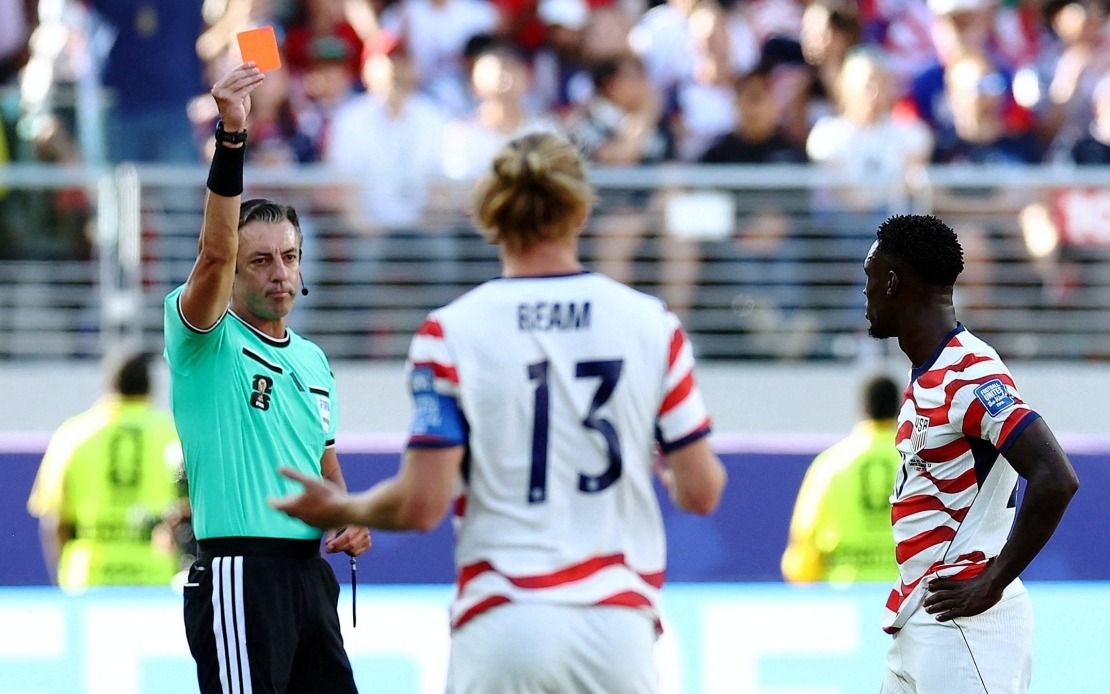
FIFA has moved decisively to defend Brazilian referee Raphael Claus against criticism from US President Donald Trump, with the organisation's leadership publicly affirming their trust in the official's integrity and professional standards. The clash between the American leader and the match official has become another flashpoint in a World Cup tournament that has attracted unusual political attention, highlighting the tensions that can emerge when sporting decisions intersect with high-profile personalities.
Trump's complaints centred on Claus's handling of a controversial red card incident involving US striker Folarin Balogun during the nation's last-32 encounter against Bosnia and Herzegovina. The Brazilian referee made the decision to send off Balogun following a VAR review, a judgment that evidently rankled the American president enough to warrant direct public criticism. The red card incident has become emblematic of the broader debates about refereeing consistency and the role of video assistance in modern football, issues that resonate across Southeast Asian football communities who follow international competitions closely.
What makes this situation particularly noteworthy is the unusual intervention that followed the initial red card decision. Balogun's suspension was controversially overturned just days later, allowing the player to feature in the United States' subsequent last-16 match against Belgium. However, that reprieve proved little consolation as the American team suffered a heavy 4-1 defeat in Seattle on Monday, suggesting that Balogun's availability ultimately made minimal difference to the tournament's outcome for the US squad.
FIFA president Gianni Infantino, responding to what appears to have been a personal request from Trump to review the incident, released a carefully worded statement that acknowledged the matter without directly addressing the specific controversy. Rather than defending Claus by name in that initial response, Infantino offered broader remarks about the quality and selection standards of World Cup officials, emphasising that match officials had been chosen through rigorous evaluation processes that examined their technical skills, consistency in decision-making, and sustained performance over extended periods.
Pierluigi Collina, FIFA's chief of refereeing operations, took a more direct approach in his defence of the Brazilian official. Collina highlighted that Claus had been selected to officiate at his second FIFA World Cup, having previously participated in the tournament held in Qatar in 2022. By pointing to Claus's previous World Cup experience, Collina sought to establish his credentials as someone who had already demonstrated the necessary capabilities at football's highest levels. The referees chief stated unequivocally that FIFA maintains complete confidence in Claus as a trusted match official, sending a clear message that the organisation stands behind its personnel in the face of external pressure.
FIFA's official statement went further in its commendation, characterising Claus as "one of the world's leading professional referees and a valued member of Team One," the organisation's collective designation for its World Cup refereeing contingent. The statement underscored that throughout his career, Claus had consistently demonstrated the highest standards of professionalism and integrity, language designed to counter any suggestion that his judgment or conduct had fallen short of expected norms.
One intriguing dimension to this situation involves the possibility that Claus's strong performance in the tournament might yet see him elevated to even greater responsibility. With Brazil having exited the competition at the last-16 stage, there are no obvious conflicts of interest that would preclude him from being selected to referee the final match. Such an appointment would represent the ultimate vote of confidence from FIFA's leadership, effectively nullifying any lingering doubts raised by Trump's public criticism.
Infantino's broader comments about the quality of officiating and the importance of respecting referees strike at a deeper concern within world football regarding the erosion of respect for match officials. In his Instagram statement, the FIFA president emphasised that the tournament has been "an overwhelming success," and that the match officials have been instrumental to this achievement. He stressed the fundamental principle that referees are "the best in the world," selected through processes that rigorously evaluate their capabilities.
The Swiss administrator reiterated a familiar but apparently necessary reminder that referees must be respected, and that the rules governing football must be upheld. Infantino's assertion that "without referees, there is no football" underscores a basic truth that sometimes requires restatement in an environment where high-profile figures may seek to undermine officials' decisions based on outcomes that disadvantage their preferred teams.
For Southeast Asian observers of international football, this episode offers instructive lessons about the pressures that face match officials operating at the World Cup level, and the ways in which political figures can attempt to influence sporting outcomes through public pressure. The willingness of FIFA's leadership to defend Claus, despite the prominence of his critic, signals that the organisation intends to maintain the independence of its refereeing operations even when challenged by powerful figures. How effectively such institutional protections hold in future cases, particularly involving developing nations whose political leaders may lack Trump's media profile, remains an open question that affects the global credibility of football's governance structures.
The incident also illustrates the peculiar challenge that video assistance technology presents for modern refereeing, insofar as controversial decisions can now be reviewed multiple times and subjected to intense public scrutiny that extends well beyond the immediate aftermath of a match. This transparency, while potentially beneficial for accuracy, has created new avenues through which political pressure can be applied to overturn or reconsider officiating judgments.

