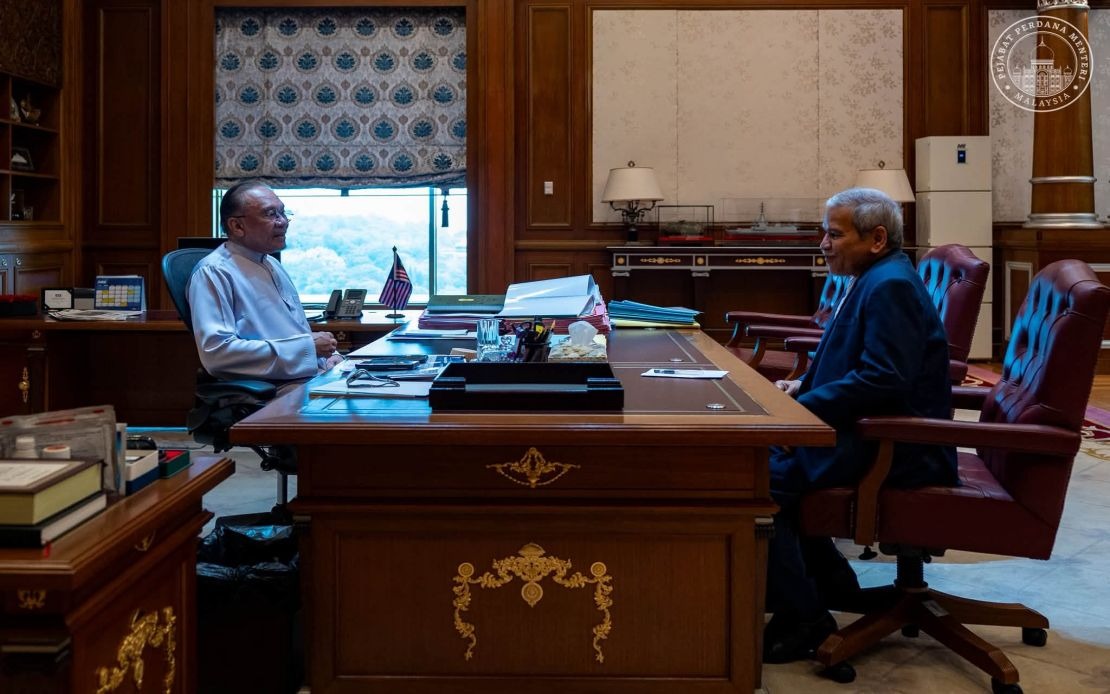
Prime Minister Datuk Seri Anwar Ibrahim has underscored the critical importance of maintaining momentum in strengthening the Federal Land Development Authority (FELDA), arguing that the institution's role in supporting settler communities remains central to the government's social agenda. During a meeting with newly appointed FELDA chairman Tan Sri Ahmad Badri Mohd Zahir in Putrajaya, Anwar reiterated that institutional development must proceed in tandem with concrete measures to enhance the welfare of settlers across all generations.
The timing of this statement coincides with fresh leadership at FELDA, with Ahmad Badri taking the helm on July 15 following the conclusion of his predecessor Datuk Seri Ahmad Shabery Cheek's tenure on June 30. This transition provides an opportunity to refocus the organisation's strategic direction, and Anwar's comments suggest the government views the new chairmanship as a pivotal moment for repositioning FELDA in Malaysia's broader development framework.
Anwar, who simultaneously holds the Finance portfolio, has framed FELDA's development within a dual mandate: advancing settler welfare while building institutional resilience through economic competitiveness and operational sustainability. This dual focus reflects recognition that legacy settler communities require continued support, yet FELDA itself must adapt to contemporary economic pressures and market realities. The emphasis on sustainability signals awareness that traditional approaches alone may be insufficient for long-term viability.
A particularly significant dimension of Anwar's statement centres on the younger generation of settlers, an often-overlooked constituency within FELDA communities. Young settlers face distinct challenges including limited access to modern agricultural technologies, agricultural education, and diverse income streams beyond traditional plantation activities. By explicitly raising these concerns, the Prime Minister has placed intergenerational equity on FELDA's agenda, suggesting policy shifts may address skills development, youth employment, and entrepreneurship within settler communities.
The MADANI Government's stated commitment to provide comprehensive support reflects a broader acknowledgment that FELDA's challenges extend beyond individual institutional capacity. These include volatility in commodity prices affecting settler incomes, ageing settler populations, land management complexities, and competition from regional agricultural producers. Government backing implies potential policy coordination across multiple agencies and possibly enhanced funding mechanisms to address these systemic issues.
FELDA's role in Malaysian society extends beyond economics into social stability and rural development. The organisation manages approximately 3.6 million hectares of land and serves hundreds of thousands of settlers and their families. Sustained institutional weakness could have ripple effects across rural economies, particularly in states where FELDA schemes concentrate, including Pahang, Johor, Perak, and Terengganu. This explains the government's emphasis on institutional preservation rather than restructuring or dismantling.
The appointment of Ahmad Badri suggests the government seeks proven administrative competence to navigate FELDA's complex challenges. The incoming chairman inherits an organisation balancing historical obligations to existing settlers with pressures to modernise operations and diversify revenue streams. Anwar's confidence in Ahmad Badri's ability to advance a "restoration and strengthening" agenda suggests the new leadership will pursue both recovery of institutional stability and forward-looking transformation.
Contextually, FELDA's challenges reflect broader rural development concerns affecting Southeast Asia. As urbanisation accelerates and younger generations migrate to cities, agricultural communities struggle to retain population and ensure economic viability. Malaysia's FELDA model, once a flagship rural development initiative, now contends with structural changes that require innovative responses beyond traditional plantation management.
The government's emphasis on keeping FELDA "relevant for future generations" acknowledges that relevance cannot be assumed but must be actively constructed through responsive policy and strategic investment. This might encompass diversification into higher-value crops, agro-technology initiatives, value-added processing, or ecotourism ventures that complement traditional activities while generating supplementary income for settler families.
Anwar's statement also carries implicit political messaging, affirming the MADANI Government's commitment to constituencies that may have felt neglected in previous administrations. FELDA settlers represent a defined voter group with specific grievances and expectations. Prioritising FELDA strengthening demonstrates responsiveness to this demographic and signals continuity of government attention to rural welfare concerns.
The path forward for FELDA under Ahmad Badri's leadership will likely involve detailed assessments of operational efficiency, stakeholder consultations with settler communities, and development of medium to long-term strategic plans addressing both immediate welfare concerns and systemic sustainability. Whether the new chairman can translate government commitment into tangible improvements in settler livelihoods will substantially influence FELDA's trajectory and its relevance to Malaysian rural development objectives.

