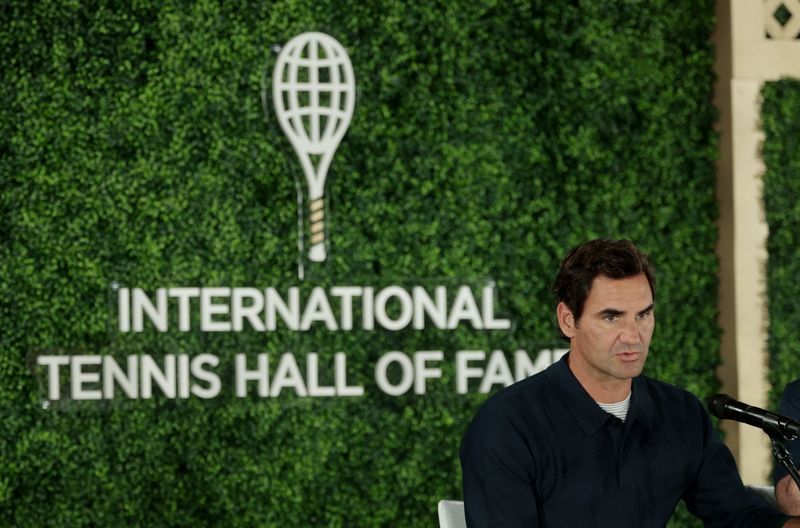
Roger Federer's induction into the International Tennis Hall of Fame this weekend marks a pivotal moment for the Swiss maestro to step back from the achievement-focused narrative that defined his playing career and examine the deeper imprint he has left on professional tennis. Speaking at a news conference on Friday ahead of his Saturday induction ceremony in Newport, the 45-year-old described the honour as fundamentally different from the tangible rewards that shaped his competitive years—the trophies, rankings, and records that once drove his relentless pursuit of excellence.
The significance of Federer's induction alongside respected broadcaster and journalist Mary Carillo underscores how the Hall of Fame evaluates contributions that transcend match victories. Federer's record speaks for itself: eight Wimbledon titles, six Australian Open crowns, five U.S. Open victories, and the 2009 French Open completion of his career Grand Slam, plus 103 ATP Tour titles and 310 weeks holding the world number one ranking. Yet in recent years, the Swiss legend has grown increasingly vocal about his desire to be remembered not simply as a collector of trophies but as someone who advanced the sport's structural health and inclusivity.
Central to Federer's vision of his legacy is the material improvement in conditions across professional tennis. He pointed specifically to the dramatic expansion of prize money distribution, noting that financial security has extended far beyond the champions and runners-up who once captured all attention. The growth in purses for early-round matches—particularly the first and second rounds where most players compete—has fundamentally altered the economics of the sport. This democratisation of earnings represents a quiet revolution in professional tennis, one that Federer identifies as a cornerstone of his behind-the-scenes advocacy work.
Beyond economics, Federer has invested considerable effort in upgrading the overall environment for all stakeholders in professional tennis. He highlighted improvements in player accommodations, medical support systems, media facilities, and stadium infrastructure as tangible outcomes of collaborative discussions with ATP leadership, Grand Slam organisers, and various player councils. These may lack the glamour of Grand Slam victories, yet they represent the scaffolding upon which a sustainable professional circuit depends. For emerging players from developing tennis nations, including Southeast Asia where the sport continues to grow, these baseline improvements can mean the difference between maintaining a career or abandoning it.
Federer's philosophical shift toward measuring success beyond rankings and titles reflects a maturation in how elite athletes conceive of their societal contribution. He acknowledged that early in his career, he consciously embraced the pressure and expectations that accompanied his ascent from a gifted Swiss teenager to a global sporting icon. His deliberate preference for performing on Centre Court rather than peripheral courts underscored his instinctive competitiveness. Yet the constant external scrutiny that accompanies elite sport—the ceaseless judgement of players exclusively through the lens of victory—has extracted a psychological toll he now openly discusses.
The mental burden of elite professional sport, as Federer characterised it, can become an overwhelming cacophony, a storm within the mind that risks eroding the intrinsic joy that drew players to their sport initially. While Federer credits himself with largely navigating this minefield successfully and maintaining happiness throughout his career, his candour about the potential psychological hazards represents valuable testimony for contemporary athletes facing even more intense digital scrutiny than he endured. This aspect of his legacy—demonstrating that one can simultaneously pursue excellence and protect mental wellbeing—carries particular weight in an era when athlete mental health has become a focal point of global sporting conversation.
Federer's recent exhibition appearance at Arthur Ashe Stadium ahead of the U.S. Open provided a poignant reminder of his enduring capacity to captivate audiences, even in retirement. Rather than fading entirely from the sport's ecosystem, he has signalled his intention to remain strategically involved in ways that continue contributing to tennis' development. He left open several pathways for future engagement, including the possibility of captaining the Laver Cup—an increasingly prestigious team competition—mentoring the next generation of players, or transitioning into commentary roles where his analytical perspective and global recognition could educate audiences.
Federer's commitment to attending three to four events annually demonstrates his intent to remain connected to competitive tennis rather than disappearing into retirement. He frames this ongoing involvement not as nostalgia or an inability to relinquish his former identity, but as a source of intellectual and emotional renewal. Witnessing the evolution of the game, observing new players navigate challenges he once faced, and contemplating potential contributions keeps him mentally engaged with professional tennis in ways that feel authentically purposeful.
For Malaysian and Southeast Asian tennis enthusiasts, Federer's evolving conception of sporting legacy carries instructive implications. As the region develops its own competitive tennis infrastructure and produces increasingly accomplished players, the model Federer represents—one prioritising sustainable career economics, comprehensive player support systems, and measured expectations around psychological wellbeing—offers a template for responsible sporting development. His emphasis on expanding financial opportunity beyond champions suggests that regional tennis bodies might focus not merely on producing grand champions but on creating viable long-term careers for a broader cohort of players.
The Hall of Fame induction represents both a culmination and a transition for Federer. It formalises his status among sport's immortals while simultaneously freeing him from the pressure to accumulate additional titles or records. This liberation from competition's immediate demands appears to be directing his energy toward more systemic contributions. His willingness to engage in governance discussions, mentor emerging players, and participate in strategic initiatives suggests that his most enduring impact on professional tennis may ultimately extend far beyond the elegant backhand and astonishing record books that initially defined his career.
Looking forward, Federer's post-competitive journey illustrates how former champions can remain vital figures within their sports through deliberate engagement with structural questions rather than mere ceremonial appearances. His induction into the Hall of Fame validates not only what he achieved between the lines but also what he has become since—an advocate for sustainable professional athletics, a thoughtful voice on player welfare, and a mentor committed to ensuring that future generations inherit a sport fundamentally stronger than the one he inherited.

