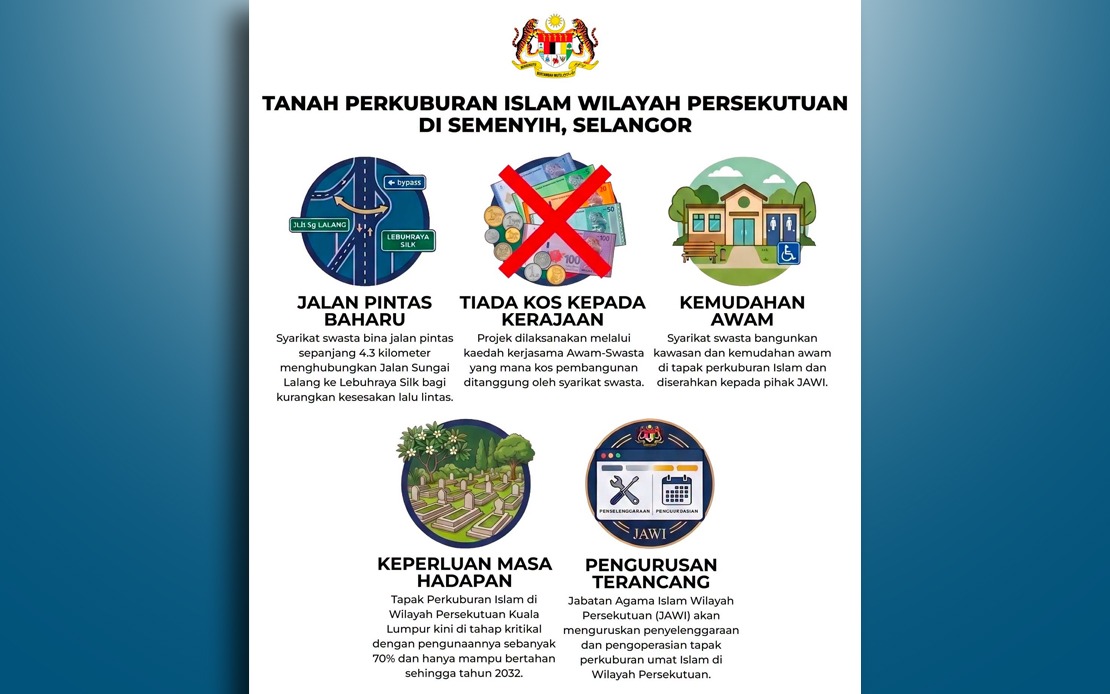
The government has moved to dispel confusion swirling across social media by confirming that the Federal Territory Muslim Cemetery Development Project in Hulu Semenyih, Selangor, represents a long-standing infrastructure solution that has been under consideration since 2005. Hannah Yeoh, Minister in the Prime Minister's Department (Federal Territories), issued the clarification to address mounting public concern about the initiative, underscoring that the project responds to genuine demographic pressures facing Malaysia's capital rather than representing a hastily conceived plan.
The urgency driving this cemetery expansion becomes apparent when examining occupancy data across Kuala Lumpur's existing Islamic burial grounds. The Federal Territories' current Muslim burial infrastructure has already surpassed 70 per cent capacity, leaving fewer than 34,496 available plots as of June 2023. Projections suggest these remaining plots will serve the community's needs only until approximately 2032, creating a critical gap in essential religious and social infrastructure. For the Muslim population of Kuala Lumpur, which views proper Islamic burial as a fundamental religious and cultural requirement, this impending shortage represents a genuine welfare concern affecting families across the city.
The Hulu Semenyih development will establish 104,470 Muslim burial plots across 332.6 acres of land currently owned by the Federal Lands Commissioner, substantially expanding capacity to accommodate future generations. Beyond serving Kuala Lumpur's Federal Territory population, the project incorporates provisions benefiting the broader Selangor community, with 10 per cent of capacity reserved for residents from surrounding areas. This sharing arrangement reflects both the geographic realities of the Klang Valley conurbation and a pragmatic recognition that burial needs transcend administrative boundaries.
The project structure reflects contemporary infrastructure delivery models emphasizing public-private partnerships while maintaining strict government control over sensitive religious facilities. The developer will assume full financial responsibility for constructing comprehensive infrastructure, including prayer facilities (surau), administrative offices, staff accommodations, cafeteria services, sanitation facilities, and security infrastructure. Critically, the Federal Lands Commissioner will retain ownership of the land itself, while day-to-day management, administration, and operational control will rest exclusively with the Federal Territories Islamic Religious Department (JAWI), ensuring that a government religious authority—not a profit-seeking private entity—governs burial practices and maintains Islamic standards.
Addressing local traffic concerns that have emerged during consultation phases, the development includes construction of a 4.3-kilometre link road connecting Jalan Sungai Lalang to the SILK Highway. This infrastructure component, entirely financed by the developer at a cost of RM93.89 million and imposed as a development condition by Selangor's state government, aims to establish alternative routing options that circumvent existing bottlenecks in Semenyih. The road's construction signals recognition that substantial infrastructure projects must incorporate mitigation measures addressing community concerns about vehicular congestion and traffic flow disruption.
The project has undergone rigorous evaluation frameworks before advancing toward implementation. Technical assessments have examined site suitability, soil conditions, access arrangements, and utility requirements necessary for cemetery operations. Additionally, a Value Management Lab evaluation provided independent scrutiny of project design, cost structures, and operational efficiency. This staged approval process involved both the Selangor state government and federal authorities, reflecting Malaysia's constitutional division of powers and the necessity of coordinating between different governmental layers when projects span multiple jurisdictional boundaries.
From a regional Southeast Asian perspective, the Hulu Semenyih project reflects broader demographic trends affecting major metropolitan areas across the region. As cities expand and urbanization intensifies, planning for death-related infrastructure often lags behind residential development, creating acute shortages in burial facilities for established communities. Malaysia's multicultural composition means that Federal Territory authorities must provide adequate burial infrastructure serving Buddhist, Christian, Hindu, and Muslim communities simultaneously—a challenge that requires strategic long-term planning rather than reactive crisis management.
The government's public articulation of planning origins dating to 2005 serves an important accountability function within Malaysia's political context. By establishing the project's historical pedigree, officials can demonstrate that this represents measured urban planning rather than recent political decision-making responding to contemporary pressures. For Malaysian citizens accustomed to infrastructure debates where accusations of improper motivation or hasty implementation frequently emerge, the timeline documentation provides factual grounding for administrative decisions.
The cemetery's designation structure, reserving substantial capacity for Federal Territory residents while allocating 10 per cent to surrounding Selangor communities, illustrates pragmatic federalism in action. Rather than adopting rigid exclusionary policies based purely on administrative boundaries, planners recognized that the Klang Valley functions as an integrated economic and social region where many residents work, worship, and maintain family connections across jurisdictional lines. This allocation acknowledges both formal administrative responsibilities and the lived reality of how contemporary Malaysians navigate boundaries between federal and state territories.
For Muslim families in Kuala Lumpur, the project represents essential future planning addressing a fundamental lifecycle requirement. The capacity shortage forcing many families to secure burial plots in distant locations, or facing years of delay when deaths occur, constitutes a genuine hardship affecting religious observance and family dignity. The Hulu Semenyih development, by substantially increasing available plots, removes this constraint on religious practice and restores families' ability to make timely burial arrangements without excessive expense or geographic dislocation.
The project also exemplifies how Malaysian authorities balance competing infrastructure needs within constrained geographic areas. Kuala Lumpur's designation as Federal Territory removes cemetery development from state government control, requiring federal coordination and investment. Simultaneously, the location in Hulu Semenyih, technically within Selangor jurisdiction, necessitated state government cooperation and imposed conditions such as the link road development. This coordination, while complex, ultimately produced a solution addressing legitimate Federal Territory needs while incorporating state-level traffic and development concerns.
Moving forward, the project's completion timeline and implementation challenges will likely attract continued scrutiny. Cemetery infrastructure, unlike office complexes or commercial developments, engages deeply held religious and cultural values making public communication essential throughout construction and operational phases. The explicit commitment to maintain JAWI jurisdiction over management and operations, avoiding private commercial control, directly addresses concerns that might otherwise emerge from Muslim communities regarding profit motives influencing sacred burial practices. Ultimately, the Hulu Semenyih development represents necessary long-term infrastructure planning addressing a real demographic challenge facing Malaysia's capital, combining public land ownership, government religious administration, and strategic private sector involvement in a configuration balancing multiple legitimate interests.

