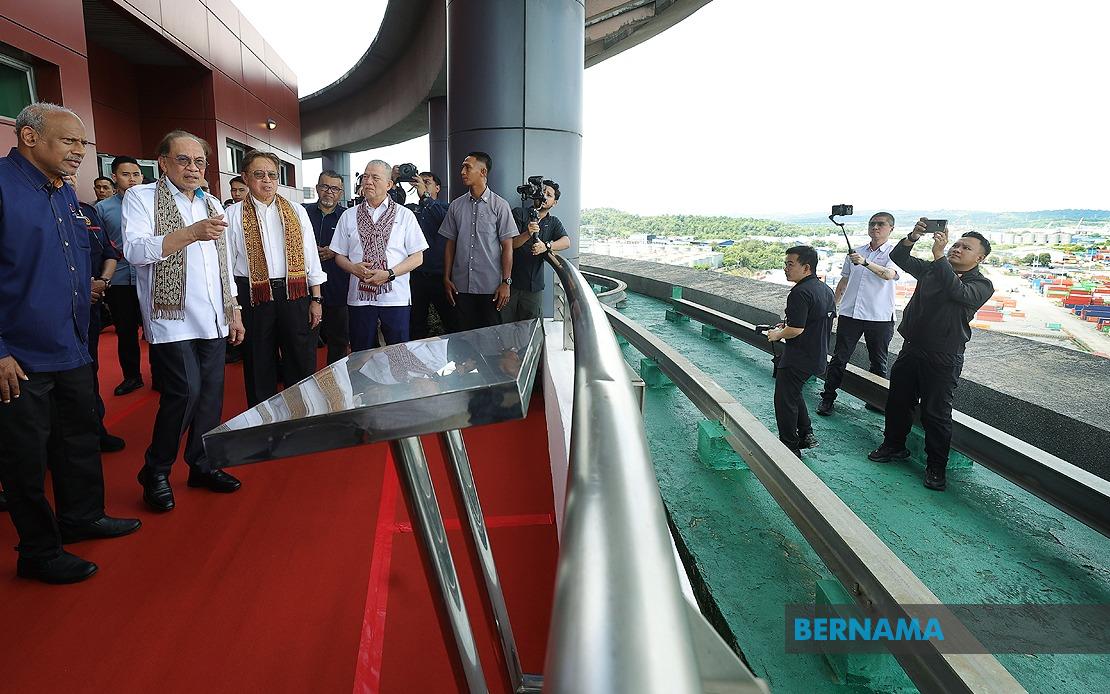
Prime Minister Datuk Seri Anwar Ibrahim has declared the Federal Government's full confidence in Sarawak's ability to operate Bintulu Port following the transfer of the facility from federal to state management. The transition, formalised through a ceremony in Bintulu today, represents a significant recalibration of port governance in Malaysia and underscores the administration's commitment to empowering state governments within the federal framework.
During remarks at the Sarawak Level Gawai Dayak 2026 Dinner in Kuching, Anwar emphasised that the state possesses the expertise and personnel required to successfully run the strategically important facility. His public affirmation reflects confidence in Sarawak's administrative capacity and serves as a statement of intergovernmental partnership at a time when federal-state relations remain a contentious issue across Malaysia.
Bintulu Port holds particular significance for Malaysia's energy sector. The facility serves as a crucial hub for the nation's liquefied natural gas operations, which represent a major revenue stream and technological cornerstone of the Malaysian economy. The port's efficiency and competitiveness directly influence Malaysia's standing in Asian energy markets and its ability to supply global LNG demand. Any disruption or mismanagement could ripple through regional energy supply chains and affect Malaysia's competitive positioning.
The handover also carries symbolic weight beyond operational considerations. By transferring management of a federal port to state authority, Kuala Lumpur signals a broader philosophical shift towards decentralisation and trust in state capacity. This move potentially sets a precedent for how the Federal Government approaches port administration and resource management more generally. For Sarawak, it represents tangible recognition of the state's institutional maturity and technical competence.
Sarawak's governance of Bintulu Port will be scrutinised closely by both federal authorities and international stakeholders. The state must maintain the port's operational efficiency, safety standards, and strategic value while ensuring transparent, professional management. Any performance shortfalls could undermine confidence in state-level port administration and complicate future devolution of federal infrastructure to other states.
The timing of this transfer reflects evolving centre-state dynamics within Malaysian federalism. The Pakatan Harapan-led administration has generally sought to strengthen state autonomy in specific sectors, particularly those aligned with state resources and economic interests. For Sarawak, oil and gas resources have long been sources of both revenue and political negotiation with the federal centre. Port governance directly affects how efficiently these resources reach global markets.
From a regional perspective, Sarawak's assumption of control over critical energy infrastructure enhances the state's institutional profile within ASEAN and positions Sarawak as a self-directed economic actor rather than merely a federal administrative unit. This elevation could attract investment and partnerships based on direct state-level relationships, potentially accelerating economic diversification beyond traditional petroleum dependence.
The Federal Government's public confidence in Sarawak's capabilities may also address longstanding grievances within the state regarding resource management and autonomy. Sarawak has historically sought greater control over its economic and administrative matters. This port transfer, while technically significant, functions partly as a confidence-building measure in the broader relationship between Putrajaya and Kuching. Such gestures can ease tensions around resource-sharing formulas and federal-state coordination.
However, the practical implications remain to be tested. Sarawak must establish robust governance frameworks, ensure adequate training and technology infrastructure, and maintain international standards in port operations. The state's track record with other major enterprises will influence market confidence in its stewardship of Bintulu Port. Any operational difficulties could prompt federal re-evaluation of further devolution initiatives.
International investors and LNG purchasers will monitor Sarawak's management closely. Port efficiency directly affects contract fulfilment and long-term commercial relationships. Should Sarawak maintain or improve operational performance, the transition could demonstrate that state-level management of strategic infrastructure is viable in the Malaysian context. Conversely, difficulties could reinforce arguments for federal oversight of critical facilities.
The broader context includes Malaysia's need to modernise and upgrade port infrastructure to remain competitive with regional alternatives. Sarawak's assumption of management responsibility includes the opportunity—and obligation—to invest in technological upgrades, environmental compliance, and operational efficiency improvements. These investments could serve as benchmarks for federal-state cooperation in infrastructure development.
Looking forward, the Bintulu Port transition may inform policy discussions around governance of other major facilities. The Federal Government's public endorsement of Sarawak's capacity potentially opens pathways for similar arrangements with other states, particularly those with strategic economic interests. However, successful implementation at Bintulu will largely determine the appetite for further devolution.
Anwar's statement reflects calculated acknowledgment of Sarawak's development aspirations and administrative capabilities. The move balances federal oversight with state autonomy, a delicate equilibrium essential to Malaysia's federal stability. Success in port management could strengthen federal-state relationships and create a model for sharing responsibility over strategic national infrastructure across the federation.

%22%2F%3E%3C%2Fpattern%3E%3C%2Fdefs%3E%3Crect%20width%3D%22100%25%22%20height%3D%22100%25%22%20fill%3D%22url(%23ph5dsj2g)%22%2F%3E%3Crect%20width%3D%22100%25%22%20height%3D%22100%25%22%20fill%3D%22url(%23ph5dsj2p)%22%2F%3E%3Ctext%20x%3D%2250%25%22%20y%3D%2250%25%22%20text-anchor%3D%22middle%22%20dominant-baseline%3D%22central%22%20fill%3D%22rgba(255%2C255%2C255%2C0.95)%22%20font-family%3D%22Georgia%2C%20'Times%20New%20Roman'%2C%20serif%22%20font-weight%3D%22700%22%20font-size%3D%22320%22%20letter-spacing%3D%22-0.02em%22%3EMUDA%3C%2Ftext%3E%3C%2Fsvg%3E)