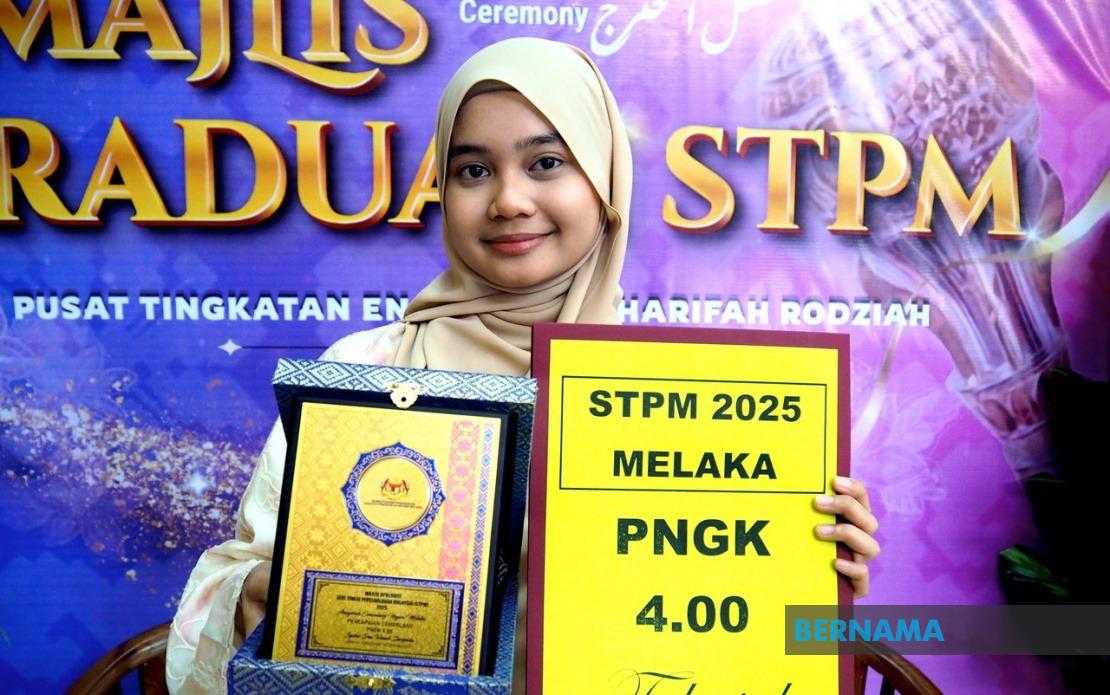
Nurfariesya Nasywa Hamedee credits her exceptional performance in the 2025 STPM examination—achieving a perfect 4.00 cumulative grade point average—to the final piece of wisdom her father imparted before his untimely death. The 21-year-old from Sekolah Menengah Kebangsaan Agama Sharifah Rodziah in Melaka has turned personal tragedy into academic triumph, completing her secondary education with a result that honours both her ambitions and her family's memory.
The loss of her father, Hamedee Asri, came at a particularly difficult juncture in her educational journey. He suffered a fatal heart attack just days before she was scheduled to sit for her SPM trial examination several years ago, a shock that threatened to derail her academic path entirely. The timing of his death meant that Nurfariesya found herself grieving while simultaneously facing the pressures of major examinations. In that vulnerable period, she contemplated abandoning her education altogether, considering instead taking up work to provide financial support to her family during their period of bereavement.
It was a message relayed through her mother, Yusnita Ruslan, that ultimately proved transformative. Her father's counsel to study diligently and not squander her abilities became a touchstone for Nurfariesya whenever motivation faltered. Rather than allowing sorrow to extinguish her academic ambitions, she reframed her studies as a means of honouring his memory and fulfilling his final wishes. This psychological shift—from viewing education as something separate from family support to seeing it as the ultimate gift she could offer—enabled her to channel her grief into purposeful work.
The magnitude of her STPM achievement becomes clearer when considered against her own expectations. Based on her trial examination results and preliminary self-assessment, Nurfariesya had anticipated a final CGPA of approximately 3.92. That she exceeded this projection by 0.08 points to achieve a perfect score underscores the intensity of her commitment during the final phase of her secondary education. Her path to this milestone also drew strength from a longstanding passion. Since her earliest days in secondary school, Nurfariesya had nursed a keen interest in Shariah law, and this genuine intellectual curiosity sustained her through the rigorous demands of her final year coursework.
Her subject selection reflected this specialisation. Nurfariesya pursued General Studies, Arabic, Usuluddin, History, and Shariah, a demanding combination that required her to balance the analytical rigour of secular disciplines with the textual and philosophical depth of Islamic studies. This interdisciplinary approach is increasingly recognised as essential training for anyone seeking a career in Shariah law, a field where practitioners must navigate both religious jurisprudence and contemporary legal frameworks. Her earlier performance in the SPM examination had already signalled her capability, when she secured seven distinctions, demonstrating the consistency of her academic excellence across different assessment modes.
While Nurfariesya's story provides an inspirational narrative, she deliberately avoids attributing her success to any mystical formula or hidden technique. In conversations with the media following the announcement of her results at Telok Mas, she emphasised that her achievement rested on conventional but demanding foundations: sustained hard work, resilience in the face of setbacks, and an unshakeable faith that her efforts were aligned with larger spiritual purposes. This grounded perspective—rejecting the notion that academic excellence requires some secret shortcut—carries important implications for Malaysian students wrestling with examination anxiety and pressure.
Nurfariesya has already begun the next chapter of her educational trajectory. She has recently completed an interview for admission to Universiti Malaya's Bachelor's Degree programme, with the aim of ultimately becoming a Shariah lawyer. Her decision to undertake STPM rather than alternative post-secondary pathways had been deliberate. She recognised that the two-year STPM qualification offered both a compressed timeline to university entry compared to some other routes and exceptional credibility with Malaysian higher education institutions. Her choice has been vindicated by the calibre of her results and the openness of prestigious universities to her applications.
Nurfariesya's achievement was recognised during the official ceremony announcing Melaka's 2025 STPM results, which was presided over by Datuk Rosli Abdullah, the State Deputy Exco for Education, Higher Education, and Religious Affairs. At the same event, another exceptional student gained prominence on the national stage. Ng Zhen Hong, a 20-year-old from Kolej Tingkatan Enam Tun Fatimah, was named the recipient of the National-Level Best Student Award for the Science Stream, securing ten distinctions in his SPM examination and now planning to pursue Chemical Engineering or Electrical Engineering at Universiti Malaya.
Ng's path to academic excellence, while distinct from Nurfariesya's journey, shares certain commonalities that illuminate broader patterns among high-performing Malaysian students. He attributes his success to parental support, educator encouragement, and genuine intellectual enthusiasm for science disciplines. His particular interest in subjects involving mathematical computation and problem-solving created a virtuous cycle wherein challenging coursework became an opportunity to refine his abilities rather than a source of dread. By dedicating between one and two hours daily to review and consolidation, Ng demonstrated that excellence emerges not from occasional bursts of intense effort but from disciplined, consistent engagement with the material.
The success of both students reflects the enduring strength of Malaysia's secondary education system and the resilience of young Malaysians in pursuing excellence despite personal and systemic challenges. For Nurfariesya, academic achievement has become a vehicle for honouring familial bonds and channelling grief toward constructive ends. For Ng, it represents the harvest of disciplined passion and sustained family support. Both exemplify how Malaysian students, when combining individual determination with institutional support and personal motivation, can achieve outcomes that position them competitively for entry into elite universities and professional pathways.

