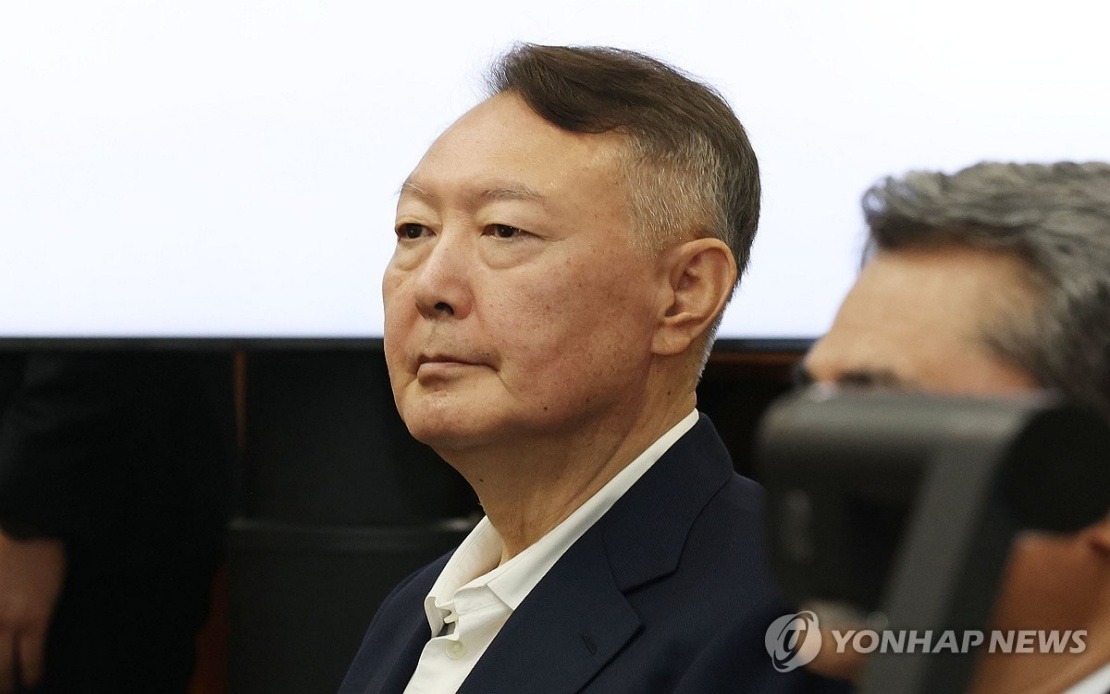
South Korea's former President Yoon Suk Yeol faces another significant legal blow after a Seoul court handed down a two-year prison sentence for accepting illegal political funding in the form of free opinion polls. The Seoul Central District Court's ruling on Monday found the jailed former leader partially guilty of violating the Political Funds Act, determining that he had received 14 unpaid surveys from power broker Myung Tae-kyun during 2021 and 2022.
The conviction represents a pivotal moment in Yoon's ongoing legal struggles, as it stands in sharp contrast to the acquittal of his wife, former first lady Kim Keon Hee, on identical charges just three months earlier. That April acquittal by the Seoul High Court relied on a different interpretation of evidence, with judges finding that the couple could not be deemed to have profited since Myung distributed similar polls to other recipients as well. The special counsel team has since filed an appeal challenging the wife's acquittal, signalling their determination to pursue a consistent legal position across both cases.
According to Special Counsel Min Joong-ki's investigation, Yoon orchestrated a scheme in concert with his wife to receive a total of 58 opinion polls valued at approximately 270 million won, equivalent to roughly $180,100 USD, without payment. The special counsel's prosecution established that these materials were provided between April 2021 and March 2022, a period when Yoon was preparing for his presidential campaign. In exchange for receiving the valuable polling data, the court found that Yoon had pledged to support former Representative Kim Young-sun's nomination as a parliamentary candidate for the conservative People Power Party during by-elections scheduled for June 2022.
The sentencing carries meaningful financial consequences beyond the prison term. The court ordered Yoon to forfeit 13.96 million won as part of his penalty, effectively stripping him of illicit gains from the arrangement. Power broker Myung Tae-kyun, the other central figure in the scheme, received an 18-month prison sentence for his role in facilitating the illegal transactions. However, these judicial outcomes fell short of the special counsel team's original demands, which had sought a four-year sentence for Yoon and a three-year term for Myung, indicating that the judges applied more lenient interpretation than prosecutors advocated.
The divergence between Yoon's conviction and his wife's acquittal underscores fundamental questions about how South Korean courts evaluate evidence and intent in political finance cases. Legal experts note that the appellate court's reasoning in Kim's case—that both received similar benefits and therefore neither profited—differs substantially from the district court's approach in Yoon's trial, which focused on the quid pro quo arrangement between the former president and the power broker. This inconsistency has become a focal point for legal observers tracking South Korea's high-profile prosecutions and raises concerns about coherent application of campaign finance law.
This conviction marks the latest chapter in an extraordinary legal trajectory for Yoon, who has found himself entangled in multiple simultaneous proceedings since leaving office. In February, a separate court convicted him of insurrection and sentenced him to life imprisonment following his attempt to impose martial law in December 2024, an audacious move that triggered massive public backlash and constitutional crisis. That attempt lasted only hours before military and political opposition forced him to withdraw the declaration, yet the consequences have proven far-reaching and potentially catastrophic for his political future.
For Malaysian and Southeast Asian observers, Yoon's cascading legal troubles offer instructive lessons about the vulnerabilities of political systems when executive power remains inadequately constrained. The opinion poll scheme illustrates how campaign finance regulation, even when formally robust on paper, can be circumvented through creative arrangements that obscure the actual transfer of value. In Malaysia's context, where campaign financing has periodically generated controversy, the South Korean precedent demonstrates how courts must remain vigilant against schemes that disguise unlawful contributions as technical compliance with letter-of-law restrictions while violating their spirit.
The multiple trials confronting Yoon simultaneously present an unusual legal scenario that strains institutional resources and raises questions about trial management efficiency. South Korean courts are simultaneously managing the life sentence for insurrection, the two-year sentence for campaign finance violations, and various other cases, creating a complex appellate landscape that could occupy judicial attention for years. This concentration of accountability actions reflects both the severity of Yoon's alleged conduct and the potential challenge of maintaining procedural fairness when defendants face overlapping charges and verdicts from different judicial levels.
International attention to Yoon's prosecutions extends beyond South Korea's borders, particularly concerning democratic nations navigating similar tensions between holding political leaders accountable and avoiding perception of politically motivated persecution. The contrast between Yoon's conviction and his wife's acquittal on essentially identical charges will likely fuel debate about whether the judicial outcome reflects evidence-based differentiation or inadvertent inconsistency. Prosecutors' decision to appeal the wife's acquittal signals their intention to resolve this contradiction through appellate review, potentially yielding a unified legal standard across both cases.
Looking forward, Yoon's immediate legal landscape remains precarious despite the relatively modest two-year sentence for the opinion poll conviction. The life sentence for insurrection effectively determines his medium-term incarceration regardless of outcomes in other proceedings, though that conviction itself faces appellate review. Defense attorneys will likely marshal these sentencing disparities across multiple trials to argue for leniency in future proceedings, emphasizing that cumulative penalties may exceed proportionality thresholds under South Korean jurisprudence.
The opinion poll case, while perhaps less dramatically consequential than the insurrection charges, carries symbolic significance as an illustration of systemic corruption in campaign financing. Power brokers wielding influence over politicians through ostensibly innocent mechanisms represent a persistent governance challenge across democracies. South Korea's willingness to prosecute such arrangements, however imperfectly executed across different courtrooms, demonstrates a commitment to campaign finance transparency that remains instructive for developing democracies throughout Asia grappling with similar accountability deficits.
Yoon's legal predicament also reflects broader South Korean institutional dynamics, where successive presidents have frequently faced prosecution after leaving office. This pattern raises structural questions about whether transitional justice mechanisms adequately balance accountability with political stability. The former president's defiant stance throughout his trials—maintaining innocence and criticizing prosecutors—mirrors dynamics seen in other high-stakes political prosecutions regionally, suggesting that leadership accountability remains a fraught challenge requiring careful institutional design and broad societal consensus.

