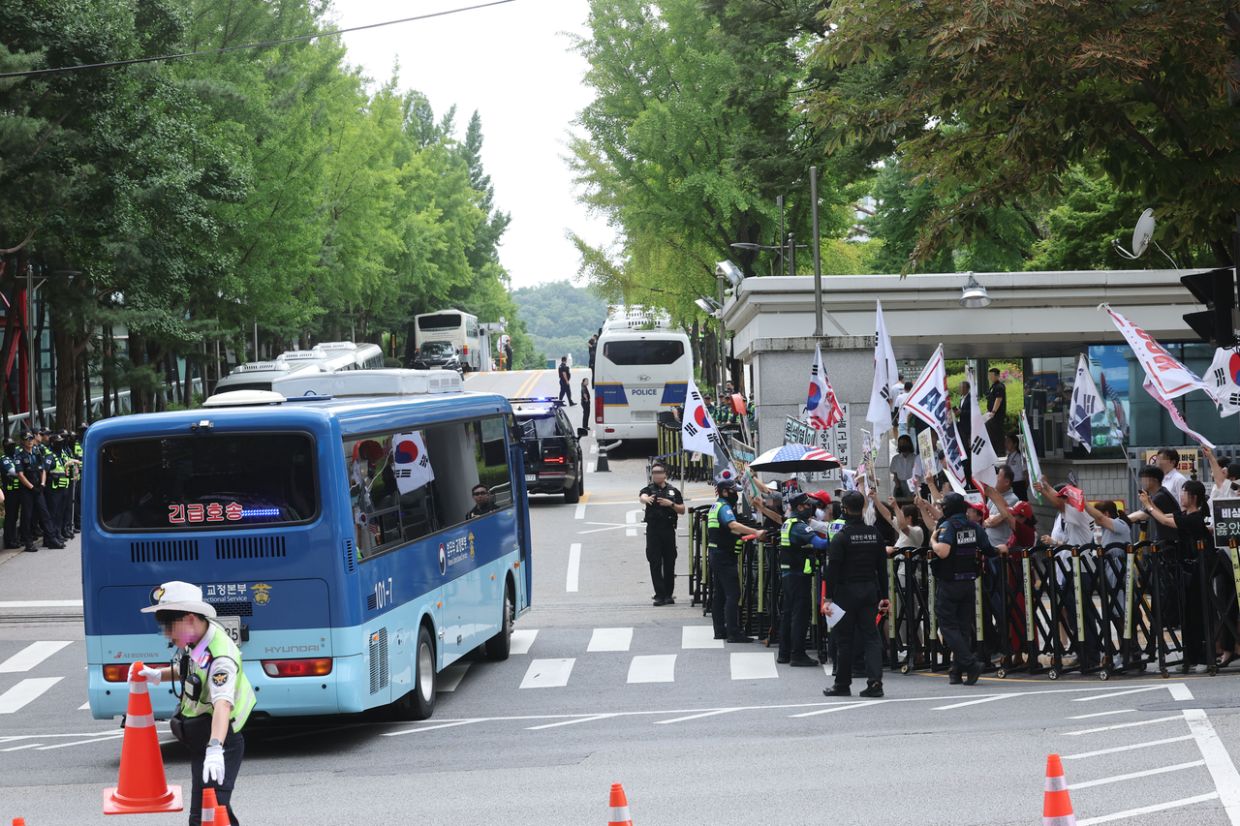
Former South Korean President Yoon Suk Yeol received a two-year prison sentence on Monday after the Seoul Central District Court found him guilty of violating the Political Funds Act by accepting unpaid polling services during his 2022 presidential campaign. The conviction centred on 14 opinion surveys valued at 27.92 million won (approximately $18,600) that were provided by political broker Myung Tae-kyun without proper disclosure or compensation.
The court's decision represents a significant moment in South Korean politics, marking one of the few instances where a former sitting president has been convicted and imprisoned on campaign-finance charges. Judge Lee Jin-gwan emphasized the critical role that opinion polls play in shaping electoral outcomes, describing the provision of undisclosed survey services as a direct threat to democratic integrity. The ruling underscores growing concerns across democracies about the potential for wealthy or well-connected individuals to gain unfair advantages through informal arrangements that circumvent campaign finance regulations.
Yoon's conviction specifically involved evidence that he had worked in concert with his wife, former First Lady Kim Keon Hee, to receive the polling services from Myung. The court determined that Kim had authorized Myung to control the timing, content, methodology, and publication of the surveys, while Yoon was aware of and implicitly approved this arrangement. This finding of a "successive and tacit agreement" among the three parties formed the legal foundation for establishing the violation, even though prosecutors initially sought to prove a more direct and explicit conspiracy.
A crucial element of the case involved allegations of a quid pro quo arrangement: prosecutors argued that Yoon promised to secure the People Power Party's presidential nomination for former lawmaker Kim Young-sun in exchange for the free polling services. The court found sufficient evidence that Yoon did indeed make such a promise to Myung and subsequently exercised influence over the party's nomination process through Chang Je-won, who was chief of staff to the president-elect. However, the court noted that proving this exchange was not strictly necessary to establish a Political Funds Act violation—the mere provision of undisclosed campaign services constituted the offense.
Myung Tae-kyun, the political broker at the centre of the scandal, received an 18-month prison sentence and was taken into custody immediately following the verdict. His role as an intermediary between Yoon and the polling services highlights the opacity that can characterize informal political networks in any competitive electoral system. The case reveals how individuals operating outside formal party structures can gain significant influence over political processes, particularly when they command resources—in this instance, access to professional polling data—that candidates desperately need.
The broader political context matters significantly here. Opinion polling has become an indispensable tool in modern campaigns, shaping candidate strategy, message development, and resource allocation. Professional polling services typically command substantial fees, making free or subsidized access a valuable in-kind contribution. The court's reasoning suggests that by providing these services without proper reporting, Myung was effectively making an undisclosed campaign contribution that gave Yoon a competitive advantage while simultaneously concealing the source and nature of the benefit.
The prosecution's initial case was substantially broader than what the court ultimately convicted on. Prosecutors had charged that Yoon and Kim received 58 free surveys worth more than 270 million won between June 2021 and March 2022. The court's decision to convict only on 14 of these surveys, valued at 27.92 million won, suggests that judges found the evidence compelling for only a portion of the alleged misconduct. This more limited finding may indicate that some of the surveys fell outside the legal definition of campaign contributions or that the evidence of their provision was less conclusive.
A particularly intriguing aspect of the case involves the divergent treatment of Kim Keon Hee's separate trial on identical charges. Despite being the individual who directly authorized Myung's polling activities according to the court's own findings in Yoon's case, Kim was acquitted at both trial and appellate levels. The lower courts in her case concluded that prosecutors failed to demonstrate she received a quantifiable financial benefit or that the surveys were provided specifically in return for Kim Young-sun's nomination. This discrepancy between the courts' findings regarding her role in Yoon's case and their conclusions about her liability in her own case creates a puzzling legal situation.
The Supreme Court is expected to deliver its final judgment in Kim Keon Hee's case on Thursday, which could potentially clarify or reconcile these seemingly contradictory rulings. Should the Supreme Court uphold her acquittal, it would create an unusual outcome where the former First Lady escapes conviction despite the trial court finding her responsible for authorizing the very arrangements that secured her husband's conviction. Conversely, if the Supreme Court reverses and convicts her, it would suggest that being the decision-maker in the illegal arrangement carries greater culpability than accepting its benefits.
For regional observers, the Yoon case provides instructive lessons about the vulnerabilities of campaign finance systems, even in mature democracies like South Korea. The willingness of the judiciary to investigate, charge, and convict a sitting president—albeit after he left office—demonstrates institutional resilience, yet the gap between the prosecution's allegations and the court's convictions also highlights how difficult it can be to prove complex corruption cases involving implicit agreements and informal networks. The case reveals how political brokers can operate in grey areas, leveraging access and resources to influence outcomes without clear paper trails or explicit contracts.
The judgment arrives amid broader political turbulence in South Korea, where questions about presidential accountability have dominated discourse. Yoon's conviction adds to a pattern of former and sitting leaders facing legal jeopardy, raising questions about whether such outcomes reflect genuine rule-of-law enforcement or have become weaponized for partisan advantage. For Southeast Asian democracies grappling with their own campaign finance challenges, the Yoon case illustrates both the importance of robust regulations and the complications that arise when enforcing them against powerful political figures.

