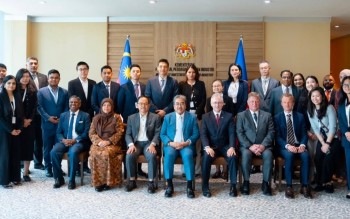
A substantial European business delegation wrapped up a three-day engagement with Malaysian government officials, signalling intensifying momentum in economic cooperation between Europe and Malaysia. The EU-ASEAN Business Council (EU-ABC) coordinated the visit, which brought together more than 25 European companies and over 70 delegates for a structured dialogue aimed at clarifying policy direction, understanding regulatory frameworks and demonstrating investor confidence in Malaysia's reform trajectory. The timing of the mission underscores Europe's growing strategic interest in Southeast Asia's largest economy amid shifting global trade patterns and the region's pivotal role in supply chain diversification.
Chris Humphrey, executive director of the EU-ABC, characterised the engagement as extraordinarily constructive, with European business representatives receiving substantive briefings from senior Malaysian policymakers across multiple economic portfolios. The delegation's initial meetings with Bank Negara Malaysia Governor Datuk Seri Abdul Rasheed Ghaffour, Investment, Trade and Industry Minister Datuk Seri Johari Abdul Ghani and Economy Minister Akmal Nasrullah Mohd Nasir focused on clarifying details of Malaysia's ongoing reform packages and securing assurances regarding the government's commitment to sustainability and digital modernisation. These discussions addressed circular economy frameworks and developmental initiatives that have become central to European corporate strategy in emerging markets.
Subsequent engagement with the Finance Ministry elevated the conversation to macroeconomic considerations, exploring taxation structures, government procurement mechanisms and the broader investment climate. For European enterprises evaluating long-term commitment to Malaysia, such clarity on fiscal and commercial frameworks directly influences capital allocation decisions. The overwhelmingly positive feedback from Humphrey suggests that Malaysian authorities have successfully conveyed both stability and openness to foreign participation, essential messaging in a competitive regional environment where businesses evaluate locations across multiple Southeast Asian jurisdictions simultaneously.
The delegation's broader agenda encompasses sectors critical to Malaysia's economic future. Natural Resources and Environmental Sustainability Minister Datuk Arthur Joseph Kurup and Energy Transition and Water Transformation Secretary-General Datuk Seri Mad Zaidi Mohd Karli engaged the Europeans on climate-related policy, positioning Malaysia as increasingly aligned with global decarbonisation imperatives that shape European investment criteria. Planned meetings with the Health, Agriculture, Digital and Tourism ministries signal European interest in diversifying engagement beyond traditional manufacturing into knowledge-intensive and service-oriented sectors that offer higher value-add and employment opportunities.
Customs modernisation emerged as a concrete operational priority, with the delegation addressing both procedural efficiency and combating illicit trade. Malaysia's battle against tobacco smuggling resonates with European regulatory concerns, suggesting that European businesses see mutual benefit in strengthening enforcement architecture. Digital customs systems and expedited clearance procedures directly reduce transaction costs and enhance competitiveness for Malaysian exporters accessing European markets, thus creating convergent interests between government, domestic industry and foreign investors.
Healthcare sector engagement reflects calculated European positioning in Malaysia's expanding medical economy. As the nation's healthcare infrastructure develops and demand for advanced medicines and medical technologies grows, European pharmaceutical and medical device manufacturers see genuine commercial opportunity. Humphrey's reference to innovative financing mechanisms indicates that discussions extend beyond simple commercial transactions to exploring partnership models that address Malaysia's developmental needs while creating sustainable revenue streams for European enterprises.
Underpinning these varied sectoral discussions lies the Malaysia-EU Free Trade Agreement, arguably the most consequential outcome of current engagement. The agreement targets finalisation by 2027, with four rounds of negotiations already completed and a fifth round scheduled for September 21-25 in Brussels. Humphrey's confidence that sufficient momentum exists to conclude the pact by mid-2026 reflects genuine optimism about convergence on outstanding issues. For Malaysia, an FTA delivers preferential market access for key export categories, potential investment commitments and alignment with evolving European standards; for Europe, the agreement secures supply chain partnerships and counters competing strategic interests in the region.
Malaysia's economic fundamentals provide rational foundation for European enthusiasm. The nation ranks among Europe's five largest trading partners, with bilateral goods trade reaching €48.9 billion in 2025, comprising €30.3 billion of Malaysian exports and €18.6 billion of EU exports to Malaysia. European accumulated investment stock in Malaysia stands at €33.1 billion as of 2024, reflecting decades of business presence and confidence. These figures demonstrate that Malaysia-EU economic integration is neither nascent nor speculative but rather mature and expanding, with both partners seeking to deepen institutional frameworks and enlarge transaction volumes.
Malaysia's geographic positioning, infrastructure quality, skilled workforce availability and natural resource endowments remain persistent competitive advantages in attracting European capital. However, the nation faces intensifying competition from other Southeast Asian jurisdictions and must continually demonstrate that its policy environment, talent development and institutional stability justify investment allocation over alternative locations. This week's delegation visit represents Malaysian policymakers' recognition that foreign investor confidence requires sustained, transparent engagement and willingness to address practical concerns affecting business operations.
The European delegation's comprehensive agenda and senior government responsiveness illustrate how contemporary economic statecraft operates through structured business-to-government dialogue. Rather than relying solely on diplomatic channels or trade organisations, major trading blocs now deploy business delegations to signal commitment, gather intelligence and test policy receptivity. Malaysia's reception of the EU-ABC delegation sends clear signals to European capitals and corporate headquarters that Malaysia remains open for partnership and serious about accelerating economic transformation.
Looking forward, the success of FTA negotiations and the concrete outcomes of this week's meetings will significantly influence the trajectory of Malaysia-EU relations. European investors increasingly integrate environmental, social and governance considerations into location decisions; Malaysia's demonstration of commitment to green transition and reform initiatives during these discussions positions the nation favourably in European strategic calculations. The September negotiations round in Brussels will prove pivotal in determining whether current optimism translates into binding commercial commitments and whether Malaysia can consolidate its position as a preferred investment destination for European capital seeking Southeast Asian exposure.

