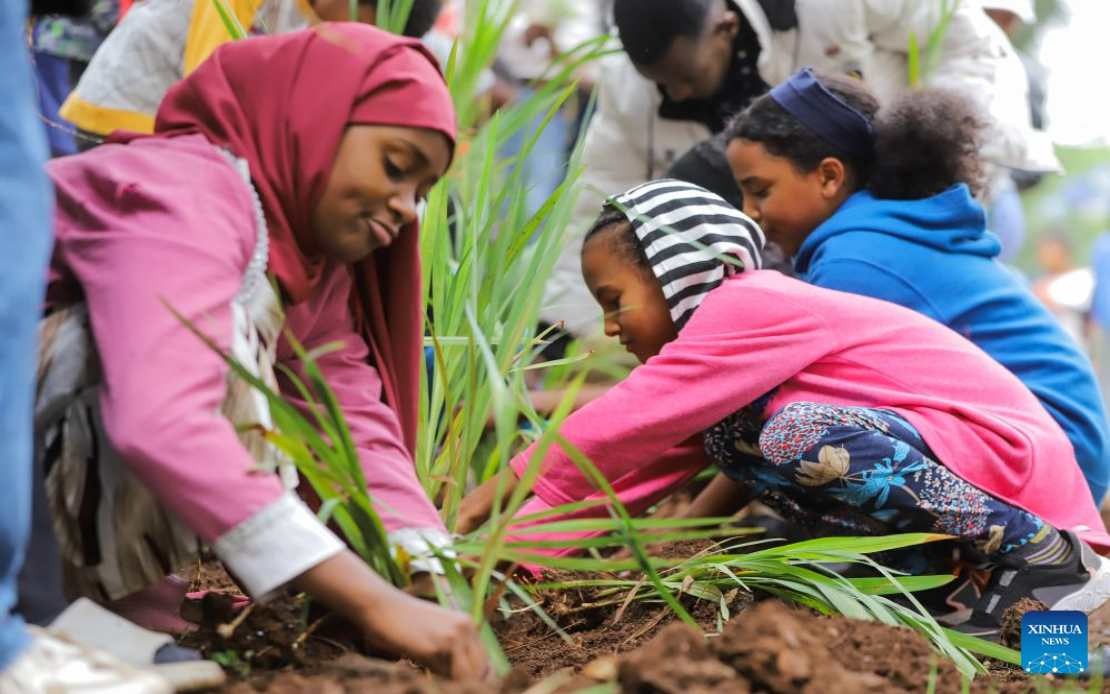
Ethiopia has executed an unprecedented environmental mobilisation, bringing together millions of citizens and expatriates across the country to plant approximately 800 million tree seedlings within the span of a single day. This extraordinary feat, accomplished on Monday in Addis Ababa and beyond, represents a significant escalation in the nation's commitment to reversing environmental degradation and building climate resilience through a coordinated national effort that transcends conventional conservation approaches.
The mass tree-planting exercise forms part of the Green Legacy Initiative, a signature environmental programme established by Prime Minister Abiy Ahmed in 2019. Since its inception nearly a decade ago, this initiative has evolved into Ethiopia's most visible and participatory climate action strategy, embedding environmental restoration into the national consciousness. This year's campaign pushes the initiative further by targeting the planting of more than 8 billion seedlings throughout the entire rainy season, with the Monday event serving as a galvanising focal point that concentrates the nation's efforts and demonstrates collective environmental stewardship.
The scope of participation reveals how deeply the initiative has penetrated Ethiopian society across age groups and professions. Among the millions participating was 13-year-old Edilawit Legesse from the Alembank neighbourhood on Addis Ababa's outskirts, who returned to participate for her third consecutive year. Her presence underscores how the initiative has cultivated environmental consciousness among younger generations, creating a cultural expectation that tree-planting constitutes a patriotic and personal responsibility. Legesse's comment about waiting enthusiastically alongside her family and community members reflects the transformation of environmental action from a top-down government directive into a grassroots movement that citizens actively anticipate and embrace.
Beyond urban participants, the campaign engaged workers across multiple sectors and professions. Hewan Legesse, a nurse from a local hospital in the Entoto Mountain area near the capital, coordinated the participation of 35 healthcare colleagues, each setting personal targets such as planting 10 trees during the day. This sectoral mobilisation demonstrates how the initiative has transcended demographic boundaries, uniting Ethiopians from diverse occupational backgrounds in pursuit of a shared environmental objective. Healthcare workers, government employees, students, farmers, and business people collectively contributed to the staggering daily total.
For Malaysia and other Southeast Asian nations grappling with rapid deforestation and forest degradation, Ethiopia's approach offers instructive lessons in scaling environmental action through political will and national coordination. While individual tree-planting initiatives exist throughout the region, Ethiopia's success in mobilising hundreds of millions of trees in a single coordinated day suggests the transformative potential of designating specific environmental campaigns as national priorities with high-level political endorsement. The symbolic weight of Prime Minister Abiy Ahmed participating personally in the planting, and subsequently communicating the message to millions via social media, reinforces the cultural legitimacy of environmental stewardship.
The ambition underlying the Green Legacy Initiative operates at multiple levels simultaneously. At the immediate level, the programme addresses the urgent reality that Ethiopia has lost substantial forest cover over recent decades due to agriculture, charcoal production, and population expansion. By targeting 50 billion trees planted since 2019, the initiative seeks to restore degraded landscapes and expand forest cover. These efforts directly combat deforestation while simultaneously strengthening the nation's capacity to withstand climate-related shocks such as drought and flooding, which have historically afflicted the Horn of Africa region.
Beyond immediate environmental restoration, the initiative functions as an instrument for realising Ethiopia's broader economic vision. Prime Minister Abiy Ahmed has articulated an aspiration to develop Ethiopia as a green, lower-middle-income economy over the coming years. This framing positions environmental restoration not as a constraint on development but rather as the foundation for sustainable economic advancement. Reforestation creates carbon sequestration benefits, improves watershed protection, supports agricultural productivity through improved soil quality, and generates potential future economic opportunities through sustainable forestry and ecosystem-based livelihoods.
The Green Legacy Initiative also represents a response to Ethiopia's acute vulnerability to climate variability. The nation has experienced severe droughts that have devastated pastoral communities and created humanitarian emergencies. Expanding forest and vegetation cover enhances soil water retention, moderates temperature extremes, and stabilises rainfall patterns across agricultural regions. From this perspective, the Monday campaign represents not merely environmental activism but essential climate adaptation infrastructure that protects the livelihoods and food security of millions of rural Ethiopians dependent on agriculture and pastoralism.
Biodiversity conservation constitutes another dimension of the initiative's significance. Ethiopia occupies a unique position within the East African biogeographic region, hosting numerous endemic species and serving as a crucial habitat for migratory birds and large mammals. Restoring forest cover and rehabilitating degraded ecosystems directly supports biodiversity conservation objectives that benefit not only Ethiopia but also contribute to global conservation goals. Regional ecosystem connectivity, particularly across the East African landscape, depends on landscape-scale restoration efforts that the initiative facilitates.
The programme's emphasis on public participation and community engagement distinguishes it from conventional top-down environmental management approaches. By transforming tree-planting into a national event that involves children, healthcare workers, government employees, and ordinary citizens, the initiative cultivates sustained public commitment to environmental stewardship. This participatory dimension generates social cohesion around a positive, constructive goal while simultaneously building human capital for long-term environmental management. Communities that actively participate in planting trees develop greater investment in their survival and protection.
Prime Minister Abiy Ahmed's communication strategy surrounding the initiative leverages modern platforms including social media to disseminate the message that environmental action represents a defining national characteristic. His statement emphasising "eight years of consistent action" and the capacity of Ethiopians "from all walks of life" to "create a lasting legacy for generations to come" frames environmental restoration as integral to national identity and intergenerational responsibility. This narrative positioning elevates environmental action beyond utilitarian resource management to the level of nation-building and moral legacy.
As Ethiopia works toward surpassing the 50 billion tree target, the initiative's trajectory suggests that sustained, politically-endorsed environmental campaigns can achieve scale previously considered impractical. The progression from the 2019 launch through successive annual campaigns demonstrates that maintaining momentum requires consistent political commitment, resource allocation, and celebration of progress. For developing nations across Southeast Asia and Africa confronting similar deforestation pressures, Ethiopia's experience demonstrates that mobilising national-scale participation around environmental restoration, when coupled with clear targets and high-level political endorsement, can generate transformative results.

