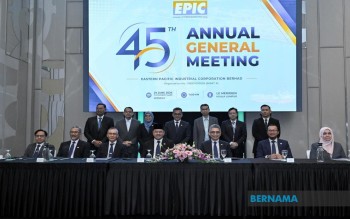
Eastern Pacific Industrial Corp Bhd (EPIC) is charting an ambitious course for the remainder of the decade, setting its sights on annual revenue of RM700 million and net asset value reaching RM1 billion by 2030. The integrated oil and gas solutions provider unveiled these targets during its 45th annual general meeting, unveiling what the company calls its EPIC Strategic Business Plan 2025-2030, a roadmap aimed at accelerating expansion across its core oil and gas operations whilst simultaneously diversifying into port management and renewable energy ventures. The dual-pronged growth strategy reflects management's confidence in Malaysia's energy sector outlook and the broader opportunities emerging across Southeast Asian markets.
According to Group Chief Executive Officer Dr Ts Muhtar Suhaili, the company anticipates revenue will nearly double from its current RM411.9 million baseline, whilst net asset value expands from approximately RM700 million to the RM1 billion milestone. These projections represent a significant acceleration from historical growth patterns, signalling EPIC's intention to transition from a regional operator to a more formidable player capable of capturing larger contracts and pursuing cross-border opportunities. The ambitious targets come at a time when Malaysia's upstream energy sector is experiencing renewed investment momentum, particularly as Petronas and other operators ramp up maintenance and infrastructure modernisation efforts.
The optimism underlying EPIC's forward guidance finds solid footing in the company's recent financial performance. For the year ending December 31, 2025, EPIC recorded net profit of RM20.6 million, a significant jump from RM16.6 million in the preceding financial year, whilst revenue climbed to RM411.9 million from RM403.8 million. These results mark another consecutive year of record earnings, extending a growth trajectory that has gathered momentum since 2022. The consistent upward trend demonstrates that EPIC's business model is resonating with major clients and that the underlying market demand for integrated O&G services remains robust despite periodic industry headwinds.
Several factors contributed to EPIC's stronger 2025 showing, with the acquisition of Rahar Niaga Sdn Bhd representing a significant driver of growth. Beyond this strategic acquisition, the company secured a major Pan Malaysia Maintenance, Commissioning and Modification and Hook-Up and Commissioning contract, a substantial win that expands EPIC's footprint across Malaysia's offshore infrastructure. Additionally, higher volumes of offshore rig arrivals and increased cargo throughput boosted operational contributions, reflecting improving utilisation rates across EPIC's asset base. These developments suggest that the market is recognising EPIC's operational capabilities and willingness to invest in the services ecosystem.
Muhtar exuded confidence regarding EPIC's near-term prospects, declaring that 2026 will represent another record-breaking year for the corporation. This optimism is underpinned by an impressive contract pipeline that already stands at between RM1.3 billion and RM1.5 billion in approved contract value across the oil and gas division. Whilst actual revenue realisation depends on work orders and purchase orders flowing from these contracts, the size of the pipeline provides substantial visibility and reduces execution risk. The geographic spread of these secured contracts is equally noteworthy, with EPIC having expanded its Petronas relationships beyond its traditional Terengganu base into the southern Peninsular Malaysian corridor, encompassing both Pengerang and Melaka, whilst recently achieving market entry into Sabah. This geographic diversification reduces concentration risk and positions EPIC to capture infrastructure opportunities across Malaysia's entire oil and gas ecosystem.
EPIC's strategy extends beyond traditional oil and gas operations into renewable energy, a sector that holds considerable strategic importance for Malaysia's energy transition objectives. The company is actively participating in bidding for a hybrid hydro-solar project at Kenyir, competing alongside its parent company Terengganu Inc. Should EPIC secure this project, it would represent a significant milestone in the company's diversification efforts and position it as a meaningful player in Malaysia's renewable energy development pipeline. This pivot towards cleaner energy production aligns with both national sustainability targets and the long-term structural decline in conventional hydrocarbon demand, providing EPIC with revenue stability as the energy landscape evolves.
Port management represents another dimension of EPIC's diversification strategy, though this segment remains less developed compared to its core O&G operations. As Malaysia's ports continue to play a critical role in regional trade and as cargo volumes fluctuate with global economic conditions, port-related services could provide EPIC with counter-cyclical revenue streams. The combination of O&G, port management, and renewable energy creates a portfolio that can navigate different market cycles, insulating the company from singular dependence on volatile hydrocarbon prices or maintenance cycles.
A particularly significant development occurred in February when EPIC, through its subsidiary EPIC OG Sdn Bhd, entered into a collaboration agreement with Begas Energy Sdn Bhd to provide project management services for a Terminal Turnaround, Maintenance and Modification contract in Sabah. This partnership arrangement demonstrates EPIC's capacity to forge alliances with complementary service providers, expanding its reach without necessarily bearing full capital requirements. The Sabah initiative strengthens EPIC's presence in Malaysian Borneo, a region of growing strategic importance as operators develop new fields and maintain existing infrastructure in increasingly challenging offshore environments.
Beyond Malaysia's borders, EPIC's board has mandated management to pursue expansion into neighbouring Asian markets as part of its comprehensive 2030 strategy. This regional expansion mandate reflects recognition that whilst Malaysia's energy sector remains central to EPIC's operations, the company possesses skills and capabilities transferable to other jurisdictions. Southeast Asia, with its diverse energy endowments and growing infrastructure requirements, presents natural extension markets. However, management is also evaluating opportunities in West Asia, though acknowledging the geopolitical complexities that characterise that region currently. This cautious but ambitious approach suggests EPIC will pursue international growth opportunistically rather than through aggressive market entry that could strain financial resources or management attention.
The five-year targets announced by EPIC should be evaluated within the context of Malaysia's broader energy sector dynamics and the company's positioning within that landscape. With contract visibility extending well into 2026 and a diversified revenue base emerging across O&G, renewables, and port services, EPIC appears well-positioned to execute its growth agenda. The company's track record of consistent profit growth, combined with management's demonstrated ability to secure marquee contracts from Petronas and other major operators, suggests that the RM700 million revenue and RM1 billion NAV targets are achievable rather than aspirational. For Malaysian investors monitoring the nation's energy sector, EPIC's strategic positioning and execution capabilities merit close observation as the company navigates the energy transition and regional opportunities that lie ahead.

