England's World Cup campaign has taken an unexpected turn after manager Thomas Tuchel's squad claimed a nervy 2-1 comeback victory over DR Congo on Wednesday in the round of 32, though the performance will do little to silence growing concerns about their defensive vulnerability in the tournament. What began as a promising campaign—highlighted by a dominant 4-0 opening victory against Croatia—has progressively deteriorated, with a goalless draw against Ghana and an unconvincing 2-0 win over Panama exposing structural weaknesses that Tuchel will need to urgently address as the competition moves into its more demanding knockout phases.
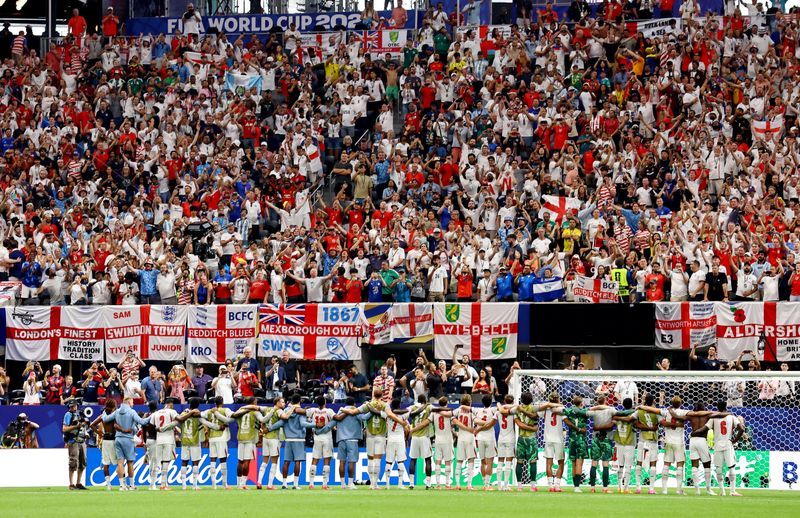
The three-time World Cup champions looked set for potential embarrassment when DR Congo's Brian Cipenga struck within the opening ten minutes at Atlanta Stadium, handing the underdogs an unexpected lead that completely upended England's tournament narrative. For the first time, England found themselves trailing in this World Cup, and more alarmingly, they possessed a grim historical precedent—having never won a World Cup match after going behind at halftime. The psychological weight of that deficit became visibly apparent among the travelling English support, with cameras capturing the anxiety etched across supporters' faces as they contemplated their side's elimination against an opponent ranked significantly lower in the global football hierarchy.
DR Congo's defensive organization proved far more formidable than pre-match assessments had suggested, with goalkeeper Lionel Mpasi producing a series of commanding performances to keep England at bay. The Congolese side's commitment to suffocating England's attacks created a claustrophobic atmosphere inside the stadium, where every counterattack carried genuine danger and every missed opportunity for the home side seemed to amplify the tension exponentially. Yoane Wissa came perilously close to extending the lead when he struck the post shortly before halftime, while Harry Kane's frustrated appeals for a penalty shortly after went unheeded, forcing England off the pitch at the interval facing the very real possibility of a historic upset.
Tuchel's tactical adjustments in the second half proved instrumental in shifting the momentum, with the German manager gradually implementing a more direct approach while introducing fresh attacking impetus. The repositioning of Declan Rice to right back and the introduction of midfielder Eberechi Eze marked visible attempts to generate width and create additional attacking opportunities, with England finally beginning to impose their quality and dominance on a tiring Congolese defense. Jude Bellingham repeatedly came close to breaking the deadlock with his intelligent movement and heading ability, forcing Mpasi into a succession of excellent saves that kept DR Congo's remarkable run alive despite their team being comprehensively outplayed in the second half.
Kane's equalizer in the 75th minute arrived as a glancing header that brushed past Mpasi's fingertips, serving as the crucial breakthrough that released months of accumulated tension within the stadium. The England captain's 83rd international goal represented his first of this tournament and proved sufficiently decisive to shift the entire dynamic of the encounter, with his follow-up strike eleven minutes later securing the two-goal margin necessary to avoid a penalty shootout that would have tested English nerves even further. The 2-1 victory marked England's first World Cup comeback win since their quarter-final triumph over Cameroon in 1990, a remarkable coincidence that occurred exactly 36 years to the day after that previous successful comeback.
Post-match comments from Tuchel revealed his awareness of both the crisis that had unfolded and the resilience required to navigate it, with the manager emphasizing the importance of maintaining belief and composure when circumstances become difficult. His observations about team spirit and commitment reflected a pragmatic acceptance that knockout football demands different qualities than the group stage had required, with grinding outcomes replacing the more expansive attacking displays that characterize the tournament's earlier rounds. Kane similarly acknowledged that the Mexico encounter would present entirely different challenges, requiring England to withstand sustained attacking pressure rather than simply attempting to break down a defensive structure.
The path forward presents England with complications that extend beyond conventional tactical considerations. Mexico City's famous Azteca Stadium sits more than 2,200 meters above sea level, creating atmospheric conditions that pose genuine physiological challenges for teams accustomed to sea-level environments. The combination of reduced oxygen levels and the peculiar aerodynamic properties of the ball at altitude—which travels faster through thinner air—represents a quantifiable disadvantage for English players whose training regimens have been optimized for standard atmospheric conditions. After the emotional and tactical exhaustion of battling through a suffocating afternoon in Atlanta, Tuchel's squad now faces the additional burden of physical adaptation at Mexico City's elevation.
The defensive deficiencies that plagued England throughout the group stage and remained evident against DR Congo suggest that the Mexico encounter will present a fundamentally different examination of their World Cup credentials. Mexico's attacking prowess and the home advantage provided by the Azteca's intimidating atmosphere could well prove a more severe test than the defensive resilience required against DR Congo, particularly given England's demonstrated vulnerability to organized counterattacking football. The injury concerns that have undermined England's defensive solidity throughout the tournament remain unresolved, forcing Tuchel to continue deploying a backline that lacks the cohesion and familiarity necessary to confidently manage Mexico's dynamic forward play.
Entering the knockout stage with significant defensive concerns and questions about tactical flexibility, England will need to demonstrate marked improvement against Mexico to maintain realistic prospects of a deep tournament run. Tuchel's substitutions and second-half adjustments against DR Congo showed tactical acumen, yet the overall quality of performance suggests England remains several levels below the world's elite sides despite their considerable individual talent. The manager's ability to transform defensive vulnerabilities into organizational strengths, combined with the team's demonstrated capacity to recover from adverse circumstances, will ultimately determine whether this World Cup campaign culminates in redemption or regret.

