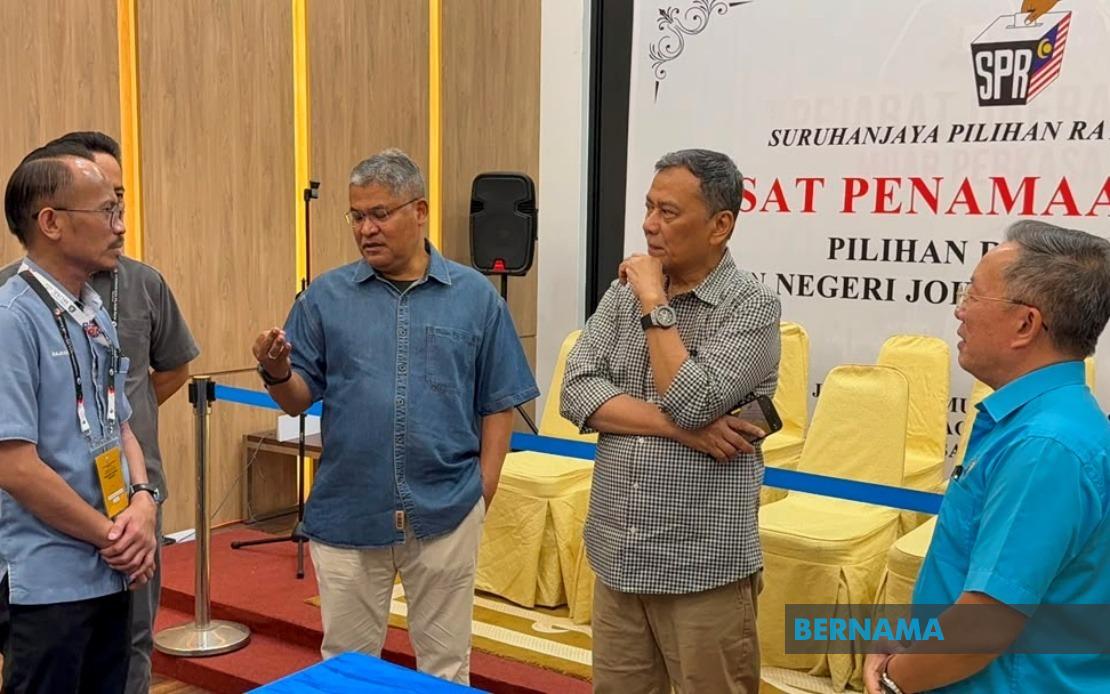
The Election Commission has wrapped up its final arrangements to guarantee that tomorrow's nomination proceedings for the Johor state election will proceed without disruption. Officials across the state capital confirmed yesterday that both logistical and technical preparations have reached completion, with returning officers at key nomination centres declaring full readiness to facilitate the process.
In visits to several Candidate Nomination Centre locations throughout Johor Bahru, comprehensive final preparations are underway, though the work remaining consists largely of technical finishing touches being executed by commission personnel. The Perling state constituency nomination centre, housed at Dewan Jubli Intan Hall, has successfully completed its premises layout and conducted final simulation exercises involving all participating agencies. This approach, involving coordination between multiple organisations before the actual event, represents standard practice in ensuring complex electoral procedures unfold without confusion or delays.
Nazatul Shima Mohamad, the returning officer responsible for the Perling centre, conveyed confidence that all stakeholders have demonstrated genuine commitment to facilitating smooth operations. She emphasised that candidates and their representatives should arrive early to allow adequate time for processing, and stressed the importance of bringing all mandated documentation including nomination deposits. The message underscores the commission's preference for orderly procedures rather than last-minute rushes that could create bottlenecks or administrative errors.
At the Kota Iskandar nomination centre, located within the Main Hall of the Iskandar Puteri City Council premises at Medini, officials similarly confirmed their state of readiness. The returning officer Shahrulizam Abdul Rashid highlighted that extensive coordination with police forces has been implemented to manage the anticipated crowds of party supporters who typically converge on nomination centres. This collaborative security arrangement reflects the commission's recognition that nomination day, while fundamentally an administrative process, often becomes a focal point for political mobilisation and public display of party strength.
The logistical measures established at the Kota Iskandar centre provide insight into how the commission intends to balance democratic participation with crowd management across all sites. Road closures surrounding the nomination centre have been planned, supporters will face a 50-metre restriction from the actual venue, temporary tents have been erected outside the main hall for party supporters, and physical barriers will separate rival party groups. These arrangements acknowledge that while supporters have the right to gather and demonstrate, their presence must be carefully orchestrated to prevent confrontations and maintain an environment conducive to the actual nomination process.
Public advisories have been issued encouraging supporters and observers to exercise restraint and avoid provocative behaviour during the nomination proceedings. The commission's messaging emphasises that while enthusiasm for candidates is natural and expected, the event's primary purpose remains the orderly receipt of nominations rather than a venue for inter-party contestation. This framing reflects lessons learned from previous Malaysian elections regarding the importance of preventive communication in managing crowd dynamics.
Nomination centres will operate from 9 to 10 in the morning, with all 56 locations across Johor simultaneously receiving nomination submissions. Following the close of the nomination window, returning officers will make the formal announcement identifying which candidates meet all eligibility requirements and have been accepted to contest. This compressed timeline, concentrated within a single hour across the entire state, requires precise coordination to prevent candidates from being unable to find their designated centre or experiencing delays that might prevent timely submission.
The electoral register for this election encompasses 2,727,926 registered voters spread across Johor's constituencies. This population comprises 2,703,175 ordinary citizens eligible to vote, alongside 12,041 military personnel and their spouses, and 12,710 police personnel and their spouses. The inclusion of these separate categories reflects Malaysia's practice of providing voting opportunities to uniformed personnel while maintaining some structural separation within the electoral framework.
The broader timeline for this election follows the dissolution of the Johor State Legislative Assembly on 1 June. The commission designated nomination day for 26 June, early voting for 7 July, and general polling day for 11 July, compressing the campaign period into a relatively brief window. This schedule allows candidates approximately two weeks to campaign after nomination day, a timeframe that has become standard in recent Malaysian state elections and contrasts with longer campaign periods in earlier decades.
For Johor's political landscape, the election represents an opportunity for the state government to renew its mandate or for opposition parties to challenge incumbent dominance. The scale of the electorate and the number of seats contested make Johor elections among the more significant state polls in Malaysia, carrying implications for federal political alignments given Johor's status as a major population and economic centre. The smooth execution of nomination procedures therefore carries importance beyond mere administrative competence, helping establish the tone for the campaign that follows.
The commission's emphasis on readiness and inter-agency cooperation reflects its institutional priority of ensuring that electoral procedures, regardless of their political consequences, are conducted in an orderly and transparent manner. Public confidence in the integrity of electoral administration depends substantially on whether the technical aspects of voting, nomination, and candidate acceptance are executed without apparent difficulty or favouritism. By confirming that all 56 centres are fully prepared and that security and logistical arrangements are in place, the commission has sought to project an image of professional administration capable of managing the complexities of simultaneous nomination procedures across a large state.

