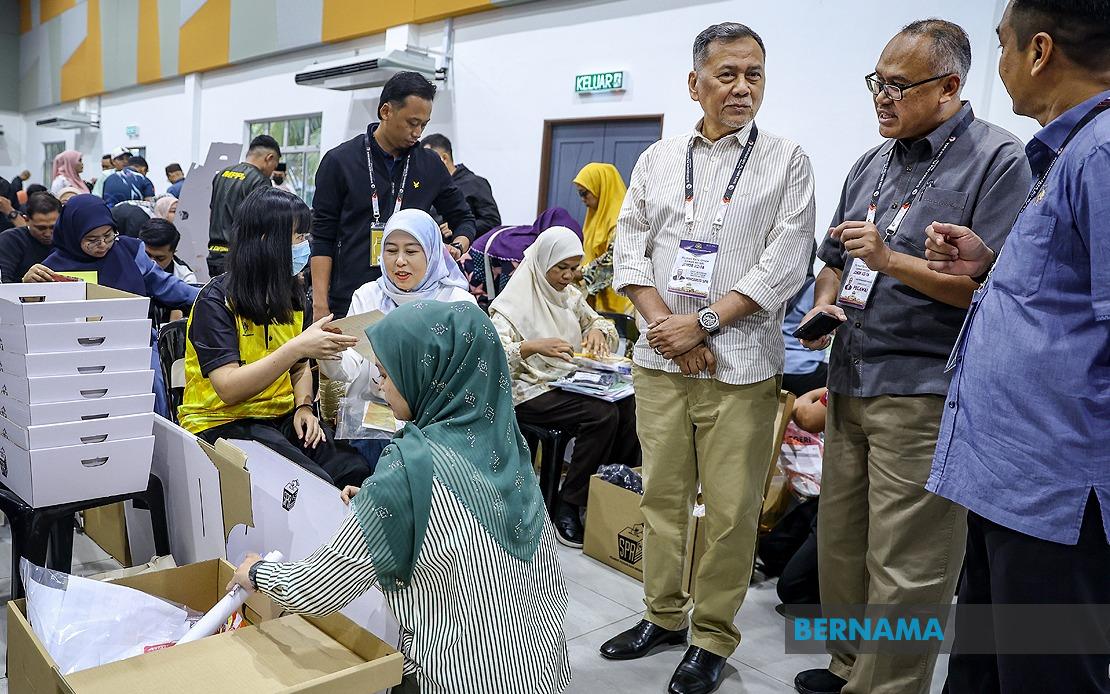
The Election Commission is putting the finishing touches on preparations for the 16th Johor State Election scheduled to begin tomorrow, with officials conducting last-minute inspections at polling and vote-counting centres throughout the state. The meticulous groundwork reflects the logistical complexity of running elections in one of Malaysia's largest and most geographically diverse states, where everything from urban constituencies to remote island communities must be accommodated within a single polling day.
Election Commission Chairman Datuk Seri Ramlan Harun confirmed that comprehensive verification of ballot boxes and election equipment across all 56 state seats has been successfully completed, confirming that every constituency is adequately stocked and prepared for voting. This verification process represents one of the election administration's most vital safeguards, designed to prevent irregularities and maintain public confidence in the democratic process. The chairman emphasised that Returning Officers at all 56 centres have substantially finished their preparatory work, though final touch-ups were still underway in some locations during the day of his inspection.
With approximately 2.7 million registered voters expected to participate in fulfilling their civic duty, the Election Commission faces the substantial challenge of orchestrating voting across multiple polling streams and locations. The sheer voter volume necessitates careful management of crowd flow and personnel deployment, which is why the commission has been particularly attentive to accessibility and comfort considerations. The chairman's inspection visits to the Sultan Ibrahim Jubilee Hall in Pontian and the Permas Multipurpose Hall in Kukup allowed him to verify on-the-ground preparations and address any emerging concerns before the official polling period commenced.
Election officials are urging voters to arrive during their allocated time slots to prevent bottlenecks at polling centres, a practical measure that becomes increasingly important when millions of people must cast votes within a compressed timeframe. Voters have been reminded to bring their identity cards and follow instructions given by election workers, whose expertise in managing the voting process is crucial to maintaining order and ensuring each ballot is cast according to electoral law. These guidelines, while straightforward, reflect lessons learned from past elections about optimising the voting experience for all participants.
At Sekolah Kebangsaan Bukit Mutiara in Johor Bahru, election workers were actively engaged in the final stages of conversion, transforming ordinary school classrooms into functional polling streams. The polling centre supervisor for the Puteri Wangsa constituency, Mohd Rasib Ngadiman, noted that twelve classroom spaces would be reconfigured to accommodate voters, supported by a team of 74 election personnel and security provided by a dozen police officers. Beyond the standard infrastructure, the Election Commission has ensured that wheelchairs are available for elderly voters and individuals with disabilities, signalling an institutional commitment to inclusive participation regardless of physical circumstances.
Similar preparation scenes unfolded across Johor's major population centres. In Kluang, officials at Sekolah Kebangsaan Kampong Melayu were setting up five separate polling streams to process roughly 3,000 voters in the Mahkota constituency, with some 30 personnel assigned to that single location. In Batu Pahat's Yong Peng district, preparations at Sekolah Menengah Kebangsaan Dato' Seth specifically prioritised creating comfortable and accessible facilities tailored to senior citizens, first-time young voters, and people living with disabilities—a multifaceted approach reflecting the diverse demographic composition of modern Malaysian constituencies.
Perhaps no preparation challenge proved more complex than arrangements for island constituencies. In Mersing, election officials faced the considerable logistical hurdle of transporting ballot boxes and materials to four separate islands—Pulau Aur, Pulau Pemanggil, Pulau Sibu, and Pulau Tinggi—that comprise the Tenggaroh state constituency. This operation required approximately 50 personnel operating from the Mersing Jetty, accompanied by security escorts from both the Marine Police Force and district police headquarters. The extraordinary measures required to ensure these island communities could participate fully in the election underscore the geographic complexity of running democratic exercises across diverse Malaysian territories.
The competitive field for the Johor election reflects the increasingly fragmented Malaysian political landscape, with a total of 172 candidates contesting across the 56 state seats. The two major coalitions—Pakatan Harapan and Barisan Nasional—have committed resources across all constituencies, signalling their determination to shape the outcome. Perikatan Nasional brings substantial representation with 33 candidates, while newer entrants including Parti Bersama Malaysia, MUDA, the Malaysian Orang Asli Party, and the Socialist Party of Malaysia round out the roster, alongside six independent candidates seeking voter support.
The diversity of contesting parties reflects broader shifts in Malaysian electoral politics, where the traditional two-coalition framework has been increasingly challenged by emerging movements and idealogical alternatives. This fragmentation means voters face more choices than in previous elections, potentially complicating vote distribution across constituencies. For the Election Commission, managing such a competitive field requires heightened vigilance in ensuring fairness, transparency, and adherence to electoral regulations across all polling centres simultaneously.
The systematic nature of these preparations—from ballot box verification to accessibility accommodations to security arrangements for island communities—demonstrates that Malaysia's electoral administration has matured into a sophisticated operation capable of handling considerable logistical demands. Yet the inherent vulnerability of any election lies in the execution phase itself, when millions of individual voting decisions must be facilitated simultaneously across geographically dispersed locations. The Election Commission's confidence in tomorrow's proceedings rests on weeks of planning and the final day's meticulous checks, with success depending ultimately on the coordination of thousands of election workers, security personnel, and poll supervisors executing their roles competently across Johor's diverse constituencies.

