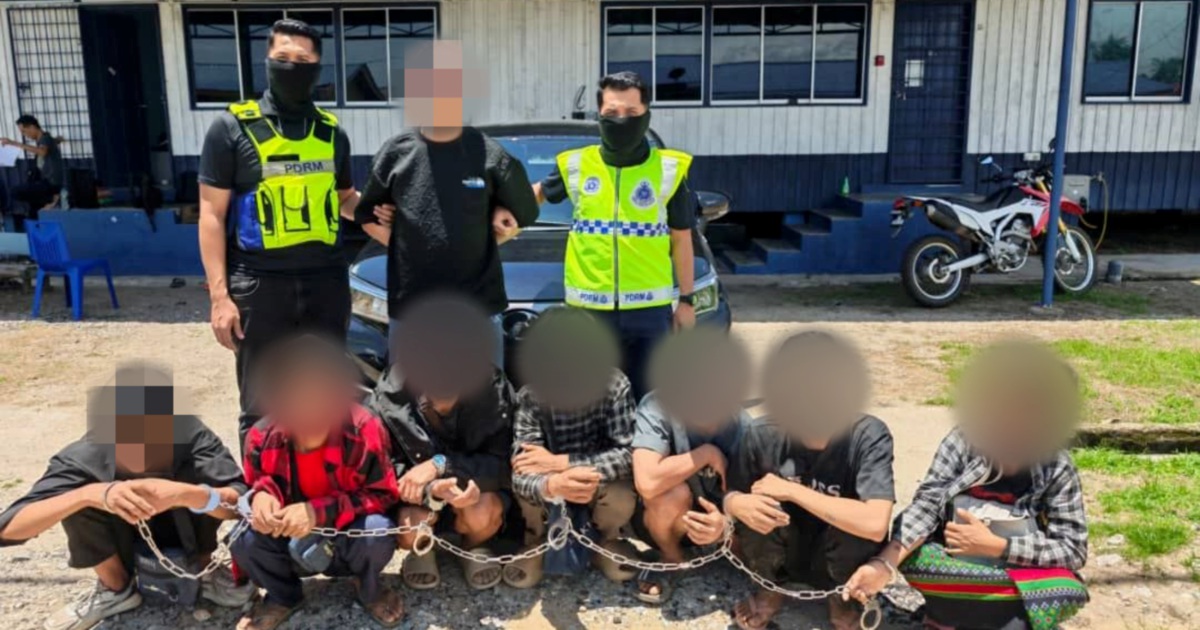
Authorities in Kelantan conducted a significant enforcement operation that resulted in the detention of eight suspects accused of involvement in migrant smuggling activities. The arrests took place in Kota Baru during the early hours of the morning, marking another blow against human trafficking networks operating across the state's porous border regions. Among those apprehended was a Malaysian citizen believed to be instrumental in transporting seven undocumented migrants from Myanmar, signalling the continued involvement of local operatives in cross-border smuggling schemes.
The operation reflects ongoing police efforts to combat the persistent problem of human trafficking in Kelantan, a state that has long served as a transit point for undocumented migrants attempting to reach Malaysia's industrial centres. The eastern seaboard's proximity to Thailand and Myanmar, combined with challenging terrain and sparse border monitoring infrastructure, has made it an attractive corridor for smuggling networks. Each month, numerous enforcement operations result in the detention of foreign nationals and their facilitators, yet the scale of illegal movement suggests that many operations escape detection.
The involvement of a Malaysian national in this particular case underscores a troubling aspect of human trafficking in the region: the domestic collaboration that enables smuggling operations to function effectively. Local operatives provide essential services—vehicle access, route knowledge, coordination with networks—that international trafficking rings depend upon to move migrants through Malaysia. This domestication of the smuggling supply chain means that enforcement efforts must focus not only on border security but also on disrupting the local connective tissue that makes exploitation possible.
The seven Myanmar nationals recovered during the operation face an uncertain future. While victims of trafficking warrant compassionate handling and support services, the Malaysian immigration system typically processes undocumented migrants through enforcement procedures. For those fleeing persecution or poverty in Myanmar, apprehension represents not relief but another setback in their migration journeys. The distinction between trafficked persons and migrant smugglers remains legally and practically blurred in many regional responses, often resulting in migrants being detained and deported rather than assisted.
Kelantan's position as a smuggling hub reflects broader regional dynamics. Myanmar's ongoing political instability, economic collapse, and communal tensions have generated sustained outflows of people seeking safety and employment. Thailand absorbs the largest share of Myanmar migrants, but Malaysia's higher wages and established migrant communities—particularly in manufacturing and construction—create powerful pull factors. This supply-and-demand reality has spawned sophisticated smuggling networks that operate across multiple jurisdictions, adapting their methods as enforcement capabilities improve.
The detection of this particular cell represents only a fragment of the trafficking ecosystem. Intelligence agencies and smuggling researchers estimate that for every operation disrupted, several others proceed undetected. Vehicles move migrants under cover of darkness along secondary roads and forestry tracks; bribes ensure passage at checkpoint; corruption within enforcement agencies creates safe passages for shipments. The eight arrests, while tactically significant, likely represent marginal disruption to networks that move hundreds of migrants monthly through northern and eastern Malaysian states.
Cross-border cooperation remains essential to combating these networks effectively. Kelantan shares frontiers with Thailand and maritime boundaries with southern Thailand and Brunei, creating complex enforcement challenges. Regional intelligence sharing mechanisms, joint patrols, and coordinated prosecution efforts could enhance interdiction capacity. However, capacity constraints, divergent priorities, and occasional diplomatic friction between ASEAN nations limit the effectiveness of collaborative approaches. Thailand focuses primarily on Thai security concerns; Myanmar's state capacities remain severely constrained; and Malaysia must coordinate federal and state-level responses across competing priorities.
The economic dimensions of smuggling merit particular attention. Smugglers charge desperate migrants thousands of ringgit for passage, often capturing substantial portions of workers' expected earnings in the process. This debt-bondage mechanism frequently traps migrants in exploitative employment situations where sub-standard wages, excessive working hours, and hazardous conditions become normalized. The trafficking supply chain thus generates profits at multiple nodes—recruitment in origin countries, transport facilitation, employment placement, and ultimately through the extraction of value from underpaid labour.
Police investigations following the arrests will likely reveal networks extending beyond these eight individuals. Interrogation of detainees typically generates intelligence about upstream suppliers, vehicle owners, document forgers, and employment placement contacts. This investigative dimension provides opportunities to disrupt broader networks and potentially identify corruption within official channels that enables smuggling operations. Such follow-up work, though resource-intensive, can generate deterrent effects that singular arrests cannot achieve.
The implications for Malaysia extend beyond immediate security concerns. The country's status as a destination for undocumented migrants, whether fleeing persecution or pursuing economic opportunity, generates labour market distortions, healthcare system pressures, and social tensions. Yet enforcement-focused responses alone prove insufficient to address root causes. Neighbouring countries' political instability and economic dysfunctions ensure continued migration pressure. Malaysia's regulatory framework for migrant workers remains restrictive in ways that drive people toward undocumented channels and trafficking networks.
Future effectiveness in combating migrant smuggling will require multi-layered responses: strengthened border monitoring and checkpoint controls; dismantling of local smuggling infrastructure; prosecution of facilitators; humanitarian assistance for trafficking survivors; and regional coordination mechanisms. Equally important are upstream interventions in source countries to address instability and economic desperation, and domestic labour market reforms that might legalise and regularise migrant work. Without addressing the structural factors that generate both supply and demand for trafficked migrants, individual enforcement operations, however successful, will remain symbolic victories against entrenched smuggling systems.

