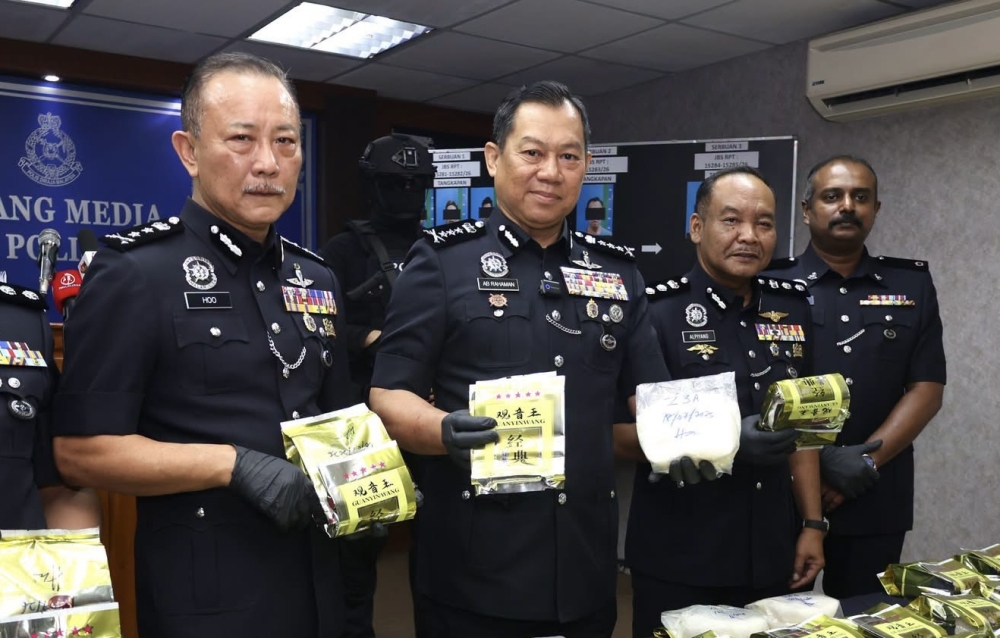
Law enforcement authorities in Johor Bahru have successfully dismantled a synthetic drug distribution network following coordinated raids that resulted in the arrest of eight suspects, including a minor. The operation represents a significant crackdown on organised drug trafficking in the state and underscores the evolving tactics employed by criminal networks to evade detection, particularly their willingness to exploit family members and their assets in the commission of offences.
Among those detained is a 16-year-old youth who allegedly played a pivotal role in the distribution phase of the operation. Investigators discovered that the teenager had been using his grandfather's vehicle without the elderly man's knowledge or consent as a mobile base for transporting and selling synthetic drugs throughout the city. This revelation raises serious concerns about criminal gangs' recruitment strategies targeting young people, who are often viewed as less likely to attract police attention and face reduced penalties under juvenile justice provisions.
The grandfather's car became instrumental to the drug ring's operations, allowing dealers to move merchandise through different locations while minimising their exposure at fixed distribution points. Police records indicate this mobile approach enabled the network to establish a more resilient supply chain, as traditional stationary drug houses are comparatively easier for law enforcement to identify and monitor. The use of family vehicles also suggests a disturbing pattern wherein younger operatives place relatives at risk of criminal liability or unwitting complicity.
Investigations revealed the network had been operating across multiple districts within Johor Bahru, with individual members maintaining distinct roles within the hierarchical structure. Some suspects were identified as primary distributors, whilst others functioned as runners or street-level sellers responsible for direct customer transactions. The syndicate's compartmentalised approach—a hallmark of mature criminal enterprises—made detection more challenging for authorities until the scale of operations warranted intensive surveillance and intelligence gathering.
The synthetic drugs seized during the raids include substances commonly encountered in Malaysian law enforcement operations. These compounds carry significant health risks, particularly for young users whose neurological development remains incomplete. The arrest of a juvenile participant suggests the network was deliberately recruiting minors to lower the risk profile of their operation, a strategy that law enforcement agencies across Southeast Asia have increasingly documented in recent years.
Johor Bahru's status as a major commercial and residential hub bordering Singapore makes it a strategic location for drug trafficking operations. The city's road infrastructure, economic activity, and cross-border connections create natural advantages for criminal networks seeking to distribute products whilst maintaining supply-chain flexibility. The proximity to Singapore, where drug penalties are notoriously severe, means Malaysian territory often serves as a staging ground and distribution centre for substances destined for the island nation's markets.
The involvement of a teenager raises uncomfortable questions about how criminal organisations identify and recruit young operatives. These networks often target vulnerable youth through peer relationships, financial incentives that appeal to economically disadvantaged young people, or coercion through prior involvement in minor offences. The critical intervention point—identifying and diverting at-risk youth before they become entrenched in criminal activity—remains underdeveloped across Malaysian society, with schools, social services, and law enforcement operating in relative isolation from one another.
Authorities have indicated that the investigation remains ongoing, with forensic analysis of seized materials and financial records expected to provide fuller clarity on the network's scope and connections to larger trafficking organisations. Previous operations in Johor have occasionally revealed links between local street-level distribution networks and international trafficking syndicates, suggesting this current dismantled ring may have been part of a broader supply chain extending beyond state boundaries.
The operation demonstrates that police resources dedicated to drug enforcement continue to yield results, though the perpetual emergence of new networks indicates that supply-side enforcement alone cannot fully address the synthetic drug problem. Complementary approaches addressing demand reduction, youth intervention, and international cooperation remain essential components of a comprehensive counter-narcotics strategy. Malaysia's location within Southeast Asia's drug transit routes means sustained vigilance and intelligence-sharing with neighbouring jurisdictions remain critical priorities for public safety officials.
For Malaysian families, this incident serves as a cautionary reminder about the importance of monitoring young people's associations and activities, particularly during formative adolescent years when peer influence reaches its peak. The fact that a grandfather's vehicle became unknowingly implicated in criminal activity underscores how criminal networks exploit family relationships and assets to insulate their operations from risk. Community awareness campaigns highlighting such recruitment tactics may help parents and guardians identify warning signs that might indicate a young person's involvement in illicit activity before consequences become irreversible.

