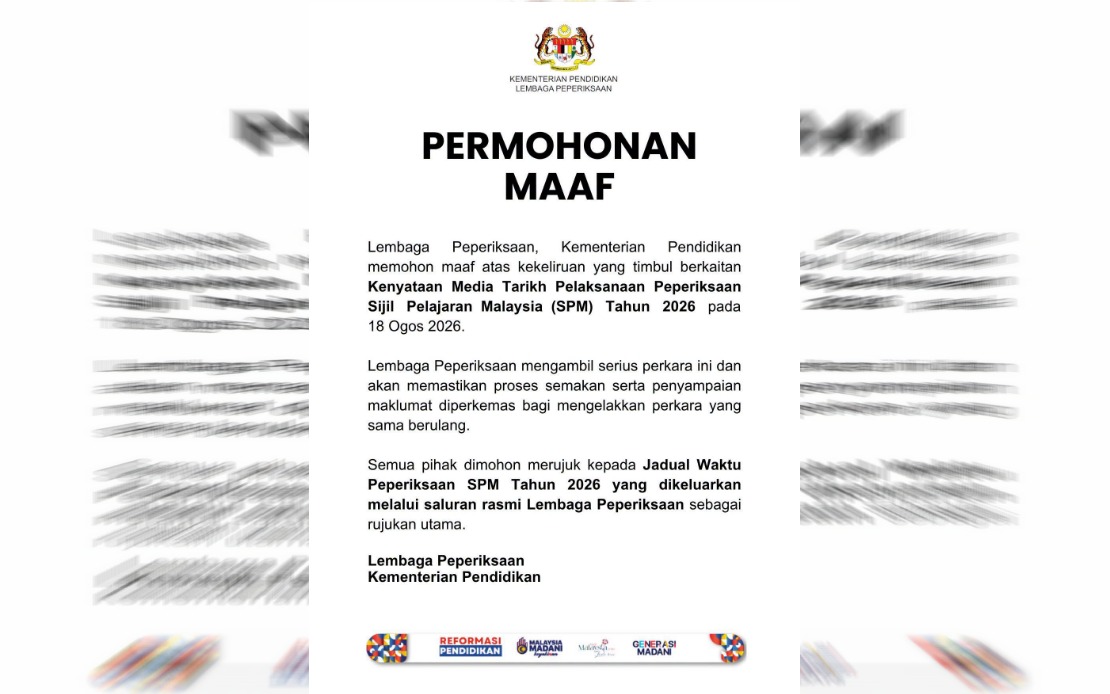
The Examination Board under Malaysia's Ministry of Education has issued a formal apology for the confusion created by conflicting information released regarding the 2026 Sijil Pelajaran Malaysia (SPM) examination schedule. The misstep, disclosed through an official statement on August 19, reflects the kind of administrative mix-up that can unsettle hundreds of thousands of students and their families during critical examination periods. The board acknowledged the seriousness of the matter and pledged to strengthen its internal review mechanisms to ensure such discrepancies do not resurface in future communication campaigns.
Accuracy and timeliness in examination scheduling represent cornerstone responsibilities for education authorities. When conflicting signals emerge regarding when major national assessments will occur, the ripple effects extend far beyond administrative inconvenience. Students and parents rely on precise timelines to structure study routines, arrange travel to examination centres, and plan academic calendars. Schools must coordinate logistics, allocate resources, and prepare physical infrastructure according to confirmed dates. Any muddling of these details generates anxiety and uncertainty at precisely the moments when clarity matters most.
The confusion originated from a press release issued on August 18 that evidently contained inconsistencies or contradictions regarding implementation dates for the 2026 SPM examination. Rather than allow ambiguity to persist, the Examination Board moved quickly to clarify the situation the following day, signalling an institutional commitment to transparency despite the initial stumble. The board explicitly directed all stakeholders—students, parents, educators, school administrators, and the broader public—to reference only the official 2026 SPM Examination Timetable distributed through proper channels as their definitive guide.
This incident underscores the critical importance of streamlined information management within Malaysia's education bureaucracy. The board's commitment to review and refine its information delivery processes suggests an acknowledgement that the current systems may require tightening. In an era when digital communication allows instantaneous distribution of materials, lapses in quality control become more visible and potentially more damaging to institutional credibility. The pledge to prevent recurrence implies concrete steps, though the statement did not specify what procedural changes would be implemented.
The scale of the 2026 SPM examination demonstrates why such administrative precision remains essential. A total of 420,879 candidates have enrolled to sit the examination across 3,334 examination centres distributed nationwide. This staggering number encompasses students from urban centres to remote areas, from well-resourced schools to institutions facing infrastructural constraints. Co-ordinating examinations for nearly half a million students represents a monumental logistical undertaking that depends on crystalline communication and unwavering adherence to announced schedules.
The confirmed examination period runs from November 23 through December 17, 2026, spanning approximately three weeks. This extended window allows the Examination Board to manage candidate flow across thousands of centres without overwhelming any single location. However, maintaining this schedule requires that students, schools, and examination personnel receive and retain consistent information from the outset. Any last-minute revisions or contradictory announcements can disrupt months of careful planning by educational institutions across the country.
For Malaysian students particularly, the SPM examination represents a pivotal moment in their educational journey. Results from these assessments influence university admissions, scholarship eligibility, and career pathway options. The weight of these stakes means that students preparing for 2026 must concentrate on substantive preparation rather than parsing conflicting bureaucratic communications. Parents investing time and resources in their children's examination readiness deserve certainty about fundamental details like testing dates.
The Examination Board's apology, while appropriate, also highlights broader questions about quality assurance mechanisms within Malaysia's education ministry. How did contradictory information reach public channels? What safeguards exist to catch errors before dissemination? Were there coordination failures between different departments or communication teams? Transparent examination of what went wrong could provide valuable insights to other government agencies managing large-scale operations requiring precise public messaging.
Moving forward, the board's emphasis on consolidating information through official channels merits careful attention from all stakeholders. Students and parents should bookmark and regularly consult the authorised 2026 SPM Examination Timetable rather than relying on secondary sources or social media rumours, which often perpetuate outdated or inaccurate information. Schools should designate examination coordinators responsible for tracking official announcements and translating them into clear guidance for their student bodies.
This episode also serves as a reminder that examination systems, while complex and consequential, remain fundamentally human endeavours susceptible to procedural errors. The important measure lies not in whether mistakes occur—they inevitably will in systems of this magnitude—but in how organisations respond. The Examination Board's prompt acknowledgement, apology, and commitment to process improvement demonstrate institutional accountability. Whether these pledges translate into tangible improvements in communication practices will become apparent as the 2026 examination season progresses and subsequent announcements are issued.

