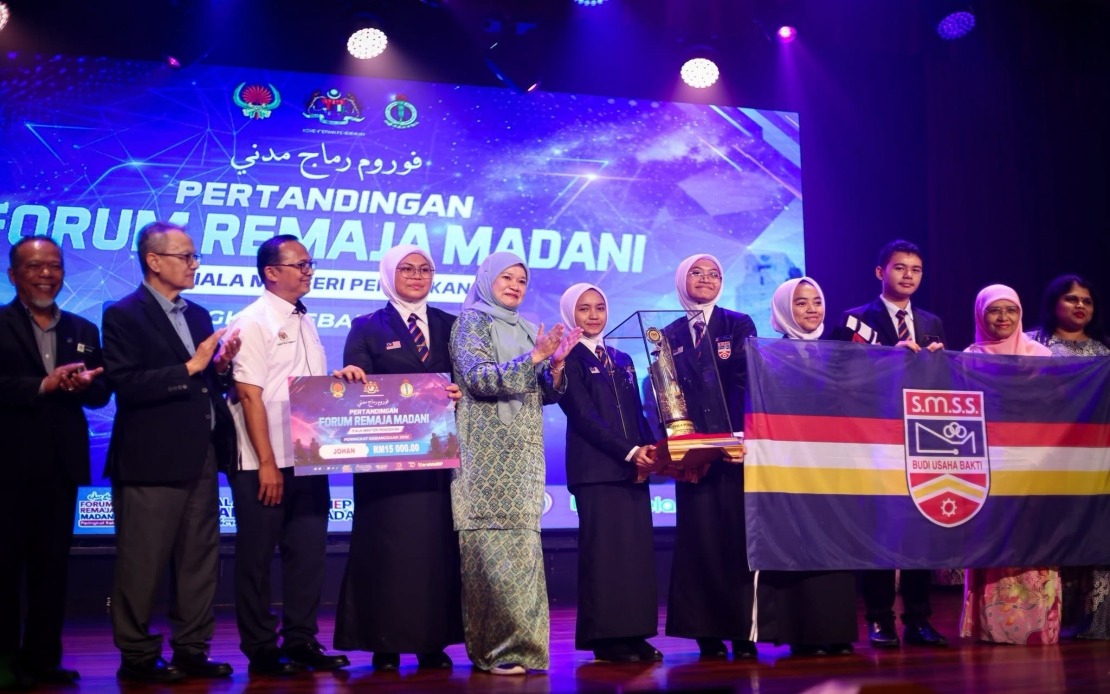
Education Minister Fadhlina Sidek has articulated a vision for character development that moves beyond traditional moral instruction, arguing instead that schools and youth programmes must actively cultivate an environment where young people feel empowered to voice their perspectives with both conviction and courtesy. Speaking following the National MADANI Youth Forum, Fadhlina outlined an educational philosophy that recognises the formative value of debate, disagreement, and intellectual rigour as cornerstones of national development rather than obstacles to social harmony.
The minister's remarks represent a deliberate shift in how Malaysia's education establishment frames character building for its youngest citizens. Rather than positioning moral education as a top-down transmission of values, Fadhlina's approach treats it as a dynamic process where young people learn to synthesise their own positions while remaining cognisant of alternative viewpoints. This model acknowledges that Malaysia's future depends not on citizens who passively accept consensus, but on individuals capable of engaging substantively with complexity and diversity of thought.
At the youth forum, Fadhlina observed participants learning to articulate nuanced arguments, defend their positions through evidence and reasoning, and genuinely consider opposing perspectives without dismissing them outright. These competencies—articulation, critical analysis, and intellectual humility—represent what she considers the genuine substance of character education. The minister framed this as distinctly different from education systems that prioritise compliance or discourage questioning, noting that Malaysia requires a generation comfortable with reasoned disagreement.
Central to Fadhlina's vision is the assertion that government should neither prescribe what young people should think nor attempt to control the substance of their expression. Instead, the role of educators and policymakers becomes clarifying how young people can express themselves effectively and persuasively. This distinction carries significant implications for how schools design debate competitions, student forums, and discussion-based learning environments. It also suggests a recalibration of authority—from educators as gatekeepers of acceptable opinion to educators as facilitators of rigorous thinking.
The minister further connected this framework for youth development to broader national priorities around language preservation and cultural vitality. She argued that the Malay language becomes genuinely strengthened when successive generations adopt it as a tool for expressing their own thoughts rather than merely reproducing established formulations. When young people feel confident using Malay to articulate original arguments, defend positions, and engage in sophisticated discourse, the language demonstrates living relevance beyond ceremonial or administrative functions.
Fadhlina's emphasis on the Malay language within this educational context addresses a particular tension within Malaysia's development trajectory. As English increasingly dominates professional and academic spheres globally, ensuring the vitality of Malay requires demonstrating its capacity to serve as a vehicle for contemporary intellectual expression. By encouraging young people to use Malay for critical thinking and debate, the minister positions language preservation as an active, forward-looking endeavour rather than nostalgic protection of tradition.
The concept of mature nationhood that Fadhlina advanced—framed not as uniformity of opinion but as sophisticated capacity for disagreement—carries substantial weight in Malaysia's political and social context. The country has historically navigated tensions around religious identity, ethnic composition, and competing visions of national development. A population skilled in respectful but firm articulation of differing views, and equally skilled in listening generously to opposition, could represent a meaningful evolution in how Malaysians engage politically and socially.
This educational philosophy also addresses practical governance challenges. When citizens lack vocabulary, confidence, or examples of how to disagree productively, disagreements tend to crystallise into identity-based conflicts or zero-sum competitions. Conversely, when young people grow accustomed to expressing themselves clearly, defending arguments through evidence rather than emotion, and genuinely considering counterarguments, the quality of public discourse improves substantially. This has direct implications for policy debates, community decision-making, and electoral contests.
The minister's framing implicitly critiques approaches to education that treat knowledge transmission as primary and character development as secondary. Instead, she suggests these elements are inseparable—that teaching substantive content without developing the capacity for critical engagement produces neither genuine understanding nor mature citizens. Young people who memorise information without learning to question, contextualise, or defend it remain intellectually vulnerable regardless of how much they have studied.
For educators implementing Fadhlina's vision, significant practical questions emerge around pedagogy and assessment. How should schools design curricula that simultaneously convey essential knowledge and encourage questioning of that knowledge? How can teachers create psychological safety for genuine disagreement while maintaining appropriate boundaries? These operational challenges will determine whether the minister's rhetoric translates into meaningful change in Malaysian classrooms and youth spaces.
The timing of Fadhlina's remarks carries additional significance given Malaysia's position as a relatively young democracy navigating questions about political participation, civil society, and social cohesion. Young Malaysians entering workforce and civic life will inherit complex challenges requiring creative problem-solving, coalition-building across differences, and willingness to propose novel solutions. An educational system that nurtures these capacities serves not merely individual development but national resilience.
Looking forward, Fadhlina's articulation of character education as fundamentally about developing capacity for respectful, critical expression suggests an educational philosophy aligned with regional and global best practices emphasising twenty-first century skills. For Malaysia specifically, implementing this vision authentically would require investment in teacher training, curriculum redesign, and creation of institutional spaces genuinely tolerant of student voice and debate. Whether these investments materialise will ultimately determine whether Malaysian youth emerge equipped for the sophisticated civic engagement their nation's future requires.

