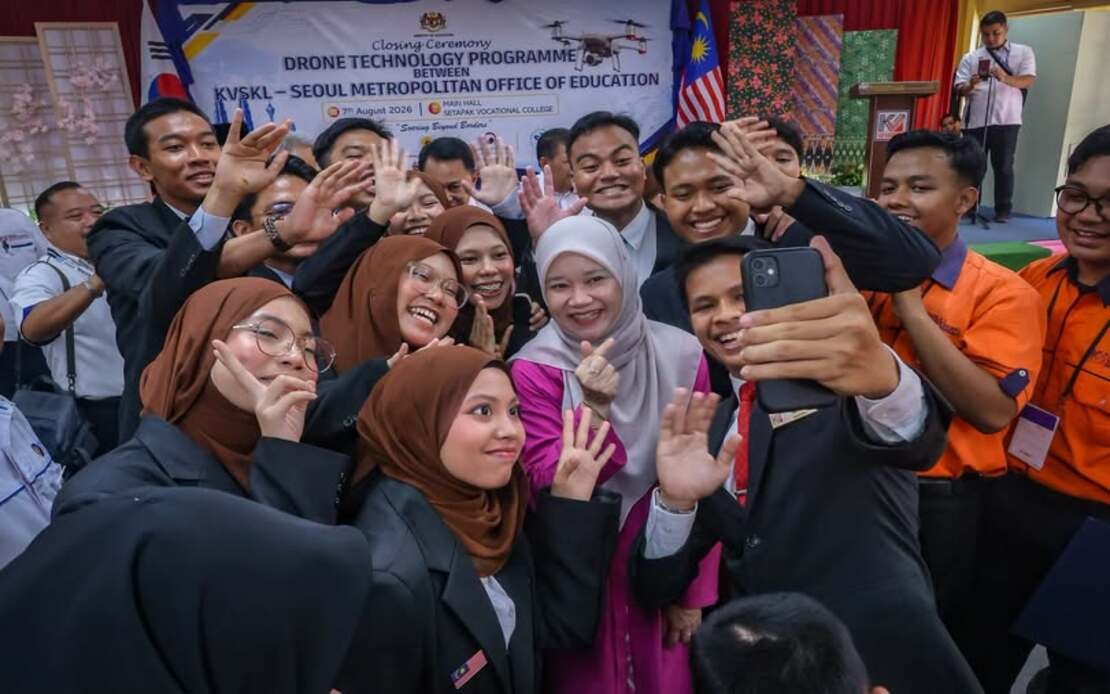
Education Minister Fadhlina Sidek has challenged students at Setapak Vocational College to harness drone technology for enhanced campus security, marking a significant shift toward experiential, problem-based learning in Malaysia's technical education landscape. The initiative, unveiled during a collaboration programme with the Seoul Metropolitan Office of Education, represents a deliberate effort to bridge the gap between classroom instruction and real-world application—a critical need as Malaysia's workforce confronts rapid technological disruption.
Fadhlina set a compressed timeline for the project, requesting students present their proposals within one month. This ambitious deadline underscores the minister's conviction that innovation thrives under pressure and that vocational students possess both the capability and mindset necessary to tackle genuine institutional challenges. Rather than treating drone technology as an abstract subject confined to theoretical exercises, the minister is positioning it as a practical tool for addressing tangible security concerns on campus, thereby giving students an authentic stake in their learning outcomes.
The programme itself reflects deeper strategic thinking about regional knowledge exchange. The partnership with South Korea's education authority signals Malaysia's recognition that technological advancement and pedagogical innovation often cluster in East Asian economies. By facilitating direct knowledge transfer between South Korean experts and Malaysian vocational students, the collaboration creates pathways for skill acquisition that might otherwise remain inaccessible through conventional curriculum channels. South Korean Ambassador to Malaysia Yeo Seung-bae's attendance highlighted the diplomatic dimensions of such educational partnerships, positioning technical education as a platform for bilateral cooperation.
Fadhlina's observations during student demonstrations reveal an educational philosophy centered on resilience and iterative learning. She noted that some students succeeded while others encountered failures, yet emphasized that the persistence itself constituted the genuine learning moment. This perspective aligns with contemporary pedagogical research suggesting that struggle and error-correction produce deeper conceptual understanding than flawless execution. For vocational students, who traditionally face lower social prestige than academic-track peers, such validation from a senior government minister carries significant motivational weight.
The minister's framing of robotics, drones, and artificial intelligence as present realities rather than future possibilities addresses a critical messaging challenge in Malaysian education. Many students and educators still perceive advanced technologies as distant prospects, when in fact labour market demand for these competencies already exists. By asserting that these technologies have transitioned from theoretical concepts to workplace staples, Fadhlina is attempting to reshape student perception of relevance and urgency. This reframing carries particular importance for vocational institutions, where student motivation often depends on perceiving direct pathways to employment.
The security application chosen for this challenge carries institutional logic beyond mere convenience. Campus security encompasses physical surveillance, access control, incident response, and preventive monitoring—domains where drone deployment offers genuine technical advantages. Students tasked with developing security solutions must grapple with constraints, specifications, and stakeholder requirements that mirror professional engineering contexts. This complexity elevates the exercise beyond a technology demonstration to something approximating authentic design thinking, where students must interrogate actual needs, evaluate technical feasibility, and propose scalable implementations.
Fadhlina's insistence that students learn not merely to operate drones but to conceptualize their application addresses a persistent gap in technical education. Proficiency with tools differs fundamentally from the creative problem-solving that distinguishes innovative practitioners from competent operators. By explicitly demanding that students think through applications and solve real problems, the minister is advocating for higher-order cognitive engagement within vocational pathways. This distinction matters considerably in Malaysia's context, where vocational education sometimes risks narrowing into rote skill acquisition rather than developing adaptive capability.
The timing of this initiative reflects broader concerns within Malaysian education about workforce preparedness. As automation and artificial intelligence reshape labour markets globally, Malaysia faces pressure to ensure its technical workforce possesses not merely operational competency but strategic comprehension of how emerging technologies integrate into organizational systems. Vocational colleges serve populations whose economic futures depend increasingly on technological literacy, making such initiatives particularly consequential for social mobility and inclusive growth.
Setapak Vocational College's selection for this challenge likely reflects institutional capacity and demonstrated commitment to innovation. The college's willingness to partner with international education authorities and accommodate the minister's challenge suggests organizational leadership oriented toward modernization. For other vocational institutions nationwide, this project may establish a template worth emulating—demonstrating how government support, international partnerships, and authentic problem contexts can catalyze meaningful learning experiences.
The one-month timeframe, though compressed, permits genuine project cycles wherein students can research applications, prototype solutions, encounter technical obstacles, iterate designs, and prepare presentations. This compressed timeline also tests whether vocational students possess the adaptive capacity and self-direction required in innovation-driven contexts. Success within such constraints would provide compelling evidence of readiness for employment in dynamic technological sectors.
Fadhlina's emphasis on keeping the education system aligned with workplace realities addresses a chronic tension in Malaysian education policy. Curriculum development cycles often lag behind technological change, creating graduates ill-equipped for employment contexts that have shifted materially during their years of study. By tasking students with contemporary problems and drawing on current expertise, this initiative attempts to compress that lag, ensuring vocational education remains responsive rather than reactive to economic transformation.
Beyond the immediate security applications, this challenge implicitly invites Malaysian society to reconsider the value proposition of vocational pathways. Technical education need not limit students to routine implementation roles; properly scaffolded, it can develop innovative thinking and strategic problem-solving. As Malaysia navigates transition toward higher-value economic participation, such demonstration projects become increasingly important for signaling that vocational excellence represents not a lesser track but a different route toward meaningful contribution to organizational and national challenges.

