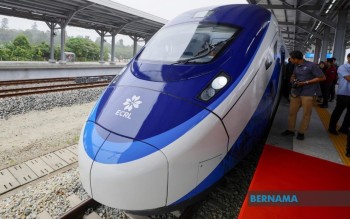
The East Coast Rail Link (ECRL) represents far more than a transportation infrastructure upgrade—it embodies a comprehensive restructuring of commerce and enterprise opportunity across Malaysia's eastern states. Deputy Minister of Economy Datuk Mohd Shahar Abdullah articulated this broader vision during recent remarks, emphasising that the RM110 billion undertaking will fundamentally reshape how businesses operate, scale, and compete within the region. The distinction matters for entrepreneurs and policymakers alike: the ECRL functions as a catalyst for systemic economic transformation rather than merely expediting cargo movement.
Central to this economic reshaping is the deliberate integration of supply-chain infrastructure alongside transport capacity. The project's design encompasses not just rail corridors but complementary ecosystems that enable seamless goods movement and service delivery. Construction contracts, ongoing operational requirements, and perpetual maintenance obligations create sustained employment and commercial activity for suppliers, contractors, and support services. This multiplier effect extends throughout Pahang, Terengganu, Kelantan, and Selangor—the four states directly traversed by the route. For Malaysian entrepreneurs accustomed to viewing infrastructure as peripheral to their operations, recognising these ancillary opportunities represents a significant strategic shift.
The logistics revolution emerging from the ECRL warrants particular attention from businesses currently hampered by geographic isolation and high transportation costs. Warehouse networks, distribution hubs, and industrial parks will materialise along the corridor, fundamentally altering operational economics. A manufacturer in Kuantan or Kota Bharu gains tangible competitive advantages: reduced delivery timeframes to markets in Klang Valley, Selangor, and beyond translate directly into improved cash flow cycles and customer satisfaction. These advantages compound when producers can negotiate volume-based pricing with suppliers, knowing that expanded market reach justifies increased production runs. The transition from producing 10,000 units to 20,000 units represents not merely scaled output but structural cost reduction that improves margins across entire product categories.
Mohd Shahar's emphasis on transit-oriented and cargo-oriented development reflects sophisticated urban planning integration increasingly recognised as essential for infrastructure projects' success. Rather than isolated rail infrastructure bypassing communities, this approach concentrates commercial activity at strategic nodes where transport, storage, and retail functions intersect. East Coast entrepreneurs gain proximity to logistics networks without requiring independent capital investment in warehouse facilities or distribution infrastructure. This democratisation of access—enabling smaller operators to compete on logistics efficiency previously available only to corporations with dedicated supply chains—could fundamentally reshape competitive dynamics within the region's commercial landscape.
Tourism sector benefits present an often-underestimated dimension of the ECRL's economic impact. Enhanced rail connectivity increases accessibility to East Coast cultural attractions, beaches, and natural reserves for both domestic and international visitors. This expanded visitor flow directly stimulates demand for traditionally marginalised commercial activities—batik craftspeople, food entrepreneurs, and local artisans suddenly access customer bases exponentially larger than their immediate communities. A batik producer in Terengganu transitions from relying on occasional tourists and local markets to positioning products within viable commercial supply chains serving national and regional demand. Such opportunities require entrepreneurial adaptation and quality standards that challenge traditional business models.
However, Mohd Shahar's cautionary remarks regarding technology adoption and business model innovation contain essential wisdom often overlooked in infrastructure enthusiasm. Merely reducing logistics costs provides limited advantage if businesses continue operating through outdated supply chain management, payment systems, or customer engagement approaches. The ECRL removes geographic constraints, but success demands corresponding operational modernisation. Entrepreneurs must embrace digital inventory systems, e-commerce integration, and data-driven decision-making to fully capitalise on expanded market access. This technological imperative represents perhaps the most significant competitive challenge for traditional East Coast businesses accustomed to regional market dynamics.
The project's construction progress—97.33 percent completion in Pahang and 93.66 percent overall as of April—indicates the economic transformation remains imminent rather than theoretical. This timeline urgency demands that businesses begin preparation now rather than awaiting formal opening ceremonies. Industrial park developers, logistics operators, and small business associations should undertake strategic positioning to benefit immediately upon completion. Government agencies promoting enterprise development across the East Coast should intensify support programmes ensuring local entrepreneurs achieve the technological and operational readiness required for successful scale-up.
Regional economic integration implications extend beyond individual state boundaries. The ECRL's linkage of Pahang, Terengganu, Kelantan, and Selangor creates a nascent integrated economic zone spanning Malaysia's east coast and densest western population centres. This configuration could catalyse specialisation and comparative advantage development—certain regions concentrating on specific manufacturing or service sectors based on local resources, labour availability, and existing capabilities. Such specialisation, facilitated by reliable transportation infrastructure, typically generates efficiency gains and productivity improvements across participating economies.
For Malaysia's broader economic objectives, the ECRL represents investment not merely in transport capacity but in systemic economic repositioning. East Coast states, historically positioned peripherally relative to western economic concentration, gain infrastructure enabling genuine competitive participation in national commerce. Entrepreneurs previously disadvantaged by geographic location acquire tools for market participation previously reserved for Klang Valley and Selangor-based competitors. This geographic democratisation of opportunity aligns with national priorities regarding inclusive development and regional economic balance.
The ECRL's completion will mark not an endpoint but an economic commencement. The critical phase follows project handover: whether businesses and policymakers translate infrastructure availability into genuine commercial transformation. This requires sustained focus on business capability development, technology adoption support, and strategic positioning within the emerging ECRL-enabled economic ecosystem. For Malaysian entrepreneurs, the approaching completion timeline presents an opportunity window demanding immediate strategic engagement rather than delayed reaction.

