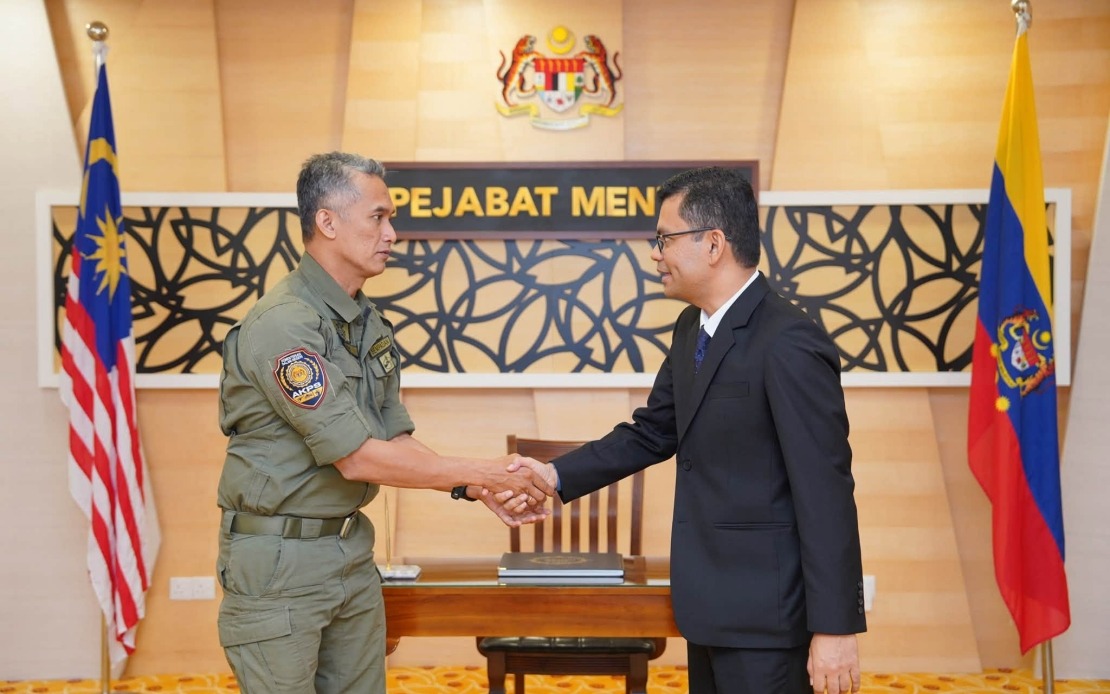
Malaysia's newly established Malaysian Border Control and Protection Agency (AKPS) is moving quickly to shape its operational agenda, having held substantive discussions with the Economy Ministry about securing development funding for border modernisation. The courtesy visit by AKPS director-general Datuk Seri Mohd Shuhaily Mohd Zain to Economy Minister Akmal Nasrullah Mohd Nasir in Putrajaya underscores the government's commitment to equipping the fledgling agency with resources needed to fulfil its mandate as a unified border enforcement body.
The agency, which commenced operations on January 1, 2025, represents a significant reorganisation of Malaysia's border control apparatus. Rather than maintaining the previous fragmented system where multiple agencies independently managed different aspects of border security, AKPS now consolidates these functions under one roof. This integration brings together immigration control, customs operations, quarantine and inspection services, health screening, wildlife protection and road transport enforcement—functions previously distributed across six separate government organisations including the Immigration Department, Royal Malaysian Customs Department, Malaysian Quarantine and Inspection Services Department, Health Ministry, Department of Wildlife and National Parks, and Road Transport Department.
The structural consolidation alone addresses a persistent vulnerability in Malaysia's border management: the coordination gaps that arose when different agencies operated with separate mandates, communication channels and technological systems. However, integrating these legacy operations requires substantial investment in compatible infrastructure and standardised procedures. The discussions between AKPS leadership and the Economy Ministry focused precisely on identifying these budgetary needs to make integration functional rather than merely administrative.
Infrastructure development emerged as a central concern. Malaysian border entry points, ranging from the Johor-Singapore crossings to the northern Thailand border checkpoints and the complex maritime boundaries in Sabah and Sarawak, require upgraded facilities to accommodate integrated operations. New inspection bays, consolidated command centres, improved cargo handling areas and enhanced passenger processing zones all demand capital investment. These upgrades become more urgent given Malaysia's role as a regional trade hub; delays at entry points cascade through supply chains affecting businesses throughout Southeast Asia.
Technology adoption represents the second pillar of AKPS's development agenda. The agency is prioritising what officials term "smart border technology," which encompasses integrated biometric systems for passenger identification, automated scanning systems for cargo inspection and real-time data integration powered by artificial intelligence. These technologies address operational efficiency but also enhance security by enabling risk-based screening that targets potential threats rather than subjecting all travellers and shipments to identical procedures. For a country processing millions of border crossings annually, such technological sophistication directly translates to faster throughput and reduced congestion.
The implications for Malaysian trade are substantial. Regional supply chains increasingly depend on rapid border processing; manufacturing sectors in automotive, semiconductors and electrical goods rely on just-in-time component delivery that demands predictable border transit times. When AKPS implements integrated biometric systems and automated cargo scanning, processing times should compress significantly. This benefit extends beyond Malaysia's domestic competitiveness to strengthen the entire ASEAN trading network, as Malaysian ports and land borders serve as critical nodes for intra-regional commerce.
Operational capacity building addresses the human dimension of border modernisation. The Economy Ministry's acknowledgment that "structured development planning will support smoother trade" reflects understanding that technology and infrastructure mean little without trained personnel capable of deploying them effectively. AKPS must develop new training protocols for officers accustomed to working within sector-specific agencies, establish career development pathways for the consolidated workforce and create accountability structures that span the formerly separate organisational cultures. Mohd Shuhaily's emphasis on "enhancing human resource capacity" indicates the agency recognises that institutional transformation requires investment in people, not merely equipment.
The timing of these discussions carries strategic significance. Border agencies globally face mounting pressure to balance security imperatives with trade facilitation—a tension that plays out acutely in Malaysia, which depends heavily on regional commerce. China's Belt and Road Initiative investments in Southeast Asian infrastructure, coupled with evolving security threats including transnational organised crime and terrorism, create an environment where border management decisions have geopolitical weight. AKPS's adoption of AI-powered data integration and biometric systems positions Malaysia as technically sophisticated, though implementation will determine whether these capabilities genuinely enhance security or simply create new bottlenecks.
The consolidation model that AKPS represents deserves scrutiny as other Southeast Asian nations contemplate border management reform. Singapore's integrated border operations and Australia's unified border force provide successful precedents, though Malaysia's geographic complexity—with land borders spanning Peninsular Malaysia, Sabah and Sarawak, plus extensive maritime boundaries—requires tailored solutions. The discussions with the Economy Ministry suggest Malaysian policymakers understand that border modernisation is not purely a security issue but an economic infrastructure decision with implications for growth trajectories.
Looking forward, the success of AKPS will depend partly on whether the Economy Ministry translates current discussions into sustained budgetary allocations. Development planning for border infrastructure typically extends across multiple fiscal years, requiring political consensus that funding commitments persist despite economic cycles or shifts in government priorities. The agency's early engagement with the Economy Ministry signals awareness that border modernisation must compete for resources with other infrastructure priorities, from transportation networks to digital connectivity.
For Malaysian businesses engaged in cross-border trade, AKPS represents both opportunity and risk. Properly resourced and competently operated, the agency could become a competitive advantage, reducing transaction costs through faster processing. If development plans fail to materialise or implementation stumbles, the consolidated structure could create new bottlenecks where previously decentralised agencies permitted workarounds. The discussions currently underway will substantially determine which outcome materialises.

