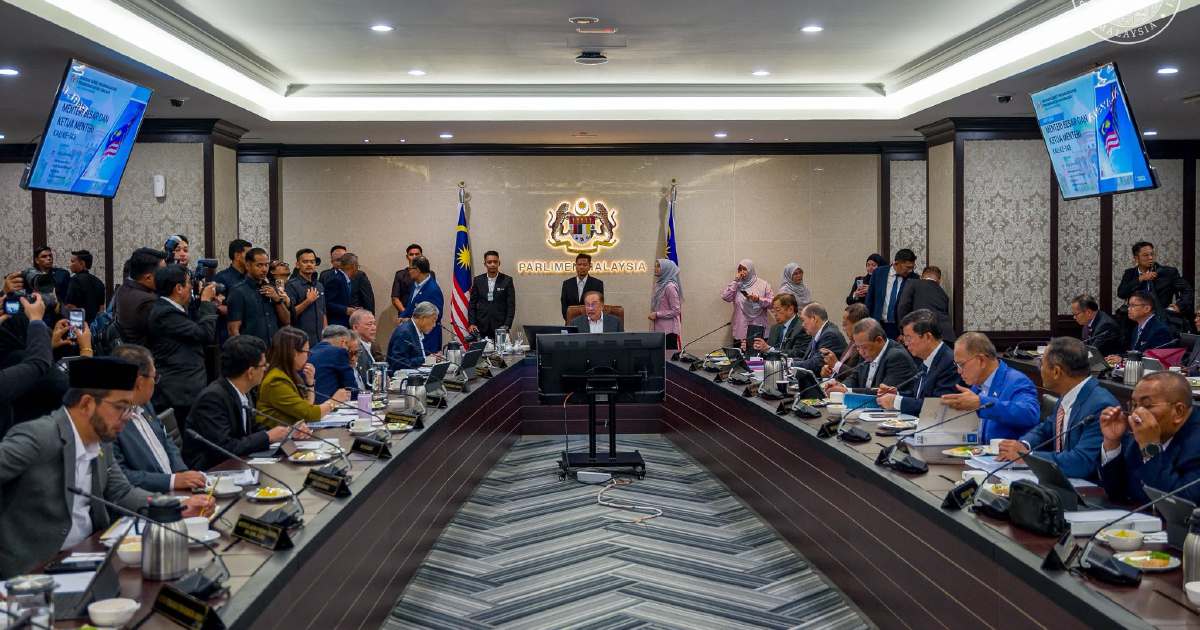
Prime Minister Datuk Seri Anwar Ibrahim brought together Malaysia's state leadership on Tuesday for the 149th Meeting of Menteris Besar and Chief Ministers, using the high-level gathering at the Parliament building to align federal and state governments on strategies for economic strengthening. The meeting underscored the administration's determination to insulate the nation from broader geopolitical turbulence and chart a coordinated path towards sustained growth.
The timing of the convocation reflects deepening concerns about external shocks threatening Malaysia's economic trajectory. Global tensions emanating from Middle East conflicts have created unpredictable commodity prices, volatile financial markets, and supply chain disruptions that reverberate across Southeast Asia's commercial networks. By assembling state executives responsible for regional development, infrastructure investment, and local business environments, Anwar signalled that economic revival requires coordination across Malaysia's federal structure rather than isolated federal policy-making.
State governments control substantial portfolios critical to economic performance, including land development, small and medium enterprise support, agricultural production, and tourism promotion. When federal initiatives lack subnational alignment, implementation falters and resources scatter inefficiently across competing priorities. This meeting format seeks to bridge that gap by fostering dialogue between the Prime Minister's office and territorial administrators who understand local economic conditions, workforce capabilities, and investment barriers.
The global uncertainty cited by the government extends beyond immediate security concerns. Prolonged conflicts in the Middle East typically disrupt oil supplies, elevate energy costs, and weaken consumer confidence among Malaysia's trading partners. For an economy dependent on manufacturing exports and regional commerce, such instability threatens growth projections and employment stability. The government's emphasis on economic revival suggests policymakers recognise that passive management of external shocks proves insufficient; instead, proactive domestic strengthening becomes essential.
Malaysia's economic model increasingly relies on resilience through diversification. The state leaders gathered would discuss practical mechanisms to stimulate domestic consumption, attract foreign investment despite global uncertainty, and develop new growth engines less vulnerable to Middle Eastern volatility. Tourism, digital economy expansion, renewable energy transition, and agricultural modernisation represent sectors where state-level initiatives can meaningfully contribute to national objectives without directly competing with global supply chain disruptions.
The 149th meeting also reflects institutional expectations around federal-state cooperation frameworks. Quarterly or regular forums between the Prime Minister and state chief executives facilitate information sharing, policy alignment, and dispute resolution before disagreements calcify into constitutional tensions. Malaysia's decentralised system grants states concurrent powers in key areas; ensuring these operate harmoniously with federal strategy prevents duplication and maximises resource efficiency.
Anwar's explicit acknowledgment of Middle East conflicts during the meeting signals that the government will integrate geopolitical analysis into domestic economic planning. Rather than treating external uncertainties as immutable constraints, this approach positions Malaysian leadership as actively monitoring international developments and adjusting strategies accordingly. State leaders gain clarity on federal expectations, allowing them to calibrate their own initiatives toward complementary rather than contradictory outcomes.
The emphasis on economic revival carries implicit messaging about government priorities beyond security or diplomatic concerns. By highlighting the economy, the administration addresses citizen anxieties about employment, cost of living, and investment climate—issues that resonate across all Malaysian communities regardless of political affiliation. This framing presents leadership as problem-solving and forward-focused rather than reactive or crisis-driven.
For Southeast Asian observers, Malaysia's approach to federal-state economic coordination offers instructive lessons. The region encompasses diverse governance structures; how Malaysia's federal system mobilises state resources during uncertain times demonstrates either effective decentralisation or exposes coordination weaknesses. Successful alignment between Anwar's office and state administrators would strengthen investor confidence, while fragmentation or conflicting messages would amplify economic vulnerabilities.
The meeting's focus on reviving the economy also implies acknowledgment that existing momentum has slowed. External shocks typically precede government convocations aimed at acceleration; the gathering thus suggests that while Malaysia weathered initial Middle East conflict impacts, authorities now seek proactive momentum rather than assuming passive recovery. This stance reflects pragmatic economics: waiting for international conditions to improve independently risks continued stagnation, whereas coordinated domestic stimulus can partially offset external headwinds.
Looking forward, the outcomes from this 149th meeting will likely materialise in policy announcements addressing state-identified bottlenecks, expedited approvals for investment projects, or targeted incentives in sectors where state governments already possess implementation capacity. The exercise itself—bringing federal and state leadership into synchronised conversation—establishes foundations for the coordinated execution that economic revival demands, particularly when external circumstances remain turbulent and unpredictable.

