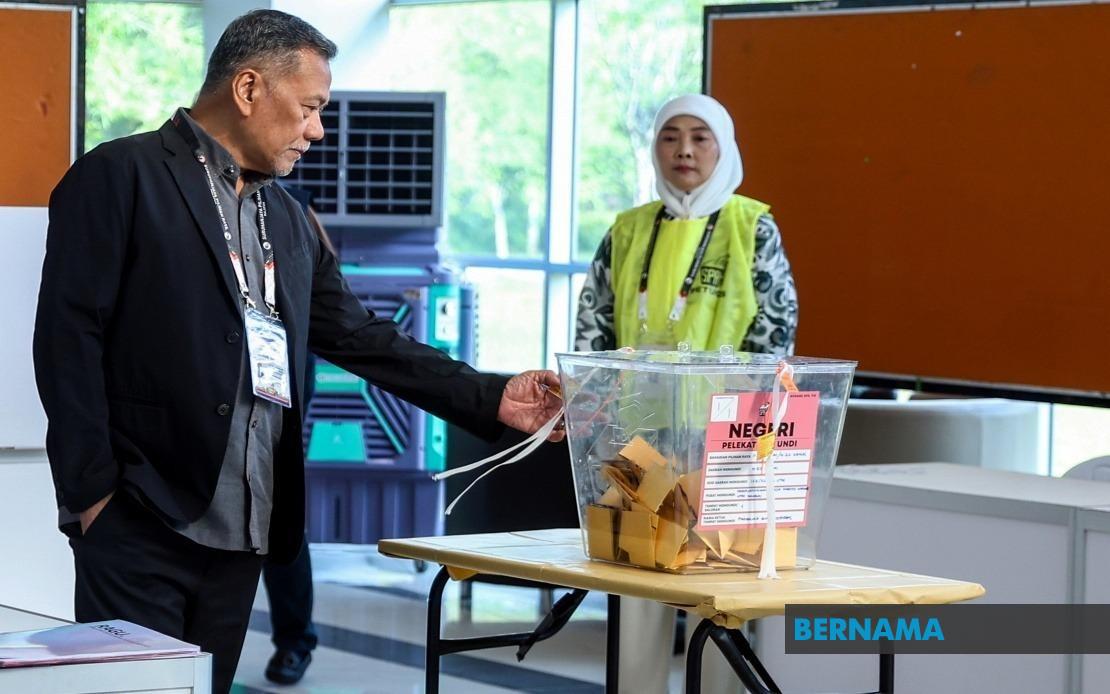
Datuk Seri Ramlan Harun, chairman of Malaysia's Election Commission, undertook a comprehensive inspection tour of polling facilities across Johor Bahru on July 11, visiting four distinct voting centres to assess the conduct and organisation of the state election. The tour, which commenced in the morning, formed part of the EC's standard operational oversight on polling day, ensuring that electoral procedures aligned with established protocols and that voters encountered no logistical impediments to casting their ballots.
The chairman's first stop was the Dewan Raya Taman Ungku Tun Aminah facility, which served as the polling centre for the Skudai constituency. This location operated seven separate polling streams, enabling the centre to process a substantial volume of voters while maintaining queue management and social distancing protocols. Ramlan arrived at approximately 8.50 am, a time that captured the initial surge of early morning voters who typically arrive before work commitments.
From Skudai, the inspection moved to the Raja Zarith Sofiah Library situated within Universiti Teknologi Malaysia's campus, where voting for the Senai constituency took place. This academic setting operated with two polling streams, reflecting the different population density and voter registration patterns compared to the residential area of Skudai. University polling centres in Malaysia typically present unique administrative challenges given the transient nature of student populations and the requirement to verify residential eligibility before ballot issuance.
The third venue visited was Sekolah Agama Taman Bukit Mewah, designated as the polling centre for the Kempas constituency and staffed to manage six voting streams. Schools remain among the most frequently utilised polling locations throughout Malaysian elections, offering established infrastructure, adequate space for queue management, and accessibility for voters with mobility considerations. The selection of an Islamic religious school reflected Johor's demographic composition and the importance of ensuring inclusive polling venues across different community segments.
Ramlan concluded his inspection circuit at Sekolah Menengah Kebangsaan Bandar Uda Utama, the polling centre for the Perling constituency, which operated the largest configuration with nine polling streams. Secondary schools typically handle higher voter volumes and require more complex logistical coordination to prevent bottlenecks and ensure timely ballot processing.
During each facility visit, the EC chairman received detailed briefings from election officials stationed at the centres. These briefings encompassed the mechanics of the voting process, including procedures for voter verification, ballot distribution, and the safeguarding of ballot papers against tampering or misuse. The presence of the EC chairman during polling operations serves as a visible assurance to both voters and election workers that the democratic process operates under active institutional oversight.
Beyond procedural assessments, Ramlan's inspection explicitly evaluated the physical facilities and amenities provided for both voters and the election personnel managing the voting stations. This evaluation component reflects growing international standards regarding election administration, which increasingly recognise that the quality of voter experience—including adequate lighting, ventilation, accessible facilities for persons with disabilities, and reasonable queue lengths—directly influences public confidence in electoral integrity and encourages broader civic participation.
The distribution of Ramlan's visits across four constituencies in different areas of Johor Bahru ensured geographic representation of voting conditions. Urban residential areas like Bandar Uda Utama presented different operational challenges than university precincts, while the mix of school types and polling stream configurations provided a representative cross-section of how the Johor electoral process unfolded on the day. This strategic sampling approach enabled the EC leadership to identify any systemic issues that might require intervention or adjustment across remaining polling locations.
The 16th Johor state election represented a significant political event in Malaysia's electoral calendar, with statewide implications for governance and representation. The EC's active inspection regime during polling day demonstrated institutional commitment to maintaining transparent and orderly democratic processes, addressing both technical electoral administration and public perception of fairness. Ramlan's visible presence at multiple polling centres, combined with the scheduled post-inspection press conference, signalled the EC's willingness to provide public accountability regarding electoral conduct.
For Malaysian observers tracking election administration standards and best practices in institutional governance, the EC chairman's inspection tour illustrated the practical mechanisms through which electoral bodies attempt to verify compliance with voting procedures in real time. The attention to facility quality and voter amenities reflects broader regional and global trends toward viewing election administration not merely as a technical exercise but as a fundamental component of democratic legitimacy that must be transparent and accessible to public scrutiny. Such inspections, when properly documented and communicated, contribute to building institutional trust essential for democratic stability in multi-ethnic, federalised political systems like Malaysia's.

