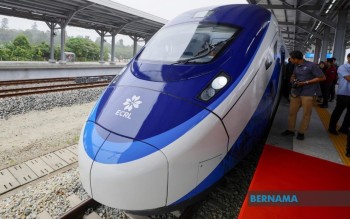
The East Coast Rail Link (ECRL) will potentially inject between RM80 and RM90 billion into Malaysia's cumulative gross domestic product by 2047, according to projections shared by the government's economic development team. The 665-kilometre railway corridor, representing a RM50.27 billion national infrastructure investment, is positioned as far more than a transportation conduit—it is being framed as a transformative economic engine capable of rebalancing regional development and strengthening the country's competitive position in an increasingly logistics-centric global economy.
Deputy Economy Minister Datuk Mohd Shahar Abdullah outlined an ambitious vision for the ECRL ecosystem during recent remarks, emphasising that 21 Economic Accelerator Projects (EAPs) will form the backbone of projected returns along the corridor. These initiatives are strategically designed to unlock dormant economic potential across the East Coast region, which has historically lagged behind the more industrialised western corridor in terms of investment attraction and employment opportunities. The integration of these EAPs with the railway infrastructure signals a deliberate policy approach to leverage hard infrastructure investments for broader regional transformation.
Three districts have been earmarked as primary logistics hubs to anchor this expansion strategy. Pasir Puteh in Kelantan commands 213 acres of designated logistical space, whilst Kemaman in Terengganu has been allocated 68 acres and Temerloh in Pahang 50 acres respectively. These facilities are intended to establish integrated logistics nodes that capitalise on the rail link's transportation advantages, converting the ECRL from a stand-alone infrastructure asset into a connected ecosystem supporting manufacturing, warehousing, and distribution operations. The deliberate geographic spread across three states underscores an inclusive development philosophy aimed at preventing economic benefits from concentrating in a single location.
The Perodua logistics hub in Paya Besar, Kuantan, represents a concrete manifestation of this development model. The first phase of this facility is scheduled for completion by 2029, demonstrating tangible commitment to materialising these ambitions within a defined timeframe. Such anchor projects help validate the economic vision and create gravitational pull for downstream investment, as supply chain operators recognise the emerging advantages of positioning operations along the ECRL corridor. The involvement of Malaysia's automotive sector, through Perodua's participation, signals confidence in the logistics infrastructure from a key industrial player.
Mohd Shahar stressed that the ECRL should be understood as a complementary element within Malaysia's broader logistics architecture rather than as a replacement for established maritime shipping channels. This calibrated positioning acknowledges realistic market dynamics—international shipping will remain dominant for long-distance, bulk commodity movement—while carving out specific niches where rail transport offers competitive advantages. The strategy reflects mature infrastructure planning that integrates new capacity into existing systems rather than pursuing self-contained competitive infrastructure. Regional connectivity improvements and supply chain efficiency gains emerge as the realistic value propositions rather than wholesale transformation of trade patterns.
Aligning the ECRL development with the Malaysia Development Composite Index and MyRMK system ensures that government investments and resource allocation decisions respond systematically to regional needs rather than ad hoc political pressures. This frameworks-based approach, which Mohd Shahar identified as central to implementation of the 13th Malaysia Plan, should theoretically improve targeting and reduce capital misallocation. For Malaysian economic policy practitioners and observers, such integration of sectoral projects within broader macroeconomic planning frameworks represents a meaningful evolution in infrastructure development governance.
The expressed commitment to narrowing the development gap between the East and West Coasts carries significant implications for regional inequality reduction and demographic sustainability. Malaysia's western corridor has traditionally concentrated population, investment, and employment opportunities, creating persistent disparities in income levels and economic dynamism across regions. The ECRL, functioning as a backbone infrastructure asset, could enable more distributed economic activity and allow provincial areas to retain skilled workforces rather than experiencing continuous outmigration to Klang Valley and Penang conurbations. Over decades, such rebalancing could reshape Malaysia's spatial economic patterns and improve quality of life outcomes across broader geographic areas.
The RM50.27 billion capital investment positions this as one of Malaysia's signature infrastructure projects of the 2020s, comparable in scale and strategic importance to the Petronas-backed mega infrastructure initiatives of previous decades. The project timeline—scheduled completion in December 2026 with operational commencement in January 2027—places the project on a trajectory where most RM90 billion GDP contribution projections would materialise during the 2030s and 2040s as the ecosystem matures and network effects accumulate. Investors and stakeholders contemplating participation in ECRL-linked ventures should factor in relatively patient capital requirements, as returns distributions will extend across multiple decades.
The rail fleet composition—11 six-car electric multiple unit train sets for passenger services and 12 electric locomotives for cargo—reflects a dual-use strategy optimising for both commuter connectivity and freight efficiency. The electrified nature of the rolling stock aligns with Malaysia's sustainability commitments whilst potentially offering operating cost advantages relative to diesel alternatives over extended timeframes. The emphasis on cargo capacity through dedicated electric locomotive provision acknowledges that freight movement—supporting manufacturing, agricultural exports, and supply chain logistics—represents the primary economic generator rather than passenger services alone.
From a regional Southeast Asian perspective, the ECRL's operational success could establish competitive benchmarks for rail-based logistics infrastructure across the Association of Southeast Asian Nations. Thailand, Vietnam, and Indonesia are simultaneously advancing rail projects aimed at similar objectives—connecting inland production centres with ports and creating multimodal logistics networks. Malaysia's execution of the ECRL, particularly regarding project delivery, operational efficiency, and actual economic impact achievement, will be observed closely by regional peer countries designing competing infrastructure strategies. Successful demonstration of infrastructure-to-GDP conversion mechanisms would strengthen Malaysia's reputation as a reliable infrastructure operator capable of translating capital investments into measurable economic benefits.
The RM80-90 billion GDP contribution projection carries implicit assumptions regarding project completion on schedule, timely activation of the 21 Economic Accelerator Projects, sustained regional investment inflows, and maintenance of competitive logistics advantages as the corridor matures. Achievement of these targets will depend upon factors beyond railway operations themselves—including business confidence in the region, policy stability, competitive positioning relative to alternative logistics routes, and macroeconomic conditions prevailing across the 2030s and 2040s. Tracking actual project outcomes against current projections will provide valuable evidence regarding Malaysian infrastructure planning methodologies and the realistic conversion rates between capital investment and long-term economic value creation.

