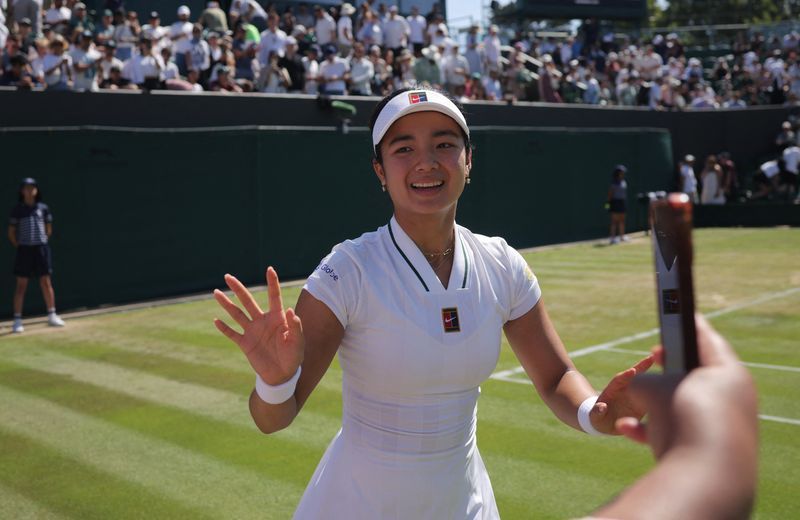
Alexandra Eala etched her name into Philippine sporting history on Thursday at Wimbledon, becoming the first player from the Philippines to advance to the third round of a Grand Slam tournament. The 21-year-old from Quezon City mounted an impressive comeback against Australia's Maya Joint, securing a decisive 3-6 6-2 6-0 victory that demonstrated her growing mastery of grass courts and competitive maturity on the sport's biggest stage.
The milestone came just two days before Eala faces a formidable challenge in defending champion Iga Swiatek, the Polish six-time Grand Slam winner. Eala's composed approach to the prospect reveals a player unburdened by the magnitude of facing one of tennis's elite competitors. Rather than viewing the matchup with trepidation, the 29th seed expressed genuine readiness to compete at the highest level, acknowledging the difficulty ahead while maintaining confidence in her ability to trouble the defending champion.
Eala's journey to this breakthrough moment has been carefully constructed over several years of persistent development. The teenager competed in only her sixth Grand Slam tournament when she accomplished this feat, underlining the rapid acceleration of her career trajectory since breaking into the top 50 rankings last year. Her continued upward momentum throughout 2024 suggests this latest achievement represents not a ceiling but rather a milestone on her path toward further advancement in professional tennis.
The grass court circuit has proven particularly suited to Eala's playing style and competitive temperament. Last month she captured the title in Birmingham, while her semi-final appearance in Berlin demonstrates sustained excellence across multiple tournaments on this surface. This specialisation on grass provides genuine grounds for optimism when facing opponents traditionally stronger on clay, and it suggests her clay-court excellence may eventually translate to dominance across all surfaces.
Beyond the sporting achievement lies a deeply personal dimension that resonates throughout Filipino society. Eala has chosen to wear her heritage visibly on court, collaborating with her sponsor Nike to incorporate Tagalog language messaging into her competitive kit. Most notably, a custom visor bears the words "Kapag lumago, hindi na hihinto"—roughly translating to "once it grows, it cannot be stopped"—a phrase that has proven prophetic given her performance against Joint. This commitment to cultural representation reflects a maturity unusual in athletes her age, particularly her determination to integrate rather than compartmentalise her national identity within her professional career.
The symbolic elements of her Wimbledon campaign extend to personal touches that reinforce her commitment to Philippine representation. Last year, Nike provided Eala with a custom hair tie adorned with a sampaguita bloom, the Philippines' national flower, for her maiden Wimbledon appearance. These deliberate acts of cultural assertion distinguish Eala from countless other professional athletes who remain culturally neutral on the international stage, revealing someone deeply conscious of the significance her success holds for her nation.
When discussing her milestone achievement, Eala articulated a nuanced understanding of the responsibility accompanying her position. She described the emotional weight of passing new milestones and breaking fresh ground, while emphasising that these achievements remained rooted in personal aspiration rather than external pressure or nationalist obligation. This psychological grounding appears essential to sustaining the mental resilience required at professional tennis's apex, where the burden of representation can become counterproductive when it supersedes individual focus.
Eala's insistence on authenticity and fidelity to her values provides insight into her approach to representing Philippine interests globally. Rather than adopting an artificial persona or adopting messaging crafted by others, she has consistently chosen to express her identity through means she finds genuinely meaningful. This integrity suggests a player less likely to succumb to the various psychological pressures that derail promising athletes, particularly those from smaller tennis-playing nations who shoulder outsized expectations.
The Philippines has historically occupied a modest position within professional tennis globally, producing few players who have competed consistently at the highest levels. Eala's emergence therefore carries implications extending far beyond individual sporting achievement. Her presence in Grand Slam third rounds, particularly at the All England Club's prestigious grass courts, potentially inspires younger generations of Filipino players to pursue the sport with seriousness and confidence. The visibility she provides to Philippine tennis on international broadcasts reaches audiences unlikely to encounter Filipino athletes competing at elite levels in other sports.
Looking ahead, Eala's matchup with Swiatek represents a definitive test of her readiness for the upper echelons of women's professional tennis. While the defending champion enters as favourite, Eala's grass-court confidence and improving ranking position legitimate her chances of producing a competitive match. Regardless of the outcome, her accomplishment of reaching this stage has already transformed her sporting legacy and established a foundation upon which future Filipino tennis players may build.
The broader context of Eala's success within Asian women's tennis reveals a talent emerging at a moment when regional strength in the sport continues strengthening. As nations across Southeast Asia and East Asia increasingly invest in player development, Eala's achievements position the Philippines competitively within this expanding landscape. Her performance may catalyse increased domestic investment in tennis infrastructure and coaching, potentially yielding additional athletes capable of competing at Grand Slam level in coming years.

