The impeachment trial of Philippine Vice President Sara Duterte took a significant turn this week as her legal team launched a robust challenge to the constitutional foundation of the charges against her, arguing that statements she made last year, however inflammatory, do not meet the threshold of "other high crimes" necessary for removal from office under the 1987 Philippine Constitution. The defence strategy, articulated during cross-examination on Wednesday, sought to systematically deconstruct the prosecution's case by questioning both the evidence presented and the legal framework being applied to the Vice President's conduct.
Duterte's lawyers concentrated their effort on undermining the credibility of the National Bureau of Investigation's investigation and the interpretation of her November 23, 2024 online press briefing remarks. During that briefing, Duterte made statements regarding President Ferdinand Marcos, First Lady Liza Araneta-Marcos, and former House Speaker Martin Romualdez that opposition figures characterised as assassination threats. The defence team argued that this characterisation fundamentally misrepresented what the Vice President actually said, and moreover, that even if the statements were taken at face value, they would not constitute grounds for impeachment under Philippine constitutional law.
Central to the defence's argument is the distinction between uttering grave threats, which may violate criminal law, and committing impeachable offences. Under Article XI, Section 2 of the Constitution, an official can be impeached only for culpable violation of the Constitution, treason, bribery, graft and corruption, betrayal of public trust, or other high crimes. Defence counsel Mark Vinluan emphasised that the prosecution had failed to present evidence demonstrating that Duterte had contracted an assassin to carry out killings, which would presumably be necessary to establish the gravity required for impeachment. Instead, the prosecution relied on recordings of the Vice President's statements themselves, which Vinluan argued fell short of proving an actual assassination plot.
The defence's contextual reframing of the Vice President's remarks proved particularly significant during the proceedings. Lawyers presented video footage showing Duterte's chief of staff, Zuleika Lopez, visibly distressed as she was cited in contempt by a House committee and faced involuntary transfer to a detention facility. The defence contended that Duterte's controversial statements were a direct response to what the team characterised as the systematic persecution of the Vice President and her staff by the House of Representatives. This contextual presentation attempted to transform the narrative from one of unprovoked threats into one of a harassed official reacting to what her team described as unauthorised intelligence and surveillance operations targeting her and her family.
The investigation itself became a focal point of scrutiny, with defence lawyers highlighting what they characterised as critical gaps in the National Bureau of Investigation's work. Notably, neither President Marcos, First Lady Araneta-Marcos, nor former Speaker Romualdez had filed formal criminal complaints, yet the NBI proceeded with its investigation motu proprio, or without an official complainant. Senior agent John Mark Calilung acknowledged during cross-examination that none of the three alleged targets had personally appeared before the bureau to provide statements or affidavits regarding the alleged threats. This absence of participation from the putative victims raised questions about the foundation of the entire investigation and whether the prosecution could establish that an actual threat had been perceived and taken seriously by those allegedly targeted.
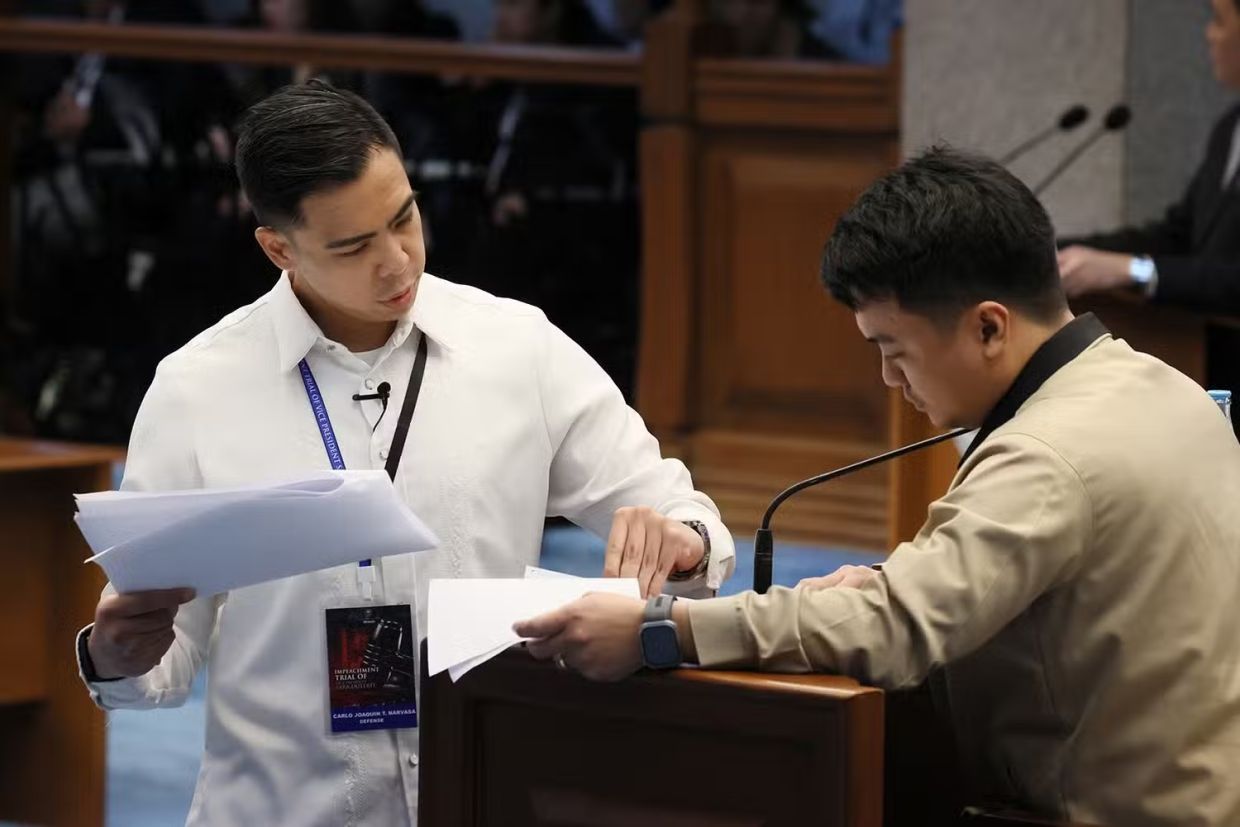
A particularly pointed moment came when defence lawyer Carlo Narvasa asked whether the NBI had genuinely investigated the case, a rhetorical question that underscored the defence's assertion that the bureau's conduct fell short of standard investigative protocols. Calilung could not answer directly after the prosecution objected, but he did confirm that revised affidavits dated February 10, 2025, contained no statements from the offended parties or journalists present at the November briefing. The defence thus built a narrative suggesting that the investigation was incomplete, potentially influenced by political motivation, and lacking the foundational elements necessary to establish even a criminal threat charge, much less grounds for impeachment.
The interaction between Senator Risa Hontiveros and the prosecution during Tuesday's proceedings provided the defence with ammunition for Wednesday's arguments. When Hontiveros directly asked whether the recordings proved Duterte had contracted an assassin, prosecution counsel Amando Ligutan conceded that the recordings did not conclusively establish this fact. Instead, Ligutan framed the statements as part of a broader pattern demonstrating the Vice President's intent. This acknowledgement became crucial for the defence, which seized upon it to argue that the prosecution itself recognised the weakness in its case regarding the core allegation.
Defence lawyer Carlo Narvasa also raised concerns about the treatment of Lopez and the conduct of the House committee that had referred the case for impeachment. He characterised the actions taken against the Vice President and her staff as constituting systematic oppression, including the controversial transfer of Lopez to a corrections facility without her lawyer present and despite her cooperation. While Narvasa did not argue that such treatment fully justified Duterte's statements, he positioned them within a context of institutional harassment that challenged the clean narrative the prosecution had attempted to construct regarding a Vice President making unprovoked threats.
The question of what constitutes an "other high crime" remains at the heart of the impeachment trial and will likely dominate the closing arguments of both sides. The phrase appears in the Constitution but lacks a precise definition, leaving considerable interpretive space. The defence's position is that mere statements, even intemperate or inappropriate ones, cannot constitute high crimes without accompanying actions such as actually hiring someone to commit murder. The prosecution appears to be arguing that statements demonstrating intent to harm high government officials, coupled with the seriousness of the targets and the official capacity in which they were made, may be sufficient to establish an impeachable offence.
Presiding Officer Senator Francis Escudero intervened at one point to note that the discussion had touched on the central question before the court, suggesting that the Senate is grappling with fundamental questions about the scope of impeachment power in the Philippines. When Hontiveros posed a question that appeared to seek legal conclusions from the defence, Escudero reminded senator-judges to avoid such questions, noting that such matters belong in closing arguments. However, Hontiveros noted that previous impeachment trials in the Philippines had permitted broader questioning by senator-judges, suggesting that the boundaries of the current trial may be more restrictive.
The defence's challenge to the legal sufficiency of the impeachment charge reflects broader questions about the appropriate use of impeachment as a political tool. In recent years, impeachment has become an increasingly fraught instrument in Philippine politics, with critics arguing that it is being wielded for partisan purposes. The Duterte trial takes place against this backdrop, and the senate's ultimate decision will likely have implications for how future impeachment cases are structured and adjudicated. The outcome may also influence the political calculus of government and opposition figures regarding when impeachment is an appropriate remedy versus when matters should be left to criminal courts.
For Malaysian observers, the Duterte case offers instructive lessons about the mechanics of impeachment in a presidential system with a bicameral legislature and a written constitution. Unlike Malaysia's parliamentary system, where prime ministers and ministers are typically held accountable through votes of no confidence in the legislature, the Philippines employs impeachment as a formal judicial proceeding conducted by the Senate. The detailed legal arguments being advanced in the Duterte trial—particularly regarding the distinction between criminal conduct and impeachable offences—highlight the complexity of establishing constitutional standards for removing high officials. As the trial continues, the Senate's interpretation of what constitutes "other high crimes" will shape the future utility of impeachment as a check on executive power in the Philippines.

