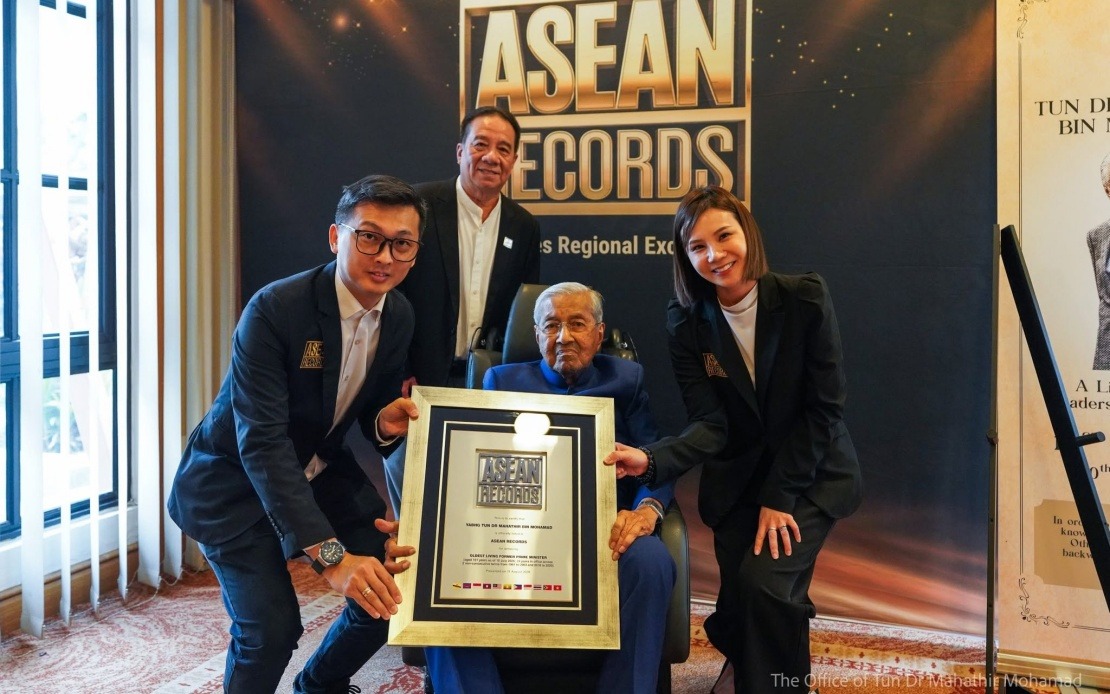
Tun Dr Mahathir Mohamad and Tun Dr Siti Hasmah Mohd Ali have etched their names into regional history books by becoming the first former head of government and spouse to both achieve centenarian status simultaneously, a distinction that has now been formally recognised through three separate record awards. The accolades underscore not only the couple's exceptional longevity but also their enduring place in Malaysia's political and cultural consciousness as they enter what is widely regarded as the twilight of distinguished lives.
The former Prime Minister, now aged 101, has been officially recognised by ASEAN Records as the Oldest Living Former Prime Minister in the region. This distinction places Dr Mahathir ahead of his contemporaries across Southeast Asia, a testament to decades spent in public service followed by more than two decades in retirement. His wife, Dr Siti Hasmah, at 100 years old, simultaneously received acknowledgment as the Oldest Living Spouse of a Former Prime Minister, a category that until recently saw few contenders in the modern era of Asian governance.
Perhaps most significantly, the couple jointly received an ASIA Records recognition as the First Former Head of Government and Spouse to Both Become Living Centenarians. This achievement represents a genuinely rare milestone in global politics, where instances of former national leaders reaching triple digits remain uncommon, and even rarer are instances where their spouses achieve the same feat. The adjudication process involved thorough verification across ASEAN member nations and major Asian markets, with no similar publicly documented achievement discovered in any comparable jurisdiction.
The recognition ceremony took place at the Perdana Leadership Foundation in Kuala Lumpur, where officials from ASEAN and ASIA Records formally presented certificates to the couple. Tan Sri Danny Ooi, chairman of the ASEAN Records Advisory Board, led the presentation, supported by chief adjudicators Gillian Ooi and Eldrick Koh, both serving as directors of the respective records organisations. The timing of the ceremony was deliberately arranged to coincide with an unusually concentrated cluster of personal milestones for the distinguished couple.
July proved to be a particularly significant month for the household, beginning with Dr Mahathir's 101st birthday celebration on July 10. This was swiftly followed by Dr Siti Hasmah's entry into her centennial year on July 12, just two days later. The closeness of their birth dates, separated by only 48 hours, adds a poignant dimension to their joint achievement, suggesting that their parallel journeys through life have extended even into this remarkable phase of longevity. Beyond these individual milestones, the couple recently marked another important occasion when they celebrated their 70th wedding anniversary on August 5, representing seven decades of marriage that have witnessed Malaysia's transformation from a newly independent nation to a developed economy.
Dr Mahathir's political career spanned multiple decades and multiple stints in the highest office. He served as Malaysia's fourth Prime Minister from 1981 to 2003, a tenure of 22 years that fundamentally shaped the nation's economic trajectory and political landscape. His administration oversaw major infrastructure projects including the Petronas Twin Towers, the Multimedia Super Corridor, and the Kuala Lumpur International Airport. Following his retirement, he remained active in public discourse and political commentary, eventually returning to lead the country once more between 2018 and 2020, making him one of the world's oldest prime ministers to assume office.
Throughout this extended period of public prominence, Dr Siti Hasmah served as his partner and later as a significant figure in her own right. As First Lady during two separate periods, she became a symbol of grace and dignity in Malaysian public life. Her parallel achievement of reaching 100 years old while maintaining public engagement demonstrates the resilience of both individuals. For Malaysian readers, their longevity carries particular resonance, as they represent a living link to the nation's founding generation and the formative decades of independence.
The recognition by international records organisations holds deeper significance for Southeast Asia beyond mere statistical achievement. It underscores the region's improving healthcare standards and quality of life that enable individuals to reach such advanced ages. The precedent set by Dr Mahathir and Dr Siti Hasmah may inspire discussion about healthy ageing, the role of continued mental engagement, and the potential for extended public contribution from older citizens. In many Asian societies where respect for elders remains culturally embedded, their achievement serves as both inspiration and reminder of the value placed on longevity and wisdom.
The records themselves represent an emerging category in global documentation, reflecting how societies are increasingly recognising achievements related to demographic milestones. The verification process, which examined records across multiple nations and required confirmation from established adjudication bodies, suggests a formalisation of what constitutes a legitimate international record. For Malaysia specifically, hosting such a milestone in its former leadership provides national pride and distinguishes the country within regional rankings of health and longevity outcomes.
Looking forward, the significance of these records extends beyond personal achievement to broader conversations about governance, succession, and the role of elder statesmen in modern politics. The couple's continued visibility—evidenced by their presence at the record presentation ceremony—indicates an intention to remain engaged with public life rather than fade into obscurity. This approach contrasts with various global models of former leadership retirement and may offer insights into how societies can meaningfully incorporate the wisdom and experience of retired leaders.
For younger Malaysians and Southeast Asians, the distinction awarded to Dr Mahathir and Dr Siti Hasmah represents a remarkable personal story within the broader context of national development. Their journey from the independence era through rapid modernisation to the contemporary period encapsulates Malaysia's own trajectory. The records serve not merely as statistical acknowledgments but as recognition of a life partnership that has endured through extraordinary historical change, personal challenges, and the demanding requirements of high office.

