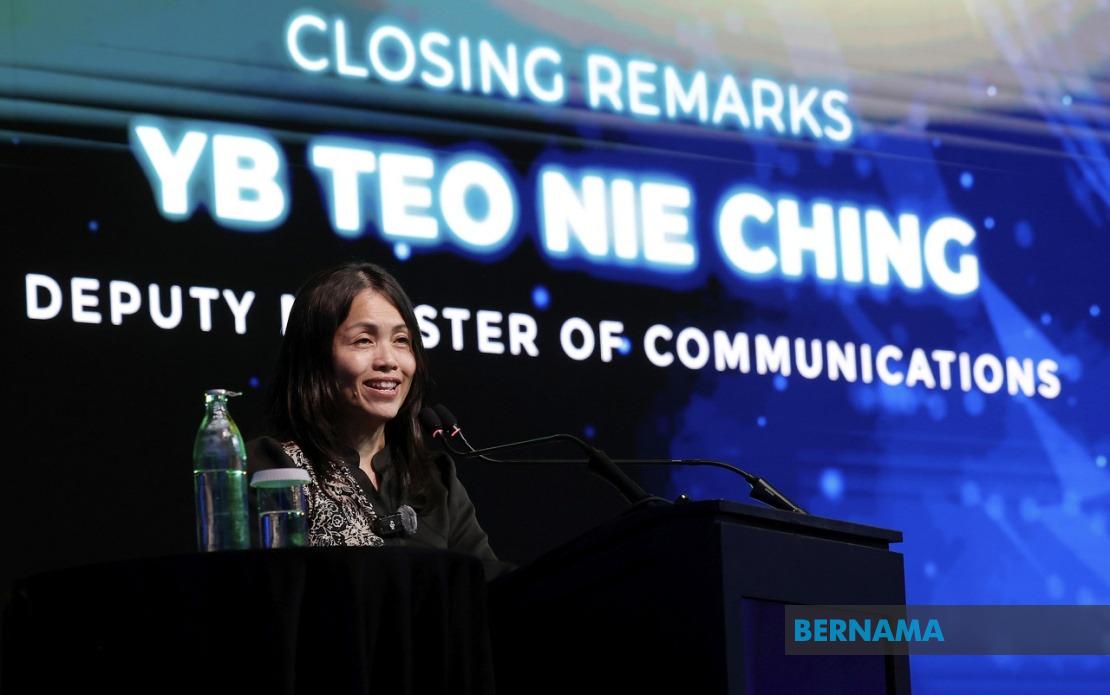
Malaysia's digital landscape faces mounting pressures to balance rapid technological advancement with effective safeguards against harm, a challenge that Deputy Communications Minister Teo Nie Ching has positioned as requiring far more than regulatory intervention alone. Speaking at the conclusion of the International Regulatory Conference 2026 in Kuala Lumpur, Teo underscored that genuine progress in the digital sphere must be anchored to two fundamental principles: unwavering accountability and a governance model that prioritises the welfare of ordinary citizens over commercial interests.
The scale of online threats confronting Malaysian regulators reflects the urgency of the challenge. The Malaysian Communications and Multimedia Commission has been confronted with a staggering workload, issuing 1.2 million content removal requests to major social media platforms spanning the period from January 1, 2022 through July 15, 2026. Of these submissions, platforms successfully removed 1.138 million items flagged as harmful, indicating a compliance rate of approximately 95 per cent. This volume underscores the sheer magnitude of malicious or dangerous material circulating across digital networks operating in Malaysia's jurisdiction, and the relentless labour required to contain it.
Moreover, the trend has accelerated dramatically in recent months. From the start of this year through mid-July, the MCMC already issued 377,502 removal requests—a figure that represents nearly 78 per cent of all requests lodged throughout the entirety of 2025. This extrapolation suggests the commission is processing approximately 1,900 removal requests on an average daily basis. During the same seven-and-a-half-month window, platforms complied by removing 350,332 pieces of content, maintaining a roughly 93 per cent compliance trajectory. The exponential growth in harmful content detection demonstrates both the proliferation of digital threats and the increasing sophistication of detection mechanisms deployed by regulators.
Teo's framing of the challenge, however, resists the notion that regulatory agencies can shoulder this burden independently. She stressed that regulations represent only one component of a multi-stakeholder response architecture. Platforms themselves, schools, community organisations, civil society groups, and the technology industry at large must recognise their distinct roles and collective responsibility in creating and maintaining digital environments worthy of public trust. This distributed accountability model represents a significant departure from top-down regulatory approaches, instead envisioning digital safety as a shared obligation embedded across society's institutional fabric.
Crucially, Teo articulated a philosophy of prevention over remediation. Rather than implementing safeguards after harmful content proliferates or misconduct occurs, she advocated for digital safety to be architected into technology systems from their inception. This reflects a growing international consensus that addressing digital harms requires interventions at the design stage rather than reactive enforcement. For Malaysian technology entrepreneurs and platform operators, this carries significant implications regarding product development cycles and operational protocols.
The deputy minister's framing also addresses a fundamental trust deficit between technology companies and public users. She noted that citizens evaluate digital technologies not primarily through the lens of technical sophistication but by whether they feel safe, treated fairly, and confident in their interactions. This consumer-centric evaluation metric diverges markedly from how technology companies often market their innovations, emphasising processing speed, algorithmic capability, or feature abundance. The gap between technical advancement and public confidence represents a critical challenge to the industry's legitimacy and social licence to operate.
Teo's remarks emerged from the International Regulatory Conference 2026, now in its third iteration, which convenes regulators, industry executives, and technical specialists from multiple jurisdictions to examine pressing challenges within the digital economy. The conference's theme—"Shaping the Next Digital Era: Regulation, Resilience and Trust"—reflects the three pillars that Malaysian authorities believe essential for sustainable digital development. For Southeast Asian policymakers monitoring Malaysia's regulatory trajectory, the conference serves as a bellwether for approaches to digital governance that might gain regional traction.
The emphasis on governance choices alongside technological innovation carries particular resonance for Malaysia and comparable economies in Southeast Asia, where rapid digital adoption has outpaced institutional capacity to manage associated risks. The question of "whom innovation serves" that Teo highlighted represents perhaps the most consequential governance question of the current era. Without deliberate structural choices embedding public interest considerations into regulatory frameworks and platform design, digital technologies can amplify inequality, enable mass surveillance, and concentrate power in ways that undermine democratic institutions and individual autonomy.
For Malaysian businesses engaged in the digital economy, Teo's remarks signal the government's expectation that companies themselves become active stewards of digital responsibility rather than merely complying with minimum legal requirements. Platform operators can anticipate increasing pressure to demonstrate proactive content governance, transparent algorithmic decision-making, and meaningful responses to user concerns. The high volume of removal requests and the MCMC's intensive monitoring suggest that Malaysian regulators possess both the capability and determination to enforce accountability.
The deputy minister's call for embedding safety into design rather than enforcing it through post-hoc removal represents an important evolution in regulatory philosophy that may reshape industry standards across the region. Rather than treating content moderation as a perpetual churn of reactive takedowns, the approach positions digital safety as a foundational architectural consideration, potentially reducing the overall volume of harmful material that reaches users while diminishing the burden on regulatory agencies and platforms alike.
Looking forward, Teo's vision articulates a path toward digital governance that treats technology not as a neutral force but as a socio-political artefact shaped by deliberate choices about accountability, transparency, and whose interests are prioritised. For Malaysia's growing digital economy and its millions of internet users, this framework attempts to harness technological possibility while safeguarding against documented harms and erosion of public trust that have characterised digital platforms globally.

