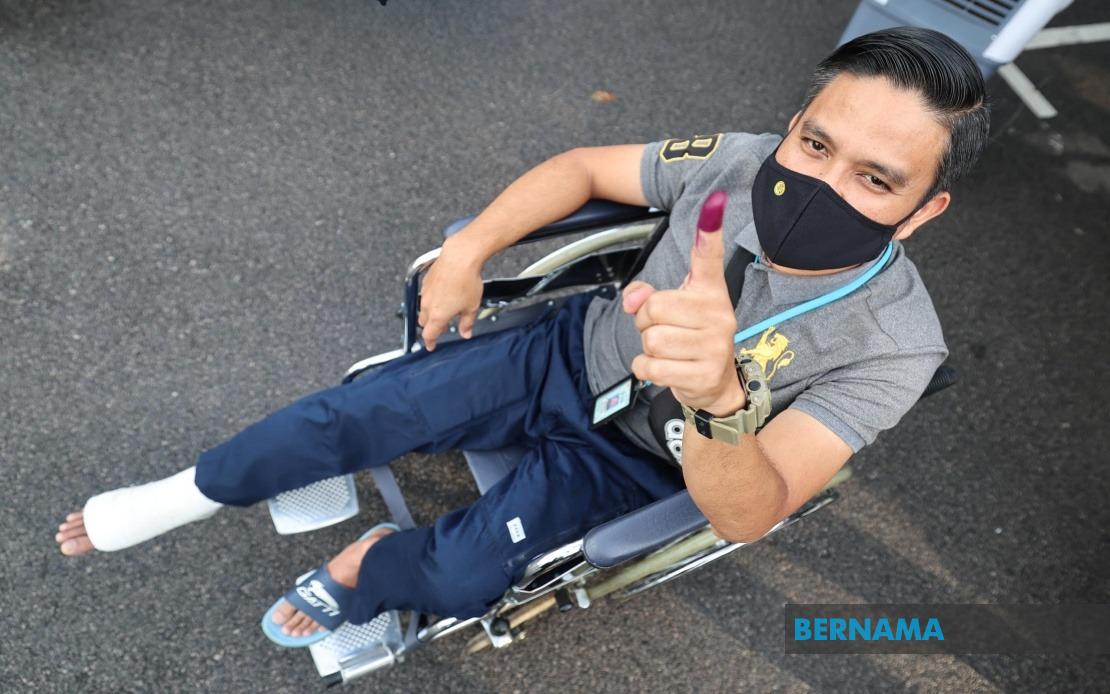
An injury sustained during a recreational sepak takraw match did not deter a police officer from fulfilling his civic duty during the 16th Johor state election's early voting phase. Sergeant Syahrizal Musa, 40, navigated to the polling centre at the Johor Police Contingent Headquarters on July 7 despite being confined to a wheelchair following an Achilles tendon tear. His decision to participate, even while on medical leave through mid-July, illustrates the significance many public servants place on electoral participation in Malaysia's ongoing democratic processes.
Syahrizal, stationed within the Internal Security and Public Order Department at the Johor IPK since 2014, explained that his medical condition presented no justification for abstaining from voting. The sergeant, who previously served nine years at the Muar IPD before his transfer to Johor, travelled from police quarters in Tampoi with assistance to reach the voting centre. His determination proved remarkable given the physical constraints he faced, yet he viewed the minor inconvenience as secondary to his responsibility as a citizen.
Medical professionals had confirmed that Syahrizal sustained only a partial tear to his Achilles tendon, injuries typically requiring several weeks of restricted mobility and rehabilitation. Despite this diagnosis and the prescribed medical leave period extending to July 16, he prioritized his electoral participation. The sergeant noted that across his 22-year police career, he had maintained a perfect voting record, never previously missing an election cycle. This particular instance marked his inaugural experience casting a ballot from a wheelchair, adding symbolic weight to his choice to participate despite adversity.
Syahrizal's athletic background as a longstanding sepak takraw competitor added context to his injury circumstances. The sport, deeply rooted in Malaysian and Southeast Asian culture, demands considerable physical agility and explosive movement. His involvement extended beyond casual participation, as he had represented the police contingent in multiple competitive tournaments throughout his service years. The injury that confined him to a wheelchair resulted from pursuing this culturally significant recreational activity, reflecting the intersection of personal wellbeing and community engagement.
The early voting process in which Syahrizal participated represented a significant logistical undertaking for the Johor election administration. Across 64 designated polling centres, election officials processed early ballots for 24,751 eligible voters on July 7 alone. The electorate comprised distinct demographic groups: 12,041 personnel from the Malaysian Armed Forces and their spouses, alongside 12,710 members of the Royal Malaysia Police and General Operations Force, including their family members. This early voting mechanism, a standard feature of Malaysian elections involving uniformed services, requires specialized venue preparation and security protocols.
The broader context of the 16th Johor state election encompassed a significant electoral undertaking scheduled for the Saturday following early voting. A total of 172 candidates sought representation across 56 state assembly seats, competing to serve a registered electorate of approximately 2.7 million ordinary voters. This competitive field represented the democratic processes through which Johor residents would select their representatives for the subsequent legislative term. The election carried implications for state governance, policy direction, and the ongoing evolution of political representation within Malaysia's second-largest state.
Syahrizal's public appeal for broader electoral participation carried particular resonance within the Malaysian political context. His statement encouraging fellow citizens to exercise their voting rights emphasized the connection between individual participation and collective governance outcomes. The sergeant framed voting not merely as a procedural entitlement but as a responsibility through which Malaysians actively shaped their state and national futures. His perspective, grounded in two decades of public service, reflected institutional values regarding civic engagement and democratic participation.
The police officer's decision held symbolic importance for public sector engagement in electoral processes. Government personnel, particularly those in uniformed services, occupy distinctive positions within Malaysian society. When such individuals openly prioritize voting despite personal hardship, they model civic virtues for broader populations. Syahrizal's wheelchair-bound presence at the polling centre provided a visible demonstration that physical impediments need not prevent democratic participation, a message potentially resonant for elderly voters, persons with disabilities, and others facing mobility constraints during standard polling day procedures.
For Malaysian readers, this narrative illuminates the mechanics through which elections accommodate diverse voter populations while highlighting individual motivations for participation. The early voting provision for armed forces and police personnel reflects administrative recognition that security personnel's professional obligations might otherwise conflict with voting opportunities. Syahrizal's utilization of this accommodation, coupled with his determination to vote despite injury, exemplified how well-designed electoral systems can facilitate broad participation. His conduct suggested that structural provisions mean little without individual commitment to democratic engagement, a principle applicable far beyond Johor's borders throughout Southeast Asia's evolving democratic landscapes.

