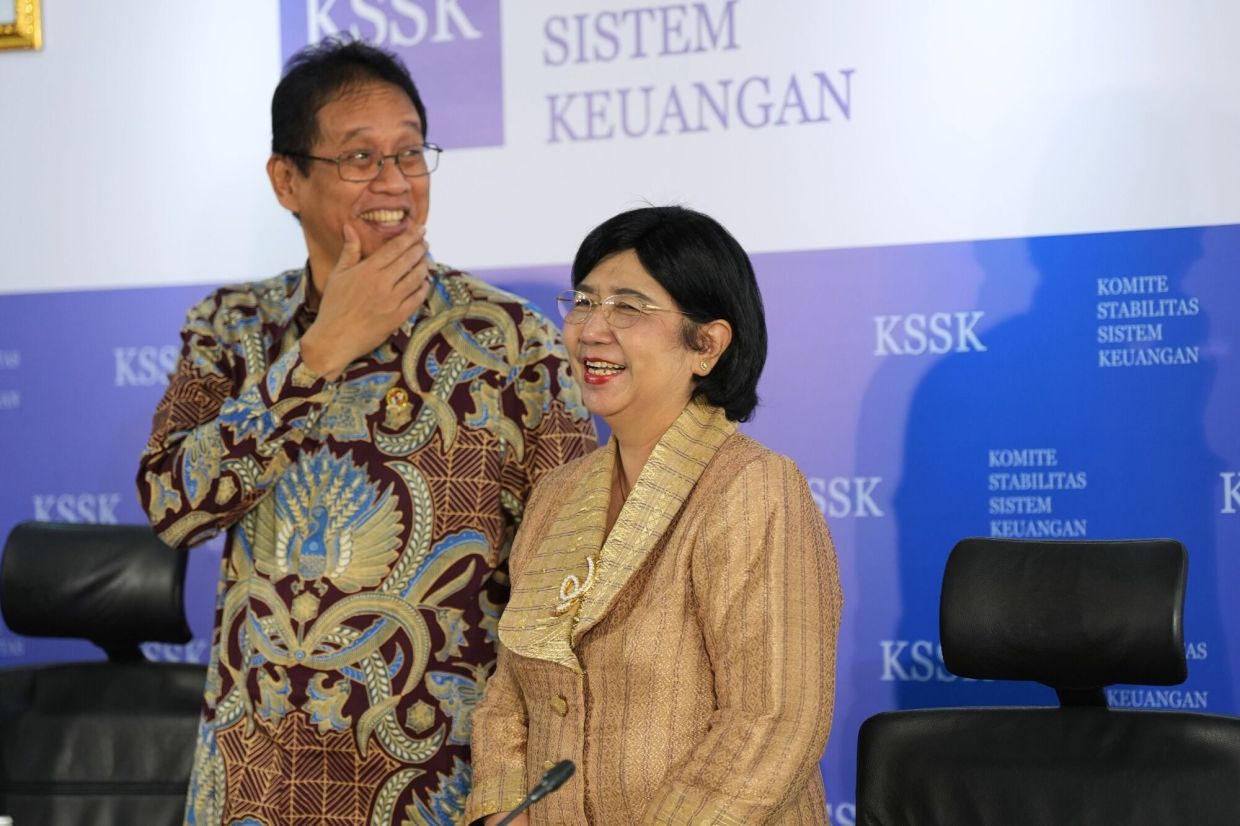
Destry Damayanti's ascent to acting governor of Bank Indonesia just over a fortnight ago signalled an important shift in how Indonesia's monetary authorities will engage with the government's economic machinery. Her inaugural move—a direct meeting with Finance Minister Purbaya Yudhi Sadewa before visiting the presidential palace—made the message unmistakable: coordination between monetary and fiscal policymakers will be tighter and more collaborative than under her predecessor. The public display of camaraderie that followed, with both officials appearing together at press conferences, underscored a deliberate repositioning of the central bank's relationship with the executive branch.
This marks a departure from the tenure of Perry Warjiyo, Destry's predecessor, whose interactions with the finance ministry were typically conducted within formal institutional structures at the presidential palace or regulatory committees. The contrast is striking: Warjiyo and Purbaya held just one publicly documented one-on-one meeting during his governorship, in September 2025, whereas Destry has already established an informal working relationship with her counterpart. President Prabowo Subianto has now formally nominated Destry as the sole candidate for the governorship, though parliamentary approval remains required, and her appointment represents an attempt to find equilibrium between a market-savvy technocrat and an official sympathetic to the administration's economic priorities.
The central challenge confronting Destry involves a balancing act of considerable complexity. Prabowo's administration has set an ambitious target to raise economic growth to 8% by 2029, and the president has already demonstrated his willingness to deploy substantial fiscal resources toward populist measures including free school meals and expanded state involvement in commodity markets. These initiatives have spooked international investors, who have grown concerned about policy coherence and institutional predictability. The rupiah has borne the brunt of this anxiety, depreciating roughly 6% against the dollar since the start of the year—making it Asia's worst-performing currency—whilst rating agencies Fitch and Moody's have placed Indonesia's sovereign debt on negative watch, citing heightened uncertainty around policy direction.
Destry must convince markets that she can simultaneously deliver the growth acceleration the president wants whilst preserving the monetary policy discipline that has underpinned the rupiah's defence and kept inflation relatively contained. Economists and market participants have expressed cautious optimism about her appointment, anticipating policy continuity and suggesting that her stronger rapport with the finance ministry could strengthen policy coordination without undermining the central bank's core mandate. When her nomination was announced, the rupiah promptly strengthened to its best level in a month, and performance against most other Asian currencies improved materially, indicating that investors view her as a steady hand capable of managing competing pressures.
Yet this optimism carries significant caveats. Helmi Arman, an economist at Citigroup, captured the essential tension in his assessment, noting that whilst improved communication between Bank Indonesia and the government is expected, the broader institutional environment for credibility remains fluid and uncertain. The question that will occupy market participants, analysts, and policymakers over the coming months concerns whether Destry will demonstrate the fortitude to maintain or even raise interest rates when macroeconomic conditions warrant such action, or whether proximity to the finance minister and presidential office will gradually erode the independence of monetary decision-making. Under Warjiyo, Bank Indonesia deployed a diverse toolkit of policy instruments, raising rates on three occasions since May whilst simultaneously intervening in foreign exchange markets to support the rupiah and deploying non-rate measures to sustain credit conditions and economic activity.
The external environment will complicate Destry's task considerably. Rising interest rates globally and a persistently strong dollar are exerting relentless pressure on emerging-market currencies including the rupiah, even as domestic inflation remains subdued by historical standards. This tension—needing to support growth objectives whilst defending the currency and maintaining price stability—will test the coherence of monetary policy throughout her tenure. Irman Faiz, chief economist at PT Bank Danamon, has emphasised that investors will be scrutinising whether the central bank's liquidity policy continues to be determined primarily by assessments of inflation, exchange-rate stability, and financial-system resilience, or whether it gradually becomes subordinated to growth considerations.
Destry arrives at the position with impeccable credentials that ought to reassure both the investor community and the government. She holds a bachelor's degree in economics from the University of Indonesia and a master's degree in regional science from Cornell University. Before her fourteen-year tenure at Bank Indonesia, she served as chief economist at PT Bank Mandiri and held a commissioner's position at the Indonesia Deposit Insurance Corp., an institution previously led by Finance Minister Purbaya himself. This shared history creates a foundation of professional familiarity and mutual respect, though it also raises questions about whether personal relationships might subtly influence the boundary between productive policy coordination and problematic institutional subordination. She enjoys substantial credibility within investor and analyst circles, maintaining regular engagement with the international financial community on central bank matters.
Yet Fakhrul Fulvian, chief economist at PT Trimegah Sekuritas Indonesia, has argued that policy continuity, whilst essential, should not be the limit of Destry's ambitions for the institution. Having successfully stabilised the currency and constrained inflation over recent years, Bank Indonesia now faces the more demanding task of translating that hard-won stability into demonstrably healthier liquidity conditions, a more normalised structure to the yield curve, stronger transmission of monetary policy decisions through the financial system, and renewed confidence from the private sector in Indonesia's economic trajectory. These objectives require not merely maintenance of existing frameworks but their substantive strengthening and modernisation.
The parliamentary confirmation process will provide the first meaningful test of Destry's capacity to navigate the competing demands of her position. Markets and institutional observers will be particularly attentive to the tenor of her parliamentary testimony and the commitments she makes regarding monetary policy frameworks, inflation targets, and the principles that will guide exchange-rate management. For Malaysian policymakers and regional observers, Destry's experience will offer valuable lessons about the viability of central bank independence within the context of close government-monetary authority coordination, and whether such arrangements can function without gradually compromising institutional autonomy. As Southeast Asia's second-largest economy grapples with the tension between growth imperatives and macroeconomic stability, the outcomes of Destry's early tenure will reverberate across the region's policy discussions and investor confidence more broadly.

