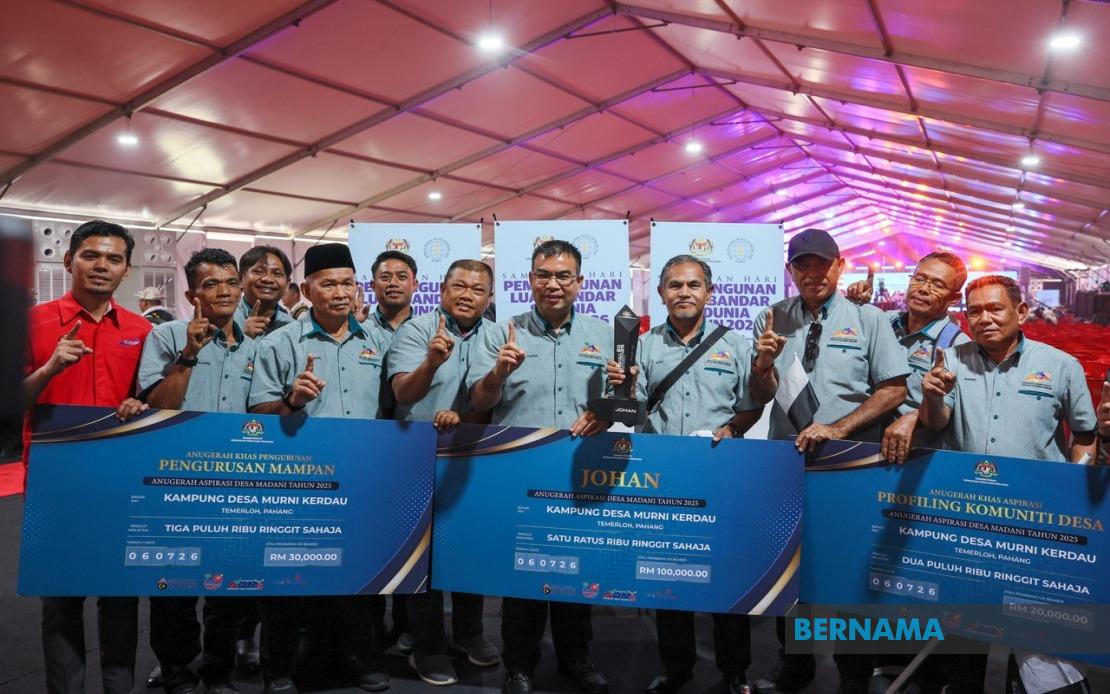
Desa Murni Kerdau, a well-organised village community in Temerloh, Pahang, has secured three significant awards at the World Rural Development Day 2026 celebration held at Tun Abdul Razak Stadium in Jengka Sentral, marking a milestone moment for rural development initiatives across the country. The accolades underscore the village's commitment to sustainable practices and inclusive community leadership, setting it apart as a model for rural transformation in Malaysia's broader development agenda.
The village's achievements span multiple recognition categories. It was crowned the 2025 MADANI Rural Aspiration Award Champion, a distinction underscoring its leadership in rural governance and development strategy. Beyond this top honour, Desa Murni Kerdau also received the Rural Community Profiling Aspiration Special Award and the Sustainable Management Special Award, reflecting comprehensive excellence across governance, environmental stewardship, and community engagement dimensions. The recognition reflects the government's emphasis on recognising villages that demonstrate tangible progress and institutional strength.
The awards were presented by senior government officials acknowledging the village's calibre. Deputy Prime Minister Datuk Seri Dr Ahmad Zahid Hamidi presented the primary MADANI Rural Aspiration Award, while Deputy Minister of Rural and Regional Development Datuk Rubiah Wang awarded the two additional special citations. The high-level presentation underscores the national significance placed on rural development success stories and the government's commitment to celebrating communities that embody the principles of inclusive growth and sustainable management.
According to Mohamad Fazrul Ahmad, Chairman of the Village Development and Security Committee (JPKK) of Desa Murni Kerdau, these honours validate the village's long-standing efforts in establishing robust governance structures and fostering community-driven development. He emphasised that the awards represent not merely institutional accolades but tangible validation of the collaborative approach adopted by village leadership and residents in pursuing shared prosperity. The recognition, he noted, vindicated the strategic choices made in directing village resources toward entrepreneurial empowerment and institutional strengthening.
The village has cultivated a vibrant entrepreneurial ecosystem that extends across diverse economic sectors. Desa Murni Kerdau has successfully nurtured approximately 20 entrepreneurs operating in varied fields spanning small and medium industries, agricultural production, and automotive sectors. This entrepreneurial diversity reflects deliberate capacity-building efforts and supportive village governance that encourages residents to establish independent income-generating enterprises. The diffusion of business activity across multiple sectors provides economic resilience and reduces dependency on single industries.
Tourism has emerged as another growth vector for the village. Desa Murni Kerdau has developed and promoted the "Kampung Stay" tourism product, which has garnered recognition as one of Malaysia's prominent rural tourism destinations. This initiative demonstrates how traditional villages can leverage their cultural heritage and authentic community experiences to generate additional revenue streams while preserving local character. The tourism offering provides supplementary income for residents and creates employment opportunities in hospitality and service sectors.
The physical infrastructure and demographic profile of Desa Murni Kerdau reflects a well-planned village structure. The community comprises approximately 200 residential units accommodating more than 600 residents, suggesting a manageable population scale that facilitates close-knit community bonds while enabling effective governance implementation. This scale permits village leadership to maintain personal relationships with residents whilst implementing coordinated development initiatives, contrasting with larger settlements where governance complexity increases substantially.
The monetary rewards accompanying these awards will be strategically deployed for community benefit. Mohamad Fazrul indicated that the prize funds will be distributed among residents and channelled toward implementing village improvement projects and broader development initiatives. This approach ensures that recognition translates into tangible improvements in community infrastructure, services, and living standards. The commitment to reinvesting award proceeds into village development demonstrates governance accountability and reinforces the principle that external recognition serves as catalyst for continued progress.
Desa Murni Kerdau's success illuminates a broader narrative about rural Malaysia's development potential. While urban-centric development has historically dominated national policy discourse, villages demonstrating effective governance, entrepreneurial dynamism, and sustainable management practices reveal that rural communities can achieve meaningful progress through deliberate institutional building and strategic resource allocation. The awards validate alternative development pathways emphasising community agency and locally-rooted solutions rather than external intervention alone.
For Malaysia's rural development framework, villages like Desa Murni Kerdau function as demonstrable proof-of-concept for the MADANI framework's implementation principles. Their success provides replicable models for other communities seeking to enhance governance capacity, diversify economic bases, and strengthen social cohesion. The Ministry of Rural and Regional Development's recognition of such achievements serves an important signalling function, communicating to other villages that institutional excellence and community-centred development receive official validation and support.
Looking forward, Desa Murni Kerdau's trajectory suggests potential scaling-up of successful rural development models. As the village continues strengthening its entrepreneurial base, expanding tourism offerings, and improving community infrastructure, it may attract increasing attention from development practitioners and policymakers seeking to understand the institutional and social factors enabling rural transformation. The village's experience could inform policy refinements at both state and federal levels, particularly regarding how to support institutional capacity-building in rural communities and facilitate sustainable economic diversification.
The broader significance of this recognition extends to Southeast Asian rural development discourse. Rural communities across the region face comparable challenges regarding economic sustainability, youth migration, and institutional capacity. Desa Murni Kerdau's multifaceted approach—combining formal governance structures, entrepreneurial support, tourism development, and inclusive resource distribution—offers a potentially transferable model worthy of regional attention and adaptation to local contexts.

