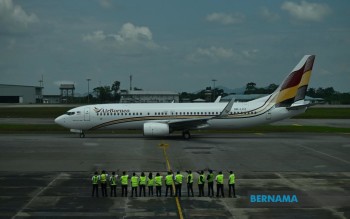
Deputy Prime Minister Datuk Seri Fadillah Yusof today ceremonially received AirBorneo Airways' maiden commercial flight at Kuala Lumpur International Airport Terminal 1, underscoring federal support for Sarawak's ambitious venture into commercial aviation. Flight MY5005 touched down carrying Sarawak Premier Tan Sri Abang Johari Tun Openg and a delegation of state ministers alongside industry figures and government representatives, marking a symbolic moment in the state's long-term economic strategy centred on transportation infrastructure.
The launch represents a watershed moment for Sarawak's aspiration to exercise greater control over its air connectivity ecosystem. For decades, the state has relied heavily on Malaysia Airlines and other carriers to service its intercity routes, with limited influence over scheduling, pricing, and network development. By establishing AirBorneo as a state-owned operator, Sarawak positions itself to shape its own aviation destiny while simultaneously diversifying the Malaysian airline landscape, which has historically been dominated by established carriers.
AirBorneo chairman Datuk Amar Mohamad Abu Bakar Marzuki, who concurrently serves as Sarawak state secretary, articulated the deeper strategic rationale during the inauguration. He framed aviation connectivity not merely as a service industry but as a critical economic catalyst that integrates dispersed communities, bolsters business confidence, and creates pathways for growth across multiple sectors. His emphasis on aviation as an "economic lifeline" reflects recognition that Southeast Asia's competitive positioning in global commerce increasingly hinges on seamless regional mobility and trade logistics.
The deployment of two Boeing 737-800 aircraft on wet-lease represents a calculated entry point into commercial jet operations. This approach—outsourcing aircraft maintenance and crew management to an external operator—allows AirBorneo to minimise capital expenditure and operational risk while building operational expertise and brand recognition. The 737-800, a workhorse twin-engine aircraft with a typical capacity of around 160 passengers, aligns well with the Kuching–Kuala Lumpur market, which historically sustains multiple daily frequencies with strong load factors.
Beginning July 21, 2026, AirBorneo will operate twice-daily service on the Kuching–Kuala Lumpur corridor. Economy fares commence at RM375 for a one-way journey, positioning the carrier competitively against Malaysia Airlines' economy offerings while undercutting legacy pricing by leveraging lower operating costs and state subsidies. Business Class seats start at RM736, suggesting AirBorneo targets both leisure and corporate segments, particularly the latter given Kuching's growing upstream petroleum and technology sectors.
The pricing strategy signals AirBorneo's intent to capture market share from incumbent carriers through value-oriented positioning rather than a low-cost model. Unlike typical budget airlines that strip amenities to the bone, AirBorneo appears positioned as a full-service regional carrier offering competitive pricing without sacrificing service quality. This hybrid positioning reflects lessons from other state-backed Southeast Asian airlines that have succeeded through operational efficiency rather than race-to-the-bottom cost structures.
AirBorneo chief executive officer Megat Ardian Mohd Aminuddin emphasised the operational quality upon which the airline's long-term success will depend. His assertion that safety, reliability, and passenger experience remain paramount—despite the excitement surrounding a new entrant—acknowledges that credibility in aviation is built methodically through consistent delivery. Southeast Asian passengers have become increasingly discerning, with access to real-time feedback platforms and extensive route choices. AirBorneo's survival thus depends on exceeding expectations rather than merely meeting baseline regulatory standards.
The Kuching–Kuala Lumpur route constitutes merely the opening phase of a broader network expansion strategy. AirBorneo has announced Singapore as its first international destination, signalling ambitions to compete on cross-border routes where regional integration creates natural demand. This progression from domestic trunk routes to international services follows the conventional playbook for emerging carriers, allowing operators to refine procedures and build customer loyalty before tackling the complexity of international regulations and connections.
From a Malaysian policy perspective, AirBorneo's launch reflects broader commitment to decentralised economic development. Rather than concentrating aviation infrastructure and benefits in the Klang Valley, the federal government has enabled Sarawak to build transport-led growth initiatives. This devolution supports regional equity objectives while tapping Sarawak's petroleum wealth and tourism potential. Moreover, increased air capacity between East and West Malaysia may stimulate cross-regional business activity and integration, benefiting the entire nation.
The political dimension warrants consideration as well. The ceremonial involvement of federal ministers—including Deputy Transport Minister Datuk Hasbi Habibollah—signals inter-governmental alignment on aviation policy. Sarawak's Chief Minister Abang Johari has long advocated for resource autonomy and infrastructure control; AirBorneo represents a tangible manifestation of that agenda. Federal endorsement, implicit in Fadillah's presence and ministerial participation, suggests acceptance that regional empowerment through transport infrastructure strengthens rather than threatens national cohesion.
AirBorneo enters a competitive environment dominated by Malaysia Airlines, AirAsia Group, and smaller operators such as Firefly. Success depends on executing the operational and customer service fundamentals, maintaining aircraft availability, managing labor costs, and building brand equity. The backing of Sarawak's state resources provides financial cushion unavailable to purely commercial startups, yet also invites scrutiny regarding long-term sustainability and subsidy dependency.
Looking forward, the critical test arrives post-launch as AirBorneo transitions from ceremonial inaugural fanfare to grinding daily operations. Passenger load factors, on-time performance metrics, and customer satisfaction scores will determine whether this venture becomes a sustainable economic contributor or a drain on state finances. The Malaysian aviation sector—and passengers across the region—will be watching closely as AirBorneo executes its expansion blueprint and proves that new entrants can thrive through operational excellence and genuine value delivery rather than discounting alone.

