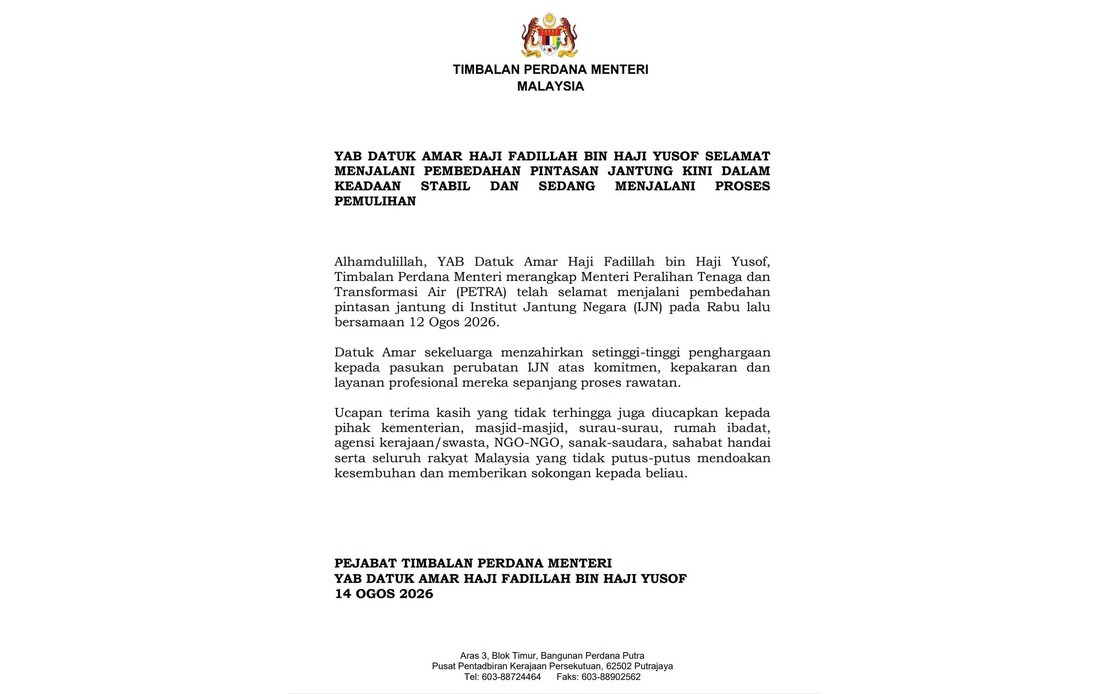
Deputy Prime Minister Datuk Seri Fadillah Yusof, who holds the Energy Transition and Water Transformation (PETRA) portfolio, is making steady progress following a successful double coronary artery bypass procedure performed at the National Heart Institute (IJN) on August 12. The surgical team, led by Senior Consultant Cardiothoracic Surgeons Prof Datuk Seri Dr Mohamed Ezani Md Taib and Prof Datuk Seri Dr Mond Azhan Yakub, completed the operation as planned, with positive outcomes already evident in the days following the intervention.
Fadillah's office acknowledged the extensive support that has surrounded the senior minister during his medical treatment, expressing gratitude to the IJN's clinical team for their expertise and dedication. The statement also recognised the prayers and encouragement offered by Malaysia's religious institutions, government agencies, private sector organisations, and the broader Malaysian public, reflecting the widespread goodwill extended to the nation's second-highest ranking political figure during his health challenge.
The pathway to surgery began when Fadillah was admitted to IJN on July 28, triggering a diagnostic process that included a coronary angiogram performed the following day. That investigative procedure revealed significant blockages in his coronary arteries, prompting the hospital's multidisciplinary medical team to recommend surgical intervention rather than less invasive alternatives. The decision to proceed with bypass grafting reflected the severity of the arterial narrowing and the team's assessment that this approach offered the most durable solution.
A notable aspect of Fadillah's post-operative care has been the implementation of IJN's Enhanced Recovery After Surgery (ERAS) protocol, a sophisticated clinical framework that coordinates multiple specialties to optimise outcomes. This methodology emphasises early mobilisation and active participation in rehabilitation, aiming to reduce complications and expedite the return to normal function. Rather than extended bed rest, ERAS protocols encourage patients to engage in structured movement and exercise as soon as medically safe, fundamentally changing how cardiac surgery recovery unfolds.
The speed of Fadillah's progress underscores the effectiveness of this approach. On August 13, just one day after the major surgical procedure, he completed a supervised cycling exercise covering 2.8 kilometres, a remarkable demonstration of cardiac capacity and cardiovascular resilience. This early mobilisation milestone indicated not only that the surgery had proceeded without complications, but also that his heart was responding positively to the revascularisation procedure. Such swift advancement in a patient's functional capacity would have been considered extraordinary in earlier decades of cardiac surgery.
Following his cycling exercise session, Fadillah was transferred from the Intensive Care Unit to a general ward, a transition that typically occurs only when patients have demonstrated adequate stability and recovery. This movement out of ICU-level monitoring represented another important checkpoint in his recovery trajectory. The general ward environment allowed him to continue his formal cardiac rehabilitation programme while receiving appropriate medical oversight, positioning him for continued progression in the weeks ahead.
For a nation's leadership, particularly at the vice-presidential level, health disruptions create both immediate concerns and broader institutional questions. Malaysia's political system must navigate the temporary absence of a senior minister while maintaining governance continuity. The transparency with which IJN and Fadillah's office have communicated his condition and progress has helped reassure both the public and the government apparatus that the deputy premier will return to full duties within a reasonable timeframe.
The case also highlights Malaysia's medical capacity in treating complex cardiac conditions. IJN, as the nation's leading heart institute, demonstrated surgical excellence through the execution of a technically demanding procedure with demonstrably excellent outcomes. This reinforces Malaysia's position as a regional medical hub, capable of providing world-class cardiac care to its citizens and increasingly attractive to patients throughout Southeast Asia seeking advanced treatment.
Cardiac bypass surgery, while routine by modern standards, remains a significant intervention that requires months of rehabilitation and lifestyle adjustment. Fadillah's return to his ministerial duties, while expected to proceed without major complications based on current recovery patterns, will likely involve a gradual reintegration. The PETRA portfolio involves substantial responsibilities related to Malaysia's energy transition and water infrastructure, sectors critical to the nation's development agenda.
The broader implications of this health incident extend to succession planning and institutional resilience within Malaysia's executive branch. While Fadillah's prognosis appears positive, any senior leader's health challenge prompts consideration of contingency arrangements and the robustness of government operations during periods when key ministers require medical leave. Malaysia's ministerial structure demonstrates sufficient depth that critical functions can continue, though the absence of a deputy prime minister does concentrate additional burdens on remaining cabinet members.
Looking forward, Fadillah's recovery will serve as a public case study in modern cardiac rehabilitation. His documented progress through the ERAS protocol, with measurable milestones like the kilometre cycling exercise, provides Malaysian patients facing similar procedures with realistic expectations and encouragement. The public nature of his treatment at a premier national institution also reflects the accessibility of advanced cardiac care within Malaysia's healthcare system.
The medical team at IJN, led by Prof Mohamed Ezani, expressed satisfaction with the deputy premier's trajectory, noting that his condition continues improving as anticipated. This assessment, offered by the hospital's leadership, provides an authoritative basis for optimism regarding Fadillah's return to full ministerial capacity. The remaining weeks of his recovery will focus on progressive rehabilitation, cardiovascular conditioning, and the gradual resumption of official duties, with the solid foundation established in these critical post-operative days suggesting a successful outcome.

