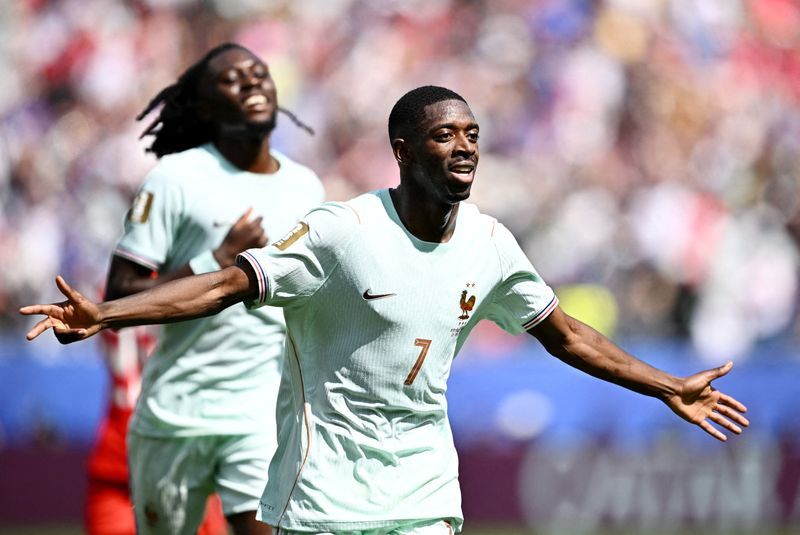
Ousmane Dembele delivered a masterclass in clinical finishing at Gillette Stadium in Foxborough, Massachusetts, on Friday, netting three goals within the opening half-hour to propel France to a commanding 4-1 victory over Norway and confirmation of first place in World Cup Group I. The winger's explosive performance underscored the defending champions' quality even when fielding a heavily rotated side, setting a blistering pace that the Scandinavian visitors simply could not match.
The Paris Saint-Germain forward's treble, accomplished between the 14th and 32nd minutes, represents an astonishing display of predatory instinct in the penalty area. Already qualified for the knockout rounds, both nations approached this fixture with different priorities—France sought to maximize their positioning for the tournament's subsequent rounds by finishing atop the group, a strategic advantage that would ease their travel logistics across the North American venues. Dembele's scoring burst made that ambition a reality, catapulting the two-time World Cup runner-up and reigning champion into the next phase with palpable momentum.
France's intensity from the opening moments telegraphed their intentions unmistakably. Within 20 seconds, Kylian Mbappé unleashed a steeply angled shot that struck the crossbar, signaling that the French were determined to press their numerical and technical superiority. The Paris forward, who enters the latter stages as a genuine contender for the Golden Boot award, orchestrated much of the early attacking play. Six minutes into the match, Mbappé dispatched a sweeping cross-field pass of exquisite quality to Dembele, who engineered space through deft footwork before finishing with a low, angled drive that beat goalkeeper Egil Selvik.
The second goal followed in almost identical circumstances fourteen minutes later. Mbappé again found Dembele in space, and the winger demonstrated remarkable composure and technical execution to create daylight and deliver a dipping finish that left the Norwegian goalkeeper stranded. These opening exchanges established the template: France's width and pace stretching the Norwegian backline, which had been depleted by coach Stale Solbakken's wholesale resting policy. The Norwegian manager, seeking to preserve his squad for the knockout phase, had benched nearly the entire starting eleven from the previous match against Senegal, including the prolific Erling Haaland and skipper Martin Odegaard.
That strategic decision, arguably necessary for squad rotation in tournament football, nonetheless exposed Norway to the full force of French attacking prowess. Thelo Aasgaard momentarily pulled Norway back into contention with a goal shortly after Dembele's second, providing brief respite for the Scandinavian supporters. However, the reprieve proved fleeting. In the 32nd minute, Dembele sealed his hat-trick with a precisely curled effort into the bottom corner, securing his place alongside an elite cohort of France World Cup performers. Only Just Fontaine and Mbappé himself had previously achieved this feat for Les Bleus at the tournament, a distinction highlighting the rarity of such explosiveness in the global competition.
The timing of Dembele's hat-trick merits particular historical context. At 32 minutes, it ranks as the second-quickest such achievement in World Cup history, trailing only Erich Probst's Austrian display against Czechoslovakia in 1954, when he completed his treble after just 24 minutes. This statistical rarity underscores the calibre of Dembele's performance against a depleted but still technically capable Norwegian outfit. The French players had collectively pledged to secure victory as a tribute to head coach Didier Deschamps, who had returned to France to attend his mother's funeral, adding an emotional dimension to their emphatic display.
Norway mounted a second-half recovery effort that produced moments of vulnerability in the French defensive setup. Jørgen Strand Larsen squandered a golden opportunity when his penalty in the 50th minute was expertly saved by Mike Maignan, denying the Norwegians an avenue back into the contest. Winger Oscar Bobb subsequently forced another save from the French custodian, suggesting that the defensive backline had loosened somewhat as Les Bleus managed the scoreline. Nevertheless, France's fourth goal arrived in the final moments through Désir Doué, who powered home a header from a cross supplied by substitute Bradley Barcola, sealing a comprehensive victory that reflected the quality differential between the two sides.
The victory ensures France's passage into the Round of 16 as group winners, positioning them for a likely knockout encounter with Sweden, whose own campaign unfolds simultaneously. By contrast, Norway's second-place finish condemns them to face Ivory Coast in their first knockout fixture, a considerably more daunting prospect than the contest they might have anticipated with group progression. For Malaysian and Southeast Asian football enthusiasts, France's clinical execution offers a masterclass in how tournament-quality teams exploit opportunities against weakened opposition, a lesson particularly relevant as regional sides contemplate their own competitive ambitions on the world stage. The display further illuminates the capacity of elite performers like Dembele and Mbappé to dominate proceedings when operating in peak form, setting the benchmark for attacking excellence as the World Cup progresses toward its climax.

