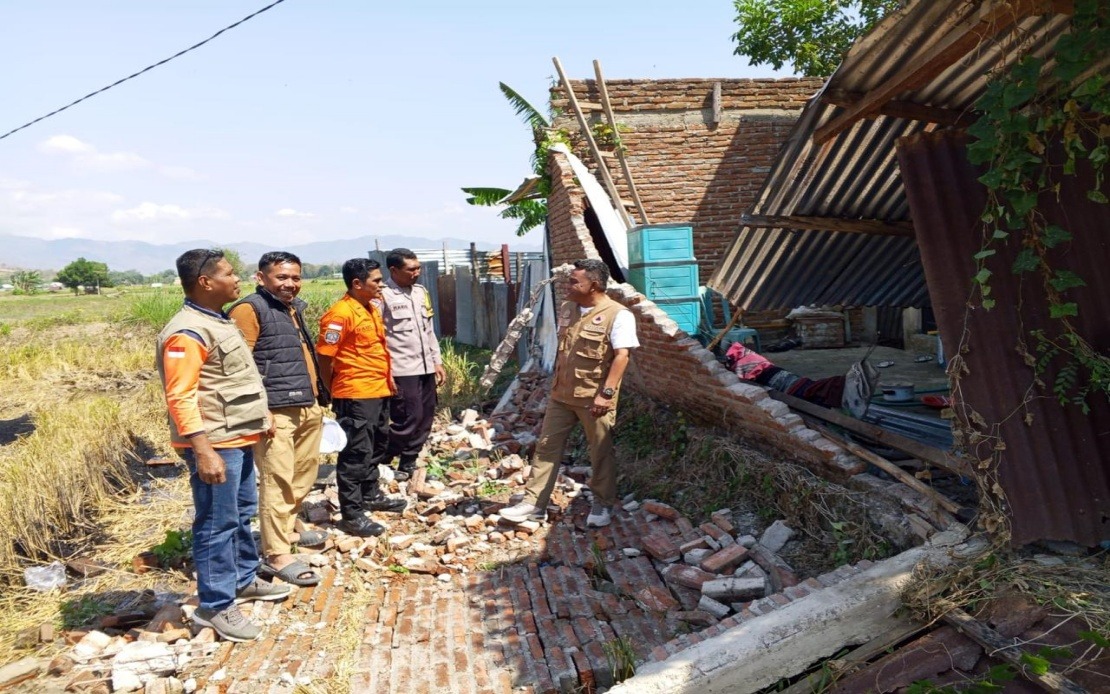
A powerful magnitude 7.7 earthquake struck Indonesia's Flores Island in East Nusa Tenggara early Saturday morning, leaving at least 38 people dead and prompting a large-scale rescue operation involving military, police, and specialized search and rescue personnel. The tremor, which hit at 4.58 am local time with its epicentre in the sea approximately 30 kilometres from Mbay at a depth of 15 kilometres, has triggered one of the most significant natural disasters to affect the eastern Indonesian region in recent years.
According to Suharyanto, chief of the National Disaster Management Agency (BNPB), the immediate aftermath revealed a sobering humanitarian crisis. By 3 pm local time on Saturday, authorities had recorded two people with serious injuries and another 11 with minor wounds, while approximately 2,000 residents had already evacuated to safer areas of their own volition. However, Suharyanto emphasised that rescue personnel remained focused on locating those still believed to be trapped beneath the rubble of collapsed and severely damaged structures across multiple affected communities.
The earthquake's destructive force manifested across multiple sectors of infrastructure. Dozens of residential dwellings sustained significant damage, whilst several community health centres were rendered partially or wholly inoperable—a particularly concerning development given the potential need for medical facilities in the aftermath of such a disaster. The disaster also triggered numerous landslides that obstructed critical transport routes throughout the region, complicating access to affected villages and hampering the movement of rescue teams and medical personnel. Airport terminal facilities and two port installations were impacted, though the runway infrastructure retained operational capability, allowing for continued aerial access to the disaster zone.
One of the factors that limited the catastrophe's scope was the rapid dissipation of tsunami concerns. A tsunami warning was issued immediately following the initial earthquake but was subsequently lifted at 7.31 am after oceanographic monitoring showed no abnormal sea-level variations beyond the initial wave activity. This allowed rescue and evacuation efforts to focus entirely on land-based operations without diverting resources to coastal evacuation procedures.
The response from Indonesian authorities has been comprehensive, with multiple agencies mobilising resources. The National Search and Rescue Agency (Basarnas), Indonesian military forces, and local police have all deployed personnel to conduct systematic searches through damaged areas. This coordinated multi-agency approach reflects the recognition that time is critical in extracting survivors from beneath rubble, as the window for finding people alive typically narrows significantly within the first 72 hours following a major earthquake.
Airborne assets have proven essential to the relief effort. The BNPB deployed two helicopters and one fixed-wing aircraft to facilitate evacuations and transport essential supplies to isolated communities. These aircraft have been particularly valuable given the road obstructions caused by landslides, which have effectively severed normal supply routes to numerous affected settlements. The rapid deployment of aerial resources demonstrates the preparedness protocols that have been refined through Indonesia's previous experiences with major seismic events.
Logistical coordination has extended to road clearance operations, with the Ministry of Public Works mobilising engineering teams and heavy equipment to remove debris and earth that blocked key transport arteries. Restoring these routes is fundamental to sustaining the rescue operation and ensuring that relief supplies can reach communities beyond the immediate disaster epicentre. Authorities have also prioritised the restoration of communication networks, recognising that functional telecommunications are essential for coordinating rescue efforts and allowing affected residents to contact relatives.
The distribution of humanitarian assistance has commenced across affected areas, with relief convoys delivering food items, potable water, clean water supplies, temporary shelter in the form of tents, electrical generators, and other critical necessities. This supply chain operation represents a significant logistical undertaking given terrain constraints and infrastructure damage that complicates distribution networks. Priority has been given to areas with the highest population density and most severe damage.
Suharyanto acknowledged that the full scope of the disaster remained incompletely understood on the first day following the earthquake, with casualty figures and damage assessments expected to shift substantially as rescue operations progressed and damage surveys extended into more remote areas. This preliminary nature of initial reports is typical in major natural disasters, where accurate information takes time to gather across affected regions.
For the Southeast Asian region, the Flores earthquake serves as a stark reminder of the seismic vulnerability that characterises the archipelago's geography. Indonesia sits along the Pacific Ring of Fire, a zone of intense tectonic activity where several major plates converge and generate frequent powerful earthquakes. The disaster also underscores the ongoing challenges that developing nations face in disaster response, particularly in remote areas where terrain and infrastructure limitations can severely constrain rescue and relief operations.
This event will likely prompt renewed discussions across Southeast Asia regarding earthquake preparedness, early warning systems, and building code enforcement in seismically active zones. The effectiveness of Indonesia's response mechanisms, including its disaster management protocols and inter-agency coordination, will be closely examined by regional disaster management authorities seeking to strengthen their own preparedness frameworks. For Malaysia, which despite its lower seismic activity experiences regular tremor activity in Sabah and Sarawak, the Flores earthquake provides important case study material for evaluating regional disaster response capacity and mutual assistance arrangements.

