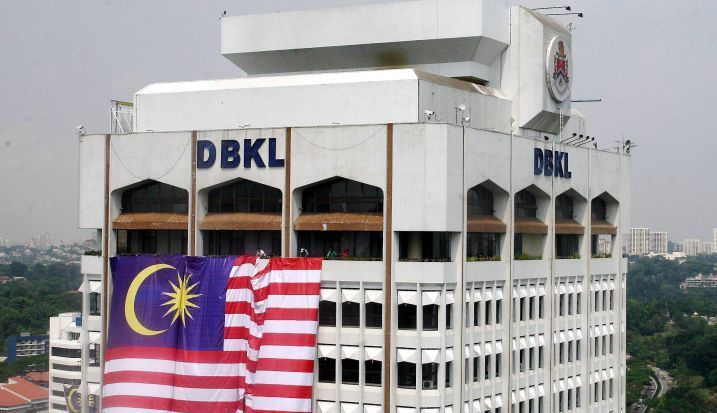
Kuala Lumpur City Hall (DBKL) has escalated its long-simmering conflict with the Taman Desa Phase 1 Residents Association by issuing a formal two-week demolition deadline for unauthorised security infrastructure installed throughout the neighbourhood. The action represents a critical juncture in a months-long standoff over gated community access controls, with DBKL enforcement officers formally notifying the residents association on Thursday, August 27, that facial-recognition scanners and vehicular boom gates erected at Guard Posts 1 and 4 must be removed immediately or face compulsory removal by the city authority itself.
The red enforcement notices affixed to the scanning equipment, accompanied by distinctive yellow DBKL tape sealing the structures, cite Section 70 of the Street, Drainage and Building Act 1974 as legal justification for the directive. According to a DBKL spokesperson, the city authority consulted its legal department extensively before issuing the notices, underscoring the seriousness of the infringement and the deliberate process behind the enforcement action. The spokesperson confirmed that if the residents association fails to comply within the stipulated fortnight, DBKL will unilaterally remove the obstructions at the association's likely expense, while expressing hope that the matter would be resolved cooperatively.
This enforcement notice represents the culmination of an escalating series of compliance failures spanning several months. In March, DBKL had already formally objected to the installation of closed-circuit television cameras and facial-recognition systems, stating explicitly that these security measures had been deployed without municipal approval. The residents association was subsequently granted thirty additional days to bring its operations into compliance with city regulations, yet when DBKL conducted a follow-up inspection on August 17, officers discovered that critical requirements remained unmet. On August 18, DBKL issued a formal written order explicitly demanding that the association fully reopen Guard Posts 2, 5 and 6 to vehicle traffic, dismantle all unapproved structural installations, and restore unrestricted public access to the affected roads.
The underlying dispute extends beyond mere bureaucratic compliance, however. On August 24, more than forty residents, predominantly pensioners aged fifty and above, assembled at Gate 5 along Jalan Desa Ria to publicly protest the access restrictions they contend have severely compromised their quality of life and safety. The gate in question remains permanently sealed to vehicular traffic and locked to pedestrians until six in the morning, a restriction that residents argue forces early-morning exercisers to undertake a substantially longer and considerably more hazardous detour along a high-traffic thoroughfare merely to access a nearby public park. This particular grievance highlights the tension between security infrastructure and legitimate residential access rights.
Beyond inconvenience, the protesters raised substantive concerns regarding the facial-recognition technology itself. Multiple residents characterised the biometric identification system as an objectionable invasion of privacy, reflecting broader anxieties about surveillance technologies in residential spaces. Equally concerning to residents is the potential that physical barriers and manned checkpoints could impede emergency response times, a legitimate worry in an urban environment where seconds can prove critical in medical or security emergencies. These safety and privacy considerations have given the dispute a dimension that transcends simple property management disputes.
The residents association has defended its actions by asserting that it followed proper procedural channels and secured the support of eighty-one percent of neighbourhood residents through what it characterises as a legitimate consultation process. According to TDP1RA president Frank Yeh, the association obtained necessary approvals and maintained majority backing for its neighbourhood security scheme. This claim of democratic legitimacy, however, carries limited weight against DBKL's statutory authority to regulate public road usage and access rights, which cannot be overridden by residential preferences or even supermajority approval from individual neighbourhoods.
The Taman Desa dispute encapsulates broader tensions within Malaysia's urban landscape between community-led security initiatives and municipal governance obligations. Gated communities and security barriers have proliferated across Malaysian residential areas in recent decades, reflecting legitimate concerns about crime and property values. However, the fundamental legal and ethical principle remains that public roads—regardless of the neighbourhoods they traverse—cannot be converted into private access-controlled environments through unilateral resident action. DBKL's enforcement action reasserts this principle.
The case also raises questions about regulatory consistency and oversight. If Taman Desa's unauthorised modifications remain unaddressed, other residents associations might interpret this as tacit permission to implement similar schemes, potentially creating a patchwork of inconsistent access controls across Kuala Lumpur. This fragmentation would undermine the city's traffic management capacity, emergency services coordination, and the principle that public infrastructure remains accessible to all legitimate users regardless of residential status.
For Malaysian property owners and residents association leaders elsewhere, the two-week deadline serves as a cautionary signal about the limits of community authority. While residents associations play vital roles in neighbourhood management and security planning, any infrastructure modifications affecting public roads require explicit municipal authorization. Proceeding without such approval—however well-intentioned or popularly supported—invites enforcement action and potential financial liability for removal costs.
The coming fortnight will reveal whether Taman Desa's leadership prioritizes accommodation with City Hall or continued resistance. The residents association faces a genuinely constrained choice: voluntary compliance protects it from the expense and embarrassment of forced demolition, while defiance risks legal escalation and reputational damage. Given DBKL's demonstrated resolve and the clear statutory violations involved, voluntary removal appears the prudent path, though resolving the underlying security concerns that motivated the barriers in the first place will require constructive dialogue between residents, the association leadership, and municipal authorities.

